Published: August 12, 2026
A water heater's purchase price is only one part of the decision. Fuel rates, installation work, hot-water capacity, and fixed utility charges can reverse the apparent bargain over the life of the tank. A useful comparison includes standard electric resistance, natural gas, and electric heat-pump models, then applies the numbers from your home and utility bills.
The short answer
For a like-for-like storage-tank replacement, each option has a clear use case:
- A standard electric water heater is simple, quiet, and free of combustion exhaust. It is usually the practical budget choice in an all-electric home, although its energy cost is often higher than gas at typical U.S. rates.
- A gas water heater usually recovers hot water faster than a similar electric tank. It makes the most sense when the home already has compliant gas piping and venting, gas will remain for other appliances, and peak hot-water demand is high.
- An electric heat-pump water heater uses far less electricity than a resistance tank and can cost less to run than gas. It costs more upfront and needs a suitable location, airflow, and condensate drainage.
Our default recommendation is an ENERGY STAR heat-pump model when the room, electrical service, budget, and hot-water profile support it. We keep gas in the comparison when a conversion would be expensive or its faster recovery solves a real capacity problem. A standard resistance tank is the lower-cost electric fallback.
First, separate the three technologies
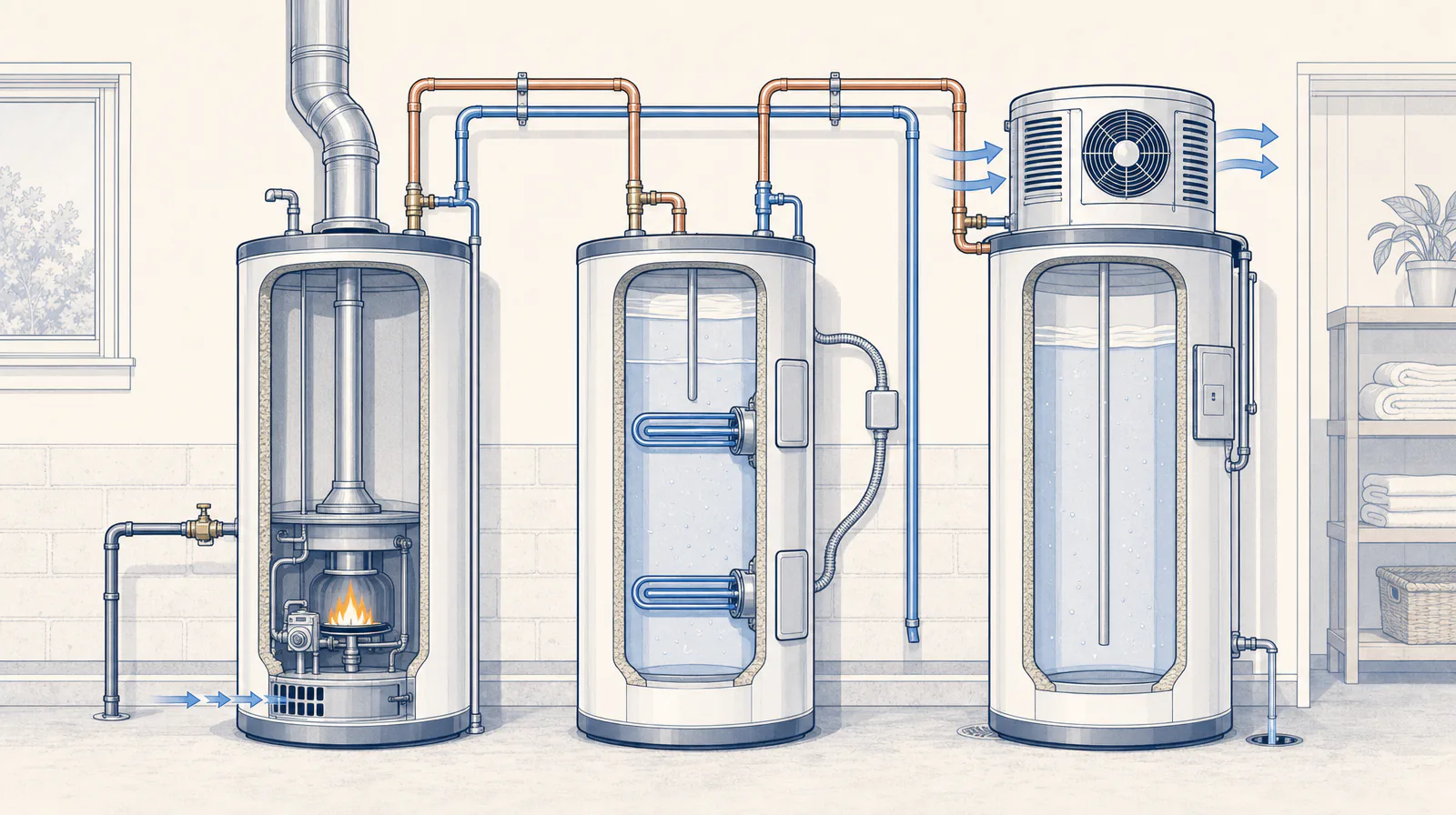
“Electric” covers two very different ways to heat water:
- Electric resistance: Immersed heating elements turn electricity directly into heat.
- Electric heat pump: A compressor moves heat from the surrounding air into the tank. Most models also have resistance elements for periods of high demand.
- Gas storage: A natural-gas burner heats the tank, and combustion gases leave through an atmospheric, direct, or powered vent.
These are storage-tank systems. Tankless equipment changes the capacity, gas-line, venting, and electrical requirements, so it belongs in a separate comparison. Our guide to heat pump versus tankless covers that decision.
Electric vs. gas water heater comparison
| Factor | Standard electric tank | Gas storage tank | Electric heat-pump tank |
|---|---|---|---|
| Upfront project | Often the simplest in a home with the required circuit | Straightforward when the gas line and vent can be reused | Higher equipment cost, with possible electrical and condensate work |
| Variable energy cost | Usually higher than natural gas at typical U.S. rates | Usually lower than standard electric | Often lower than both standard electric and gas |
| Hot-water recovery | Slower for a like-sized tank | Usually faster | Slower in heat-pump-only mode; hybrid backup adds capacity |
| Site requirements | Dedicated circuit, commonly 240 volts | Gas supply, combustion air, and code-compliant venting | Model-specific circuit, adequate air and temperature, plus a condensate route |
| Combustion in the home | None | Yes | None |
| Sound | Nearly silent | Burner sound; power-vent models also have a fan | Compressor and fan noise |
| Routine attention | Tank, anode, relief valve, and elements | Tank items plus burner and venting | Tank items plus air filter and condensate system |
The table describes common residential models. The selected model's specifications control every installation and performance detail.
What the operating-cost math actually shows
The common claim that gas costs less to run is accurate when gas is compared with standard electric resistance at average U.S. rates. Heat-pump electric changes the result.
We built a like-for-like illustration from federal efficiency data. DOE's purchase table lists a standard electric tank at 3,437 kWh per year and a UEF of 0.95. It lists a qualifying heat-pump model at 984 kWh and a UEF of 3.3. Both figures use the federal test load of 20,075 gallons of hot water per year. For gas, we used the FEMP performance benchmark of 0.64 UEF for a medium-draw storage model and normalized it to the same useful hot-water output.
The 2025 U.S. average residential electricity price was 17.30 cents per kWh. The 2025 gas average was $15.34 per thousand cubic feet. Using EIA's natural-gas conversion of 10.37 therms per thousand cubic feet, that gas price is about $1.48 per therm.
| Storage water heater | Efficiency and annual use in the example | Approximate annual energy cost |
|---|---|---|
| Standard electric resistance | 0.95 UEF, 3,437 kWh | $595 |
| Natural gas | 0.64 UEF, about 174 therms | $258 |
| Electric heat pump | 3.3 UEF, 984 kWh | $170 |
This is an energy-only screen, rather than a predicted household bill. It excludes equipment, installation, maintenance, financing, fixed utility charges, and the small amount of electricity used by some gas models. Hot-water use and local rates can move every figure.
Recalculate the cost with local rates
The yellow EnergyGuide label gives annual energy use and an estimated annual cost under standardized assumptions. The cost figure uses a national energy price, so the FTC EnergyGuide guidance says actual cost depends on local rates and use.
Use these calculations:
Electric annual cost = label kWh per year × marginal electricity rate
Gas annual cost = label therms per year × marginal gas rate + auxiliary electricity
For electricity, include supply and per-kWh delivery charges. For gas, include every charge that changes with therm use. Fixed customer charges belong in the comparison only when an electric conversion lets the household close the gas account. If the furnace, range, or dryer remains on gas, those fixed charges remain too.
Time-of-use rates need one more adjustment. A tank that heats mainly off-peak should use the applicable off-peak or blended rate. For rooftop solar, each added kWh has the value of avoided grid purchases or forgone export credit under the home's tariff. Its value is not automatically zero.
As a rough break-even screen, a 0.95 UEF resistance tank matches a 0.64 UEF gas tank when the electricity price in dollars per kWh is about 5.1% of the gas price in dollars per therm. At $1.50 per therm, electricity would need to cost about 7.6 cents per kWh. A 3.3 UEF heat-pump model reaches parity at about 26.4 cents per kWh. Fixed fees and installation costs still sit outside those thresholds.
Installation can outweigh the tank price
A fuel conversion expands a water-heater replacement into an electrical, plumbing, and mechanical project.
Replacing electric with electric
A standard resistance tank can often reuse a suitable 240-volt circuit. A heat-pump model may use the same type of circuit, although the exact breaker and wiring depend on the unit. It also needs a condensate route and enough air around the intake and exhaust. Our heat-pump installation guide explains the room, drainage, and electrical constraints.
Replacing gas with electric
The quote needs to account for electrical capacity, breaker space, a new circuit if required, safe gas-line capping, and proper treatment of the old vent. A panel replacement is not automatic. Some homes can support a 240-volt model without one, and 120-volt heat-pump options can reduce the electrical work in suitable projects.
This conversion becomes more attractive when the water heater is the last gas appliance. Closing the gas account removes its fixed monthly charge, which can matter as much as the difference in fuel use.
Replacing electric with gas
Adding gas can require service availability, meter and line capacity, combustion air, and a new vent path. That infrastructure can erase years of variable fuel savings. We would not add gas solely to reduce a standard electric tank's bill before comparing a heat-pump model and the full installed prices.
Every quote should separate the heater, labor, electrical work, gas and vent work, plumbing, condensate drainage, permit, old-unit removal, and confirmed incentives. Permit rules are local, and our water-heater permit guide explains when the replacement usually triggers one.
For a heat-pump water heater placed in service in 2026, the old federal Section 25C credit is no longer available. The IRS credit page states that qualifying property had to be placed in service by December 31, 2025. State and utility rebates can still change the net installed cost.
Size the heater by first-hour rating
Tank volume does not describe the full hot-water capacity. First-hour rating, or FHR, measures how many gallons a fully heated storage unit can deliver in the first hour. A higher number combines stored water with recovery during that hour.
Gas tanks often have a higher FHR than like-sized resistance tanks because the burner supplies heat faster. An electric tank can close the capacity gap with a larger volume. For heat-pump models, ENERGY STAR sizing guidance recommends upsizing when possible so the compressor can do more of the work and the resistance backup runs less.
Compare each model's FHR with the household's busiest hour, including overlapping showers, laundry, and dishwashing. Two 50-gallon tanks can deliver materially different first-hour capacity.
Safety, maintenance, lifespan, and outages
Safety and maintenance
Electric resistance and heat-pump units have no burner or combustion exhaust at the water heater. Gas models add venting and carbon-monoxide risk if combustion or exhaust systems fail. The CDC's carbon-monoxide guidance calls for annual service of fuel-burning water heaters by a qualified technician and proper venting. The CPSC recommends CO alarms on each level and outside sleeping areas.
All three storage types still have water, temperature, pressure, corrosion, and leak risks. Their model-specific maintenance schedules cover the tank, anode rod, temperature and pressure relief valve, and sediment. Heat-pump models add an air filter and condensate drain. Gas adds the burner and vent system.
Lifespan
Fuel type does not guarantee a longer-lived tank. DOE's 2023 standards analysis estimates the average storage water-heater life at around 15 years across the category. Water chemistry, temperature, installation quality, anode protection, maintenance, and the individual model create a wide range around that average. Compare warranty terms and local repair support instead of assuming every electric tank outlasts every gas tank.
Power outages and emissions
An electric tank cannot reheat during an outage, although its stored water stays warm for a time. Some atmospheric gas tanks with standing pilots can continue heating. Gas units with electronic ignition, powered venting, controls, or tankless operation usually need electricity, so gas is not a universal outage solution.
Gas produces combustion emissions at the home. Electric models have no onsite combustion, while their upstream emissions depend on the electricity supply. A heat-pump model reduces that electricity demand substantially compared with resistance heat.
Which water heater fits your home?
Choose a standard electric tank when:
- the home already has a suitable circuit
- upfront cost and a fast replacement matter most
- hot-water demand fits the model's first-hour rating
- the location cannot support a heat-pump model
Keep a gas tank in the running when:
- compliant gas piping and venting already exist
- the gas account will remain active for other appliances
- peak demand calls for high first-hour delivery
- electrical work makes conversion disproportionately expensive
Choose an electric heat-pump tank when:
- the site has the needed space, air, temperature range, and drainage
- the household wants lower operating energy use
- a planned replacement leaves time to obtain the right size and quotes
- rebates or avoided gas-account charges improve the installed-cost math
We recommend starting with the heat-pump quote, then comparing it with the practical same-fuel replacement using the EnergyGuide and rate calculations above. That sequence exposes the long-term savings without forcing an expensive conversion where the house cannot support one.
FAQ
How can I tell whether my water heater is gas or electric?
A gas tank has a gas pipe and control valve, a burner area near the bottom, and an exhaust vent at the top or side. A standard electric tank has a heavy electrical cable or disconnect, usually two element-access panels on the side, and no combustion vent. A power-vented gas heater can also have an electrical cord, so the gas line and exhaust are the decisive clues.
Does this comparison apply to propane water heaters?
No. The gas calculations above use utility natural gas priced by the therm. Propane is delivered and priced by the gallon, with a different energy content and often a separate tank or delivery charge. Use the propane model's EnergyGuide consumption and the household's delivered propane price for that comparison.
If a heat-pump model fits the home, browse our incentive pages before requesting itemized quotes.