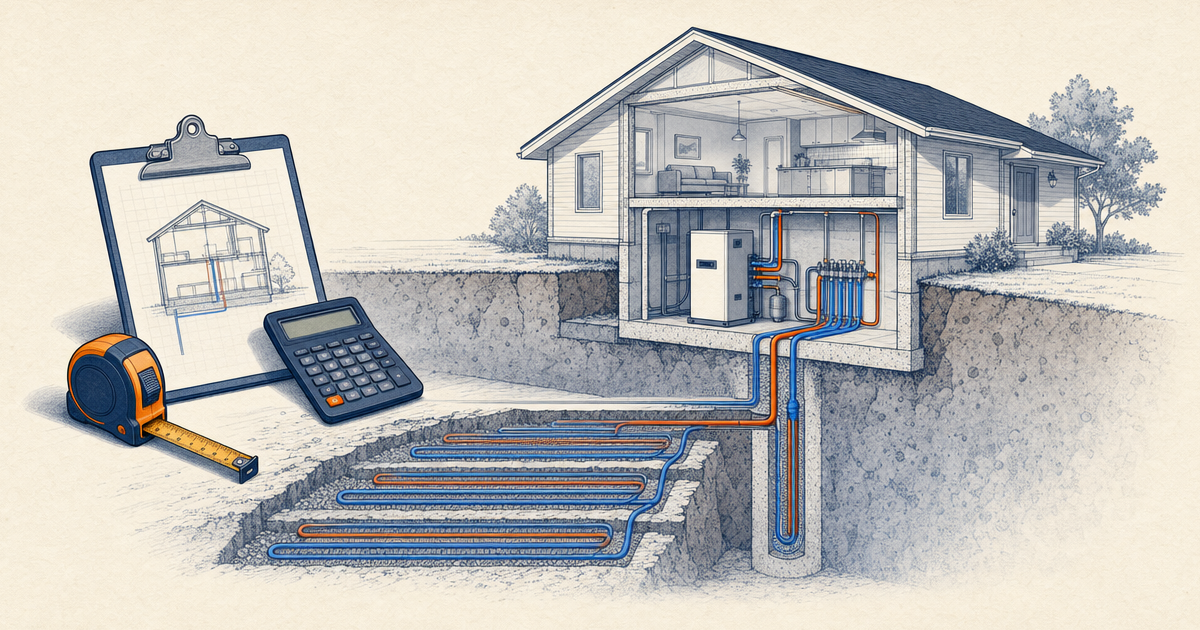
Geothermal heat pumps can heat and cool a home efficiently, but the underground loop makes the installation a different financial decision from an air-source heat pump. The number depends on how much loop, drilling, equipment, and house preparation your site needs, so one average hides the real budget.
You can set a defensible 2026 budget by seeing how the ground-loop choice changes the quote and which incentives still count before you compare installers.
Last reviewed: 2026-09-14 (Pacific time)
Geothermal heat pump installation cost at a glance
For a typical U.S. single-family project, a practical 2026 planning envelope is about $20,000 to $50,000 before incentives, financing costs, and ongoing maintenance. This is a planning inference from the DOE per-ton model, not a national average. A small, straightforward horizontal-loop installation can land below that range. A larger system, difficult drilling, major ductwork, or extensive restoration can push the price above it.
The U.S. Department of Energy (DOE) presents $11,100 per ton of capacity as an illustrative, simplified median national capital-cost estimate for a single-building residential geothermal heat pump. Its residential scenario is a single-family detached home with one HVAC system. It is a planning model rather than a 2026 market average or a contractor quote. Multiplying it by the system size gives a useful first screen:
| Design capacity | DOE illustrative capital cost | What that number means |
|---|---|---|
| 2 tons | About $22,200 | A lower-capacity illustration; final tonnage follows the load calculation and loop design. |
| 3 tons | About $33,300 | A mid-size illustration for one HVAC system, not a square-foot rule. |
| 4 tons | About $44,400 | A higher-capacity illustration; larger or multi-zone homes may need a different configuration. |
The estimate comes from DOE’s Pathways to Commercial Liftoff: Geothermal Heating and Cooling. It combines non-loop mechanical HVAC, loop supplies, drilling and installation, and weatherization or retrofit work. Your soil, loop layout, access, local labor market, and existing distribution system determine the actual price.
DOE’s figure also shows a $3,300 federal-credit illustration and a $7,800 post-credit total. Those figures are historical planning assumptions, not a 2026 federal-credit assumption. Treat $11,100 as the gross planning model. Do not use its post-credit total for a new 2026 project: the IRS says the residential credit is unavailable for property placed in service after December 31, 2025. See the current IRS rules for the timing details.
Planning note: This is an informational budget, not a contractor quote, engineering design, permit decision, or tax instruction. Have a qualified geothermal designer and local authority confirm the final scope.
What the DOE cost model includes
The $11,100-per-ton capital-cost estimate is useful because it separates the parts that online averages often blend together:
| Cost component | DOE illustrative capital cost per ton | 3-ton illustration |
|---|---|---|
| Non-loop mechanical HVAC, including the geothermal heat pump and related equipment | $3,900 | $11,700 |
| Loop supplies, drilling, and installation | $6,100 | $18,300 |
| Weatherization and retrofit work, such as duct changes or removal of old equipment | $1,100 | $3,300 |
| Illustrative gross capital cost | $11,100 | $33,300 |
In DOE’s illustrative breakdown, loop work is the largest line item. DOE identifies drilling and installing the ground loop as the project’s most variable cost element, affected by geology, region, and the specific site. It also notes that residential geothermal equipment costs more than air-source counterparts because the market is small and specialized.
The loop type is the first major price decision
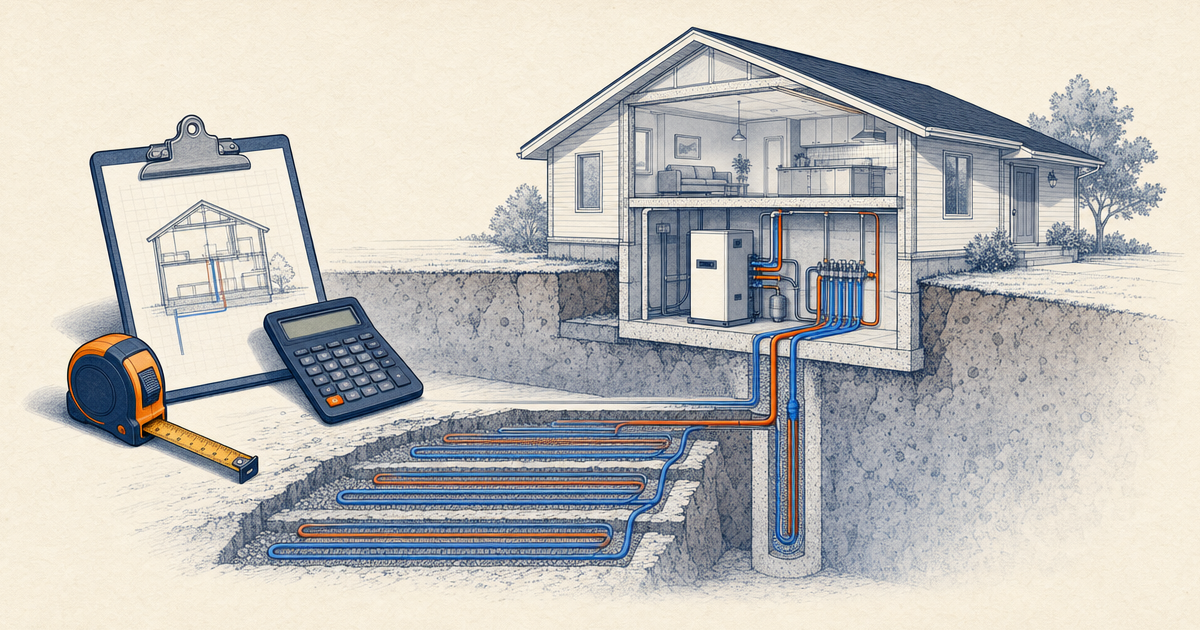
A geothermal heat pump moves heat between your home and a fluid loop in the ground or water. The site determines which loop is practical. The DOE’s Guide to Geothermal Heat Pumps describes four common arrangements.
Horizontal closed loop
An excavator places the pipe in trenches, generally at least four feet deep. Horizontal loops are usually the most cost-effective choice when you have enough open land, especially during new construction. They can disturb lawns, driveways, irrigation, and mature landscaping.
Ask the installer to show the trench map and the restoration allowance. A low excavation price that excludes replacing a driveway, irrigation lines, fencing, or established plantings is not a complete project cost.
Vertical closed loop
A drilling rig places pipe in deep boreholes. This layout uses little surface area, so it can work on a small lot. Drilling in rock, rig mobilization, drill-cuttings disposal, and borehole permits can add cost, with the exact premium depending on the site and jurisdiction.
The quote should state the number and depth of boreholes, the assumed geology, how drilling spoils will be handled, and what happens if the driller encounters unexpected rock or groundwater.
Pond or lake closed loop
If you have a suitable water body, coils can be placed on the bottom, with a buried supply line to the house. The DOE guide describes coils at least eight feet below the surface to reduce freezing risk. Water volume, depth, seasonal temperature, access, and environmental rules determine whether this is practical.
Open loop
An open-loop system pumps relatively clean well or surface water through the heat pump and returns it to a well, recharge point, or approved discharge. Adequate flow and water quality, testing, filtration, and discharge permits can offset the savings from avoiding a closed-loop field.
Five factors that move the quote by thousands
1. Heating and cooling load, not square footage alone
Two 2,000-square-foot homes can need different equipment. Insulation, air leakage, windows, orientation, indoor temperature, and local design weather determine the heating and cooling load. A designer should run an ACCA Manual J or equivalent calculation to establish that load, then use it with site data to size the heat pump and ground loop.
Loop sizing also depends on the ground or water resource. Ground-coupled designs use soil thermal conductivity and temperature stability. Groundwater designs require source temperature, well flow, and water quality; surface-water designs require a seasonal temperature profile, adequate volume and depth, and water quality. DOE’s geothermal purchasing guidance notes that these resource properties are essential to system design and that accurate loop sizing matters because the ground heat exchanger is a significant cost.
ENERGY STAR’s geothermal product criteria define the coefficient of performance (COP) for heating and the energy-efficiency ratio (EER) for cooling. Compare those ratings for the exact model and loop condition in the quote, rather than a brand’s highest headline number.
An oversized loop or heat pump raises the initial price. An undersized loop can lose efficiency, require supplemental heat, and create long-term performance problems. Correct sizing is a cost-control measure, not an optional upgrade.
2. Geology, access, and drilling conditions
Soft soil with clear equipment access is easier to excavate than a rocky, steep, or tightly confined lot. A vertical project may require a large rig, temporary access roads, traffic control, or protection for septic, utility, and drainage infrastructure. A horizontal project may require soil hauling and regrading.
Have the installer identify utility-locate responsibility, drilling access, spoil disposal, groundwater protection, and restoration in writing. If the quote says “allowance” without a quantity or unit price, ask what event changes the allowance.
3. Ducts and indoor distribution
The heat pump still needs a way to move conditioned air or water through the home. Existing ducts may need sealing, resizing, insulation, or replacement. Homes with hydronic or radiant distribution may need a water-to-water unit, buffer tank, pumps, controls, or heat emitters.
DOE’s cost model places duct and retrofit work in a separate weatherization category. Keep it separate in your quote so you can see the cost of the geothermal equipment versus work your home would need for any HVAC replacement.
4. Electrical and plumbing readiness
The compressor, blower, circulation pumps, controls, and any backup heat may require dedicated branch circuits or outlets, depending on the equipment and local code. Ask the installer and an electrician to specify breaker and disconnect sizing, wire runs, panel changes, and permit responsibility. Whether a panel upgrade is needed depends on the existing service and the new equipment, and it can become a meaningful add-on when capacity is limited.
Water-to-water systems may also require pumps, expansion tanks, mixing valves, buffer tanks, or domestic-hot-water connections. If a desuperheater or other water-heating feature is included, require its equipment, plumbing, controls, and commissioning to appear as separate line items.
5. Permits, inspections, and landscape restoration
Ground-loop work can involve building, mechanical, electrical, well, environmental, or excavation permits, depending on your jurisdiction and loop type. Fees and inspection requirements vary by location. Restoration can include topsoil, seed, sod, paving, drainage repair, irrigation repair, and removal of excess soil.
Ask who pulls each permit and who pays for re-inspection if work does not pass the first time. Keep permit and restoration costs visible rather than accepting a single “installation” line.
How incentives change a 2026 budget
The federal answer changed for new projects. The IRS says the Residential Clean Energy Credit was 30% of qualified costs for eligible property installed from 2022 through December 31, 2025, and that the credit is unavailable for property placed in service after December 31, 2025. Geothermal heat pumps were a qualifying property when they met the ENERGY STAR requirements in effect at purchase. See the current IRS Residential Clean Energy Credit rules for the timing and filing details.
For a new 2026 installation, use $0 for the federal residential geothermal credit. The IRS requires the claim for the tax year when the property is installed, not merely purchased. Ordering equipment, paying a deposit, or signing a contract in 2025 does not by itself make a project eligible if it is placed in service after the cutoff. A qualifying installation placed in service in 2025 belongs on the 2025 tax return, even if you file that return in 2026.
State, utility, and income-qualified incentives may still be available. They can differ by service territory, loop type, equipment model, contractor participation, income, pre-approval, and available funds. Start with Watt Wallet’s heat pump rebates by state guide, then confirm the amount and timing with the program administrator before treating it as savings.
Keep the money flows separate:
Gross installed quote
- upfront incentive or discount applied on the invoice
= amount due at installation

Amount due at installation
- post-install rebate paid after approval
= eventual net cost before financing
Use each incentive once, in the channel where it is paid. Do not subtract an upfront invoice discount again as a post-install rebate, and do not assume a rebate is already included unless the quote says so. Count interest and loan-origination fees in your project budget, but keep them outside any federal credit calculation. The IRS says not to include interest, including loan-origination fees, in qualified costs. Treat service or maintenance plans as separate budget items rather than assumed credit-eligible installation costs, because they cover future service. Require the installer to show gross price, each incentive assumption, who applies for it, and when you receive the money.
A quote checklist for geothermal work
Get at least two, preferably three, bids that describe the same scope. Ask every installer to include:
- The Manual J or equivalent heating and cooling loads, design temperatures, and proposed tonnage.
- The loop type, trench or borehole map, pipe size, total length or depth, fluid, and design flow rate.
- Soil or rock assumptions, drilling allowances, access requirements, spoil disposal, and groundwater protections.
- The exact indoor and outdoor model numbers, COP, EER, warranty terms, and expected backup-heat operation.
- Duct, hydronic, electrical, plumbing, controls, domestic-hot-water, and equipment-removal work.
- Engineering, permits, inspections, startup, loop pressure testing, flushing, antifreeze concentration where applicable, and commissioning measurements.
- Lawn, paving, irrigation, drainage, fence, and planting restoration, with quantities or allowances.
- Gross price before incentives, each rebate assumption, payment schedule, financing rate and fees, and change-order terms.
ENERGY STAR advises homeowners to use a trained contractor and seek a quality installation. Its heat-pump installation guidance calls for an onsite inspection, a detailed bid, proper sizing, duct evaluation, and relevant installation credentials. Geothermal-specific experience matters because the ground heat exchanger is a permanent part of the system.
For a reusable conversation script, take Watt Wallet’s HVAC contractor questions to each site visit. The goal is to compare equal scopes, not to choose the lowest number on an incomplete bid.
Is geothermal worth the installation cost?
Geothermal tends to fit best when you expect to stay in the home for many years, have workable land or drilling access, and are replacing an expensive or end-of-life heating and cooling system. It can be attractive when one system will replace both a furnace and air conditioner, or when local electricity and fuel prices make the operating-cost difference meaningful.
The economics are harder when you plan to move soon, have a newer conventional system, face major duct or electrical reconstruction, or need a difficult vertical field with no local drilling competition. An air-source heat pump, a partial-home system, or a dual-fuel design may require less capital. Compare those alternatives using the same load, distribution, and electrical assumptions.
ENERGY STAR reports that certified geothermal models use 61% less energy than a standard model in its product comparison. That is a test-based comparison, not a promise about your bill. Your result depends on the loop design, equipment settings, weather, utility rates, and how much backup heat runs.
Use a simple payback screen only after you have real quotes:
-
- Geothermal premium over the alternative system
- ÷ estimated annual energy and maintenance savings
- = simple payback in years
-
Build the annual savings estimate from your bills, local rates, equipment performance, and expected backup heat. DOE’s GeoVision Chapter 2, “What Is Geothermal Energy?”, says the installation price of a geothermal heat-pump system can be several times that of a conventional heating and cooling system of the same capacity. It estimates system life at longer than 24 years for heat-pump components and more than 50 years for the ground heat-exchange loop. Those lifetimes help explain the long horizon; they do not guarantee a particular payback.
FAQ
How much does geothermal heat pump installation cost for a 2,000-square-foot house?
Square footage is only a starting point. If the load calculation calls for three tons, the DOE illustrative model is about $33,300 before incentives. A simple horizontal loop may cost less; vertical drilling, poor access, duct replacement, or electrical work may cost more. Use the tonnage and site scope in the quote rather than a square-foot rule.
Is geothermal cheaper than an air-source heat pump?
Usually, the geothermal project costs more upfront because it adds a ground loop and specialized drilling or excavation. The operating-cost difference depends on your climate, utility rates, system efficiency, and backup strategy. Compare the geothermal premium with a specific air-source quote and your own bills.
Does a geothermal heat pump qualify for a federal tax credit in 2026?
No federal Residential Clean Energy Credit is available for a new residential geothermal installation placed in service after December 31, 2025 under current IRS guidance. A qualifying project completed in 2025 may still be claimed on the 2025 return. State and utility incentives follow separate rules.
How long does a geothermal ground loop last?
DOE estimates longer than 24 years for heat-pump components and more than 50 years for the ground heat-exchange loop. Budget for eventual indoor equipment replacement while the buried loop remains in place.
Can I install a geothermal heat pump myself?
This is a professional project. Loop design, drilling, refrigerant work, electrical connections, water quality, pressure testing, and permits require specialized training and equipment. A do-it-yourself excavation that does not match the engineered loop design may compromise performance or warranty coverage.
Bottom line
Use $20,000 to $50,000 before incentives, financing costs, and ongoing maintenance as a 2026 planning envelope, then test it against DOE’s illustrative $11,100-per-ton capital-cost model. The loop type, geology, access, distribution system, and retrofit scope explain most of the spread.
Do not carry the old 30% federal geothermal credit into a new 2026 budget. Check live local programs, get multiple itemized bids, and compare gross scope before you compare net prices. Start with Watt Wallet’s state rebate guide, then bring this checklist to qualified geothermal installers.
Sources
- U.S. Department of Energy, Pathways to Commercial Liftoff: Geothermal Heating and Cooling.
- U.S. Department of Energy, GeoVision: Harnessing the Heat Beneath Our Feet, Chapter 2: What Is Geothermal Energy?.
- U.S. Department of Energy, Guide to Geothermal Heat Pumps.
- U.S. Department of Energy, Purchasing Energy-Efficient Geothermal Heat Pumps.
- ENERGY STAR, Geothermal Heat Pumps.
- ENERGY STAR, Geothermal Heat Pump Key Product Criteria.
- ENERGY STAR, Clean Heating and Cooling.
- Internal Revenue Service, Residential Clean Energy Credit.