Last reviewed: 2026-09-23 (UTC)
High-velocity HVAC earns attention in old homes and tight renovations because small supply runs can fit through cavities where standard ductwork cannot. That space advantage comes with design constraints: the air handler, return path, outlets, condensate, electrical work, and service access still need a real plan. We explain the cost signal, comfort and noise tradeoffs, installation disruption, humidity limits, and how this option compares with conventional central HVAC and ductless mini-splits.
Quick answer
| Question | Practical answer |
|---|---|
| What is high-velocity HVAC? | A central air-distribution format that moves conditioned air through small, flexible ducts at higher velocity and pressure than conventional ductwork. |
| Is it a heat pump? | It can be paired with a heat pump, air conditioner, hydronic coil, or electric heat. High velocity describes distribution, not the heat source. |
| Where does it fit best? | Older homes, historic interiors, additions, and renovations where large ducts would consume too much space or require major demolition. |
| What does it cost? | A current trade estimate puts a moderate full-house job around $6,000 to $22,000. Use that as a planning band, not a guaranteed local price. |
| Is it quiet and comfortable? | It can be, when outlets, returns, tubing, airflow, and acoustic treatment are designed together. Poor design can create rushing air, drafts, or uneven rooms. |
| Is it more efficient? | The distribution format has no efficiency rating by itself. The matched equipment, load calculation, duct design, controls, climate, and installation determine performance. |
| Does it control humidity? | It can help in a properly matched, low-airflow, long-runtime setup. It is not a universal substitute for a whole-home dehumidifier. |
What high-velocity HVAC actually is
Small-duct high-velocity, often shortened to SDHV, changes how conditioned air travels through a house. A conventional central system moves a larger volume of air through larger ducts at lower velocity. An SDHV system moves less air through narrow, flexible runs at higher pressure, then sends it into rooms through small outlets.
The U.S. Department of Energy treats small-duct high-velocity products as a category within residential central air conditioners and heat pumps in its central-system overview. That classification helps separate two ideas homeowners often blend together:
- Distribution: how air reaches the rooms.
- Equipment: how the system heats or cools that air.
The equipment may be a cooling-only air conditioner, a heat-pump outdoor unit, or a system with a hydronic or electric heating coil. The exact combination depends on the product family and the design. A high-velocity heat pump is therefore a heat pump using small-duct distribution. A high-velocity air conditioner may cool without providing heat.
A complete installation still needs more than narrow supply tubing. The scope usually includes an air handler or fan coil, a supply plenum, branch runs, room outlets, return air, controls, condensate management, and an outdoor or other heat source. Service clearance matters too.
Why old homes and limited spaces are the main use case
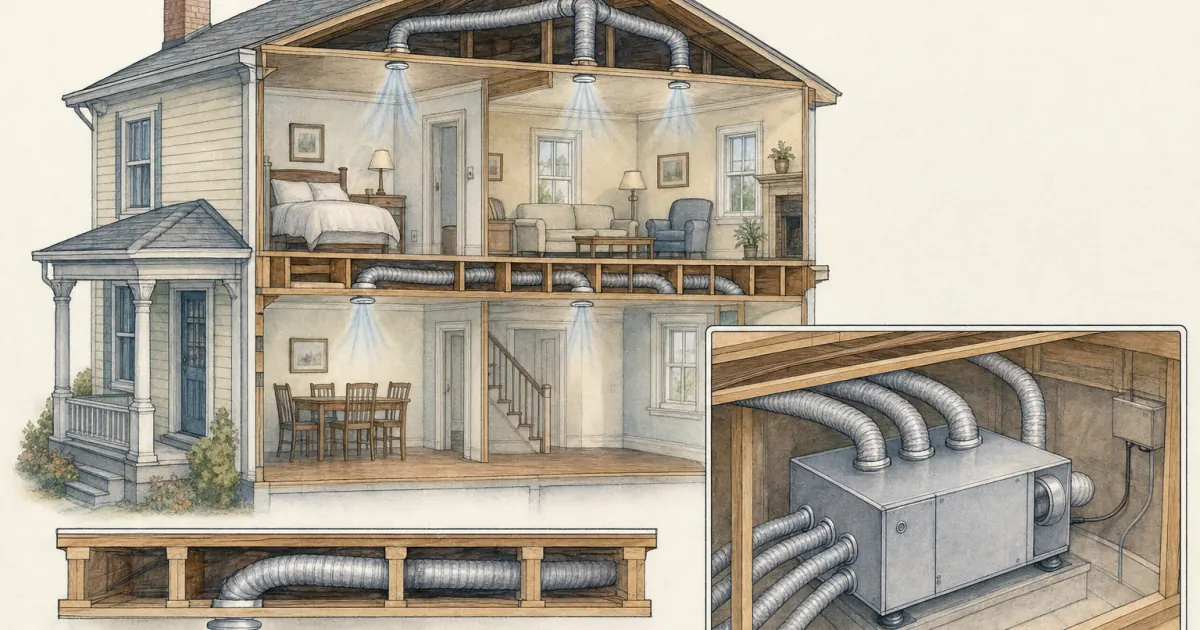
The strongest case for high velocity is structural access. HUD's 1999 rehab guide describes small-diameter flexible ducts that can pass through studs and joists, move around corners, and reach rooms through narrow openings. It also describes small outlet openings in walls, floors, or ceilings.
That makes the format worth considering when a home has:
- plaster walls, finished ceilings, or original trim that should stay intact;
- no existing ductwork because the house used radiators, boilers, baseboards, or room heaters;
- narrow joist bays, shallow chases, or a floor plan that resists large ducts;
- a new addition, attic, or finished basement that needs central heating and cooling; or
- a renovation where a dropped soffit would take too much from the room.
The space advantage has a limit. Installers still need a place for the air handler and plenum, a practical return-air route, access for filters and repairs, a condensate drain, refrigerant or hydronic connections, electrical work, and room outlets. A small supply run does not make those requirements disappear.
An open renovation or new build is usually easier than a finished home. With walls and ceilings open, the crew can route tubing and install outlets before finishes return. In an occupied old home, the same system may require access cuts, outlet holes, trim removal, and patching. It can reduce the size of the chase without eliminating disruption.
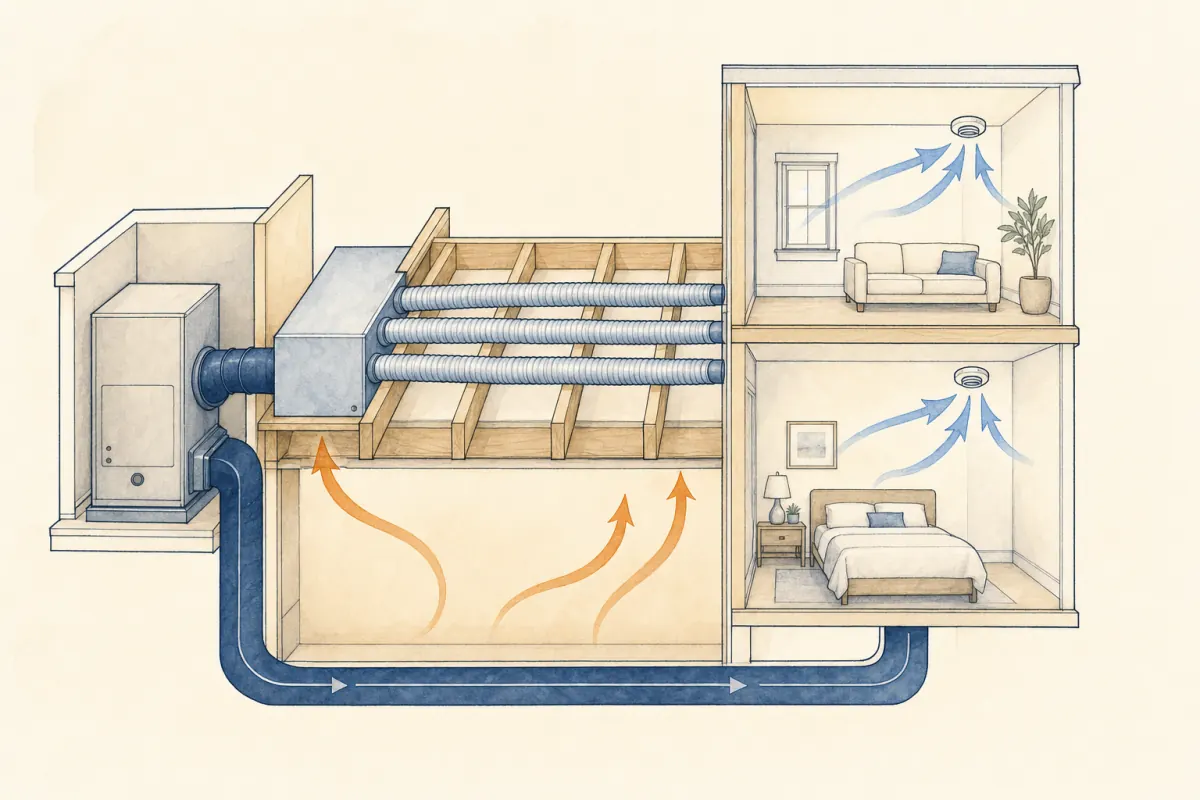
Simplified layout, not wiring instructions.
High-velocity HVAC cost
A current 2026 trade estimate from PICKHVAC's cost guide places a moderate full-house installation around $6,000 to $22,000. Its assumptions include a roughly 1,200-square-foot home, a single zone, 100 to 200 linear feet of small duct, and suburban labor.
We use that as a directional planning range only. It is a trade estimate, not a contractor quote, national market survey, or promise of what a project will cost in your area. A finished old home with difficult access can cost more than a new build with the same floor area. A single-room project and a whole-home system belong in different budget categories.
Normalize quotes by separating these lines:
| Quote line | What it should make visible |
|---|---|
| Equipment | Air handler, coil or fan, matched outdoor unit, and any backup or supplemental heat |
| Distribution | Plenum, small-diameter tubing, outlets, returns, dampers, and controls |
| Connections | Refrigerant, hydronic or electric heat, condensate, disconnects, breakers, and wiring |
| Access and removal | Old equipment or duct removal, openings, structural protection, and surface repairs |
| Closeout | Permit fees, inspections, startup, airflow balancing, commissioning, and warranty terms |
The largest cost drivers are usually:
- Project scope. A single room, an addition, and a whole-home replacement need different equipment and labor.
- Access. Attics, crawlspaces, plaster, masonry, and finished ceilings change routing and repair time.
- Duct footage and zones. More rooms, longer branches, returns, dampers, and controls increase design and installation work.
- Heat source. A cooling-only system, a heat pump, and a hydronic or electric heating configuration have different equipment and connection requirements.
- Electrical and condensate work. A new circuit, service-capacity work, pump, drain route, or code correction can widen the project.
- Local labor and permits. Contractor availability and inspection requirements vary by jurisdiction.
For broader project-class comparisons, Watt Wallet's heat pump installation cost guide is a useful companion. Keep the gross quote separate from any rebate or tax-credit estimate.
Pros and cons
Where high velocity helps
- It uses smaller distribution runs. Narrow tubing can preserve ceiling height, trim, plaster, and room layout where large ducts would require soffits or major framing changes.
- It can provide central delivery. Homeowners who want one central comfort system can avoid filling every room with a wall-mounted ductless head.
- Outlets can be discreet. Small round outlets may fit in floors, ceilings, or walls when the design and product allow that location.
- It can work with more than one heating and cooling approach. Some systems support heat-pump, cooling-only, hydronic, or electric configurations. The exact equipment match controls the result.
- Zoning may be available. Some product families support dampers and multiple zones. Zoning is a model and layout question, so a quote should spell out how it works rather than assume it.
Where it costs you
- Equipment and installer availability can be narrower. The crew needs experience with the equipment, pressure requirements, outlets, returns, and commissioning process.
- The design is less forgiving. Outlet position, branch routing, return air, balancing, and sound attenuation all affect comfort.
- Retrofit work still opens finished surfaces. Smaller runs can reduce demolition, yet an installer still needs to create access and place outlets.
- Service depends on the exact system. Filters, controls, coils, replacement parts, cold-climate capacity, and warranty terms vary by product.
- Efficiency is not automatic. A compact distribution system can still perform poorly if the equipment is oversized, the return is restricted, the tubing is damaged, or the system is commissioned badly.
Noise and comfort depend on the distribution design
High velocity does not mean a home will automatically sound loud. It does mean the air moves through smaller passages at higher pressure, so acoustic design has a larger role than many homeowners expect.
HUD's discussion of outlet placement and sound attenuation explains why the supply outlet cannot simply point at a bed, sofa, or desk. Its guidance describes strategic outlet placement and sound-attenuating tubing near the end of supply runs.
Comfort depends on the same design choices. A small outlet can deliver air at a more noticeable temperature and velocity than a conventional register. The air jet should mix with room air without creating a persistent draft. A good layout also gives each room a workable return path or transfer path so the supply air has somewhere to go.
We would treat promises such as “silent” or “no hot spots” as incomplete without a distribution plan. A serious proposal should show:
- outlet locations and the rooms they serve;
- return-air locations and transfer paths;
- branch lengths, bends, and any constraints;
- sound-attenuation details and equipment location;
- room-by-room airflow targets; and
- the measurements the installer will take during commissioning.
The final result can be comfortable and visually quiet. It can also produce rushing air or uneven rooms when outlets are poorly placed, returns are restricted, tubing is crushed, or airflow is never balanced.
Efficiency, heat pumps, and humidity limits
High velocity is a distribution format, not an efficiency rating. Efficiency belongs to the matched equipment and the installed system. The main variables are the load calculation, equipment combination, climate, controls, supply and return design, insulation, leakage, and commissioning.
That distinction matters when a contractor describes a high-velocity system as efficient. The claim may refer to a specific heat-pump model, a particular air handler, reduced duct exposure, or a measured project result. It does not apply to every SDHV system by definition.
When humidity control can improve
The U.S. Department of Energy's Building America team evaluated a centrally ducted, small-duct, high-velocity variable-capacity heat pump alongside a ducted mini-split and a ductless multisplit in low-load homes in a hot-humid climate. The moisture-control project connects better humidity control with consistent cooling runtimes, low sensible heat ratio, and controls that support low airflow at low loads.
The evidence supports a bounded conclusion: a carefully matched variable-capacity system can help manage moisture under the right operating conditions. It does not prove that every high-velocity system removes a fixed percentage of humidity or replaces a dehumidifier.
Humidity can remain difficult when the system is oversized, cycles off quickly, has high ventilation loads, or cannot operate at a low enough airflow. A proposal for a humid climate should state the expected latent load, the cooling airflow range, the condensate path, and the plan for shoulder-season moisture. If a separate dehumidifier is needed, it belongs in the scope and budget from the start.
When a high-velocity heat pump makes sense
A high-velocity heat pump combines a heat pump's heating and cooling equipment with a small-duct central distribution network. That can suit a homeowner who wants central delivery in a home without room for conventional ducts.
The heat-pump portion still needs model-level review. Cold-climate capacity, backup heat, defrost behavior, electrical requirements, controls, and sound are properties of the selected equipment and installation. The phrase “high velocity” does not establish any of them.
Installation disruption and local code
The installation usually follows this sequence:
- A contractor calculates room-by-room heating and cooling loads and maps outlets, returns, equipment, and access routes.
- The crew locates the air handler, plenum, outdoor unit or other heat source, condensate route, controls, and electrical connections.
- Small supply runs are routed through the attic, crawlspace, walls, floors, or joist bays.
- Outlets and returns are cut in, connected, sealed, and protected from damage.
- Refrigerant, hydronic, electric, condensate, and control work is completed.
- The system is started, balanced, and commissioned, with surface repairs handled according to the written scope.
The disruption is usually lowest when the structure is already open. In a finished home, the narrow runs may reduce the size of each opening, yet access work, outlet cuts, patching, and trim removal still belong in the schedule and price.
Permit and inspection requirements are local. Mechanical, electrical, plumbing, refrigerant, gas, outdoor-equipment, historic-preservation, and firestopping rules can vary by authority and project. The DOE's heat-pump permitting checklist is a useful reference for planning, though its scope focuses on air-source split-system heat pumps in one-family and duplex buildings and specific code editions. It is not a national permit rule.
The cleanest contract names who handles permits, inspections, corrections, and closeout. Refrigerant, combustion, electrical, and structural work belongs with licensed or otherwise qualified trades as required locally. A homeowner should not treat the small size of the tubing as permission to do that work without the appropriate qualifications.
For a related local-permit example, see Watt Wallet's mini-split permit guide. The permit category may differ, yet the same principle applies: fixed HVAC work can involve more than one approval.
Incentives are equipment-specific
An incentive usually attaches to the exact equipment, efficiency level, household, utility territory, installation date, contractor, and paperwork. The high-velocity distribution format alone does not establish eligibility.
That distinction is especially important for a heat-pump configuration. A cooling-only system, a hydronic coil, and an air-source heat pump can fall under different program rules. A quote that says “rebates included” should identify the program, model numbers, assumptions, and documents required for payment.
For work installed in 2026, the old federal heat-pump tax-credit assumption deserves special caution. The current IRS Energy Efficient Home Improvement Credit page says qualified improvements were eligible for the credit when placed in service before December 31, 2025. Do not subtract that expired timeline from a new 2026 project budget.
State and utility programs can have separate dates, income rules, pre-approval steps, approved equipment lists, and contractor requirements. Watt Wallet's heat pump rebates by state page is a useful routing tool, while the current official program terms control the actual result. Keep the gross installed price visible until the incentive path is documented for the selected equipment and project.
High velocity vs. conventional central HVAC vs. mini-splits
These labels describe different parts of the system, so comparing them as if they were identical technologies creates confusion.
- A heat pump is equipment that transfers heat for heating and cooling.
- A conventional central system usually means a furnace and air conditioner or a ducted heat pump using larger supply and return ducts.
- A high-velocity central system uses a compact air handler and small-duct distribution. It may use a heat pump, air conditioner, or another approved heat source.
- A ductless mini-split or multisplit uses refrigerant lines to connect an outdoor unit to one or more indoor heads or cassettes. It normally has no central supply-duct network.
| Option | Strong fit | Main tradeoff |
|---|---|---|
| High-velocity central system | Whole-home central comfort in an old or space-constrained home where large ducts do not fit and visible indoor heads are undesirable | Higher design specificity and potentially higher installed cost; exact zoning, heating capacity, and compatibility depend on the equipment and layout |
| Standard ducted central HVAC or heat pump | A home with usable existing ducts, or a renovation with enough room for conventional ductwork | Large ducts may require more invasive routing, and poor duct condition or leakage can hurt the result |
| Ductless mini-split or multisplit | Room-by-room zoning, an addition, or a home where minimal central ductwork matters most | Indoor heads or cassettes remain visible, and open-door or transfer-air limits can affect whole-home temperature balance |
A high-velocity system may use the same kind of heat-pump outdoor unit as a ductless system. That shared equipment category does not make the two distribution systems interchangeable. Watt Wallet's mini-split versus heat pump guide explains the broader ducted-versus-ductless equipment choice.
As a practical fit test:
- Choose the high-velocity path when central delivery and discreet outlets matter, large ducts do not fit, and the project can support a specialized design.
- Favor standard ducted HVAC when usable ducts already exist or the renovation has room for them.
- Favor ductless when room-by-room control, a single addition, or minimal central distribution matters more than hidden equipment.
What a high-velocity quote should include
Before comparing totals, make sure each proposal answers the same questions:
- What room-by-room load calculation supports the equipment size?
- Which indoor and outdoor model numbers are matched, and what heating capacity is available at the home's design temperature?
- Where are the supply outlets, returns, plenums, dampers, and service access points?
- What branch lengths, outlet types, airflow targets, and sound-control measures are included?
- How will condensate drain, and what happens if a pump is needed?
- What electrical circuit, panel-capacity, hydronic, gas, or backup-heat work is assumed?
- Who obtains permits, schedules inspections, handles corrections, and closes the job?
- Which wall, ceiling, floor, trim, or plaster repairs are included after access cuts?
- What startup and commissioning records will the homeowner receive?
- Which warranty covers equipment, labor, controls, and replacement parts?
Watt Wallet's HVAC quote questions guide expands this list for comparing bids. If the project may need service-capacity work, separate that scope from HVAC equipment with our panel replacement cost guide.
FAQ
Is high-velocity HVAC the same as a mini-split?
No. High velocity describes a central small-duct distribution network. A ductless mini-split generally sends refrigerant to indoor heads or cassettes. A high-velocity system can use a heat-pump outdoor unit, yet its indoor air delivery is different.
Is high-velocity HVAC quieter than conventional central air?
It can be quiet when the equipment, returns, outlets, branch runs, and sound attenuation are designed together. High airflow pressure also makes poor outlet placement, restricted returns, and bad balancing easier to hear.
Can a high-velocity system heat as well as cool?
Sometimes. The distribution format can be paired with a compatible heat pump, hydronic coil, electric coil, or cooling-only equipment. Heating capacity, cold-climate performance, and backup heat belong to the exact system design.
Does high-velocity HVAC use less energy?
The category has no automatic efficiency advantage. A well-matched system with good distribution and controls can perform well, while an oversized or poorly commissioned system can waste energy. Compare the equipment ratings and the complete installation design.
Is high-velocity HVAC a good choice for every old home?
No. It is strongest when the home needs central distribution and lacks room for large ducts. A usable existing duct system may make standard central HVAC simpler. A single room or addition may be better served by a ductless system. The air handler, returns, service access, and local installer availability still decide whether the retrofit works.
If high velocity is on your shortlist, start with an itemized design rather than a headline price. Use Watt Wallet's HVAC quote questions to compare the load calculation, distribution plan, permits, electrical scope, commissioning, and incentive assumptions before you sign.