Published: August 7, 2026
Water heater quotes are hard to compare because the retail price of a tank tells you little about the finished job. Venting, permits, electrical work, access, and code corrections can cost more than the appliance. We separate a true like-for-like swap from a conversion, show what each price band should include, and give you a clean way to compare bids. If a heat pump model is on your shortlist, we also help you find incentives that can change the amount you pay.
How much does water heater replacement cost?
Most homeowners should budget $900 to $2,500 installed for a conventional 40- or 50-gallon tank replacing a similar unit in the same location. Current national averages sit between about $1,350 and $1,950, depending on whose projects and included services are counted.
That spread matters. Angi's customer cost survey, based on more than 30,000 home projects across its cost database, reports an average of $1,346 and a usual range of $881 to $1,825. Home Depot's current basic tank replacement benchmark is $1,600 to $2,400, with an average of $1,950. A lower average can be valid while a complete local quote is higher.
Use the range that matches the project:
| Replacement path | Useful installed planning range | What the range assumes |
|---|---|---|
| Conventional gas or electric tank | $900 to $2,500 | Similar capacity and fuel, same location, ordinary access |
| Existing tankless unit | $1,400 to $3,900 | New tankless unit using a workable existing fuel, vent, and mounting setup |
| Tank-to-tankless conversion | $2,400 to $5,400+ | New mounting, plumbing, venting, gas, or electrical work may be needed |
| Heat pump water heater | $2,800 to $8,000 | Integrated unit with professional installation; difficult conversions can exceed this band |
These are all-in planning ranges, not amounts to add together. A basic 50-gallon electric tank can land near the low end. A 50-gallon gas power-vent model, difficult attic removal, fuel conversion, or relocation can push the same nominal tank size well beyond it.
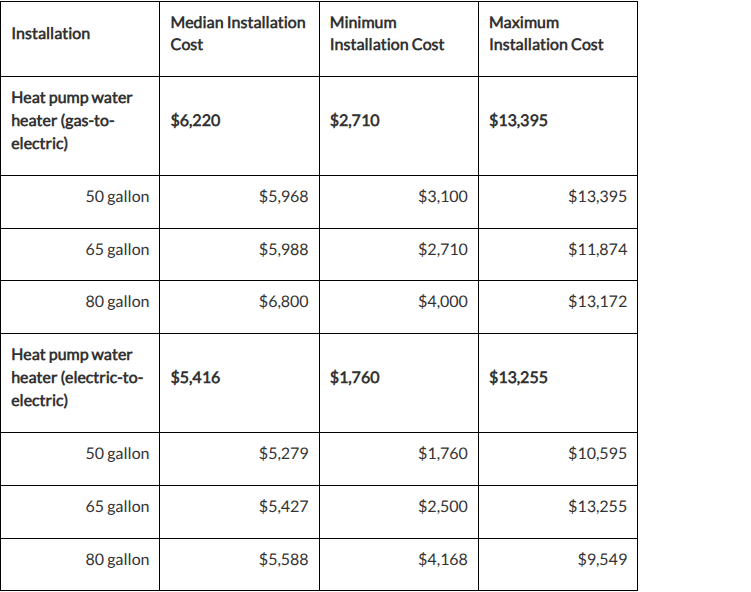
Our heat pump water heater cost guide goes deeper on that project. The national range also needs a local reality check. SMUD's rolling project data currently shows median pre-incentive installation prices of $6,220 for gas-to-electric and $5,416 for electric-to-electric heat pump water heaters. Those California program projects range from $1,760 to $13,395, which shows how little an appliance-only price says about a conversion. SMUD's project data covers actual residential installations from the prior 12 months and is refreshed quarterly.
The scope changes the price more than the tank size
A 40-gallon and 50-gallon tank often cost less than a few hundred dollars apart. A vent change, new circuit, or tight installation location can add much more. Price the project in this order.
1. Define the base replacement
Write down these details from the old unit and proposed model:
- storage tank, tankless, heat pump, or indirect
- gas, propane, electric, or boiler-connected
- exact model number and warranty
- tank capacity plus first-hour rating, or gallons per minute for tankless
- atmospheric, direct, or power vent for combustion equipment
- present location and access route
Capacity alone is a poor sizing shortcut. The first-hour rating tells you how much hot water a storage model can supply in an hour starting with a fully heated tank. Match that rating to peak-hour demand. DOE's water-heater purchasing guidance also shows that expected water use changes the value of a more efficient model.
2. Price every installation item
A complete replacement quote should account for:
- removal and disposal of the old unit
- delivery and placement of the new unit
- plumbing, gas, or electrical disconnection and reconnection
- required shutoff valves, connectors, fittings, and supports
- venting and combustion-air work for gas or propane
- drain pan, discharge piping, expansion control, or seismic restraint where required
- permit, inspection, and contractor handling of both
- startup, leak testing, cleanup, and labor warranty
Local code decides which safety items apply. A same-location swap is often the simplest permit path, though it is rarely safe to assume that it is exempt. Our water heater permit guide explains how the scope changes when the unit moves or the fuel changes.
Conversions create their own line items:
| Change | Scope that commonly appears |
|---|---|
| Tank to gas tankless | Larger gas supply, new vent route, wall mounting, condensate drain for condensing models, power outlet |
| Gas tank to heat pump | Dedicated circuit where needed, gas capping, condensate drainage, airflow or ducting, possible relocation |
| Electric tank to heat pump | Condensate drainage, room-volume or ducting work, possible circuit changes, larger tank footprint |
| Tank to whole-home electric tankless | Multiple high-amperage circuits, panel capacity, and sometimes a service upgrade |
| Same type in a new location | New water, gas, drain, vent, or electrical runs plus wall repair and added labor |
Any quote that says “standard installation” should define that phrase. Otherwise, the lower bid may become the higher bill after change orders.
3. Subtract savings at the right time
Keep three totals rather than accepting one blended “after incentives” price:
- Gross installed price: the full equipment and installation contract.
- Amount due at installation: gross price minus discounts applied directly to the invoice.
- Eventual net cost: amount due minus rebates paid to you later, plus financing fees and interest.
For a new 2026 installation, the federal Energy Efficient Home Improvement Credit is $0. The IRS states that the Section 25C credit is unavailable for property placed in service after December 31, 2025. Current IRS guidance overrides older pages and contractor handouts that still show a $600 water-heater credit or a $2,000 heat pump water heater credit.
State, utility, and local rebates can still reduce the net cost, especially for heat pump water heaters. Program funding, income limits, eligible models, and contractor rules vary. Count a rebate only when its amount and application path appear in writing for your project.
What a fair replacement quote includes
The best bid is the one that makes the final scope visible. Put competing quotes side by side using these fields:
| Quote field | What a usable bid says | Warning sign |
|---|---|---|
| Equipment | Manufacturer, full model number, capacity, fuel, vent type, efficiency rating, and warranty | “40-gallon heater” with no model |
| Base labor | Removal, installation, connections, startup, and cleanup | One unexplained labor total |
| Code and safety work | Each added valve, pan, expansion tank, strap, vent part, or drain line | “Code upgrades extra” |
| Electrical or gas work | Circuit, breaker, wire, gas-line, vent, or capping scope | Conversion sold as a simple swap |
| Permit | Fee, permit holder, inspection scheduling, and closeout | Permit omitted or left to the homeowner without explanation |
| Disposal | Drain, removal, haul-away, and disposal fee | Old tank left onsite |
| Installer warranty | Covered labor and term, separate from the equipment warranty | Manufacturer warranty presented as labor coverage |
| Incentives | Program, amount, recipient, application owner, and payment timing | Rebate deducted with no program named |
Request the same model and scope from three licensed installers. SMUD recommends at least three bids because contractor, panel distance, available electrical capacity, and relocation all move project pricing. Three near-identical totals are useful market evidence. One much higher or lower total needs an itemized explanation.
Why the installed price can dwarf the retail price
A $700 tank and a $2,000 installed quote do not imply $1,300 of take-home pay for a few hours of labor. The difference can cover delivery, disposal, fittings, permit administration, a stocked service vehicle, licensed labor, payroll costs, insurance, company overhead, and responsibility for warranty callbacks.
The details still matter. These are the main reasons an ordinary-looking quote climbs above $3,000:
- Power venting: the unit itself costs more and needs electrical power plus a compliant exhaust route.
- Large or specialized equipment: 75- and 80-gallon tanks, condensing models, indirect tanks, and combination space-and-water-heating systems carry higher equipment and labor costs.
- Difficult access: attic, crawlspace, balcony, narrow stairs, or finished-room access slows removal and placement.
- Existing work that no longer passes inspection: venting, drain, expansion control, gas piping, or electrical connections may need correction.
- After-hours replacement: emergency, evening, and weekend scheduling often carries a premium.
- Longer coverage: an installer-backed labor warranty or service plan has value, but its terms should be stated.
- Regional costs: labor, permits, code requirements, and travel time vary by market.
A high quote is reasonable when the scope explains it. “Premium package” is not an explanation.
Choose by lifetime cost, not installation price alone
The conventional tank usually wins on upfront cost. A tankless or heat pump model can still cost less over its life if the operating savings justify the installed-price premium.
For tankless units, usage matters. DOE reports that demand water heaters can be 24% to 34% more efficient than conventional storage units in homes using 41 gallons or less of hot water daily. At about 86 gallons per day, the advantage falls to 8% to 14%. Read the DOE Energy Saver guide before applying a generic savings percentage to a busy household.
We favor a heat pump water heater when the room, hot-water demand, and electrical setup fit. It offers a large efficiency gain from a standard electric tank. A gas-to-electric conversion needs a household-specific cost comparison because local gas and electricity prices can reverse the bill result. Our heat pump versus tankless comparison maps the installation tradeoffs.
Use each proposed model's yellow EnergyGuide label. The FTC explains that its annual cost is based on typical use and a national average energy price, so your actual cost will differ. The label's tested energy consumption is the better comparison input. Multiply it by your local utility rate and keep the same usage assumption for every model. The FTC EnergyGuide guide explains what the label does and does not predict.
Then calculate simple payback:
installed cost premium after confirmed rebates ÷ estimated annual operating savings = simple payback in years
Financing interest and expected maintenance belong in the decision even though simple payback leaves them out.
Repair or replace?
A repair can make sense when the tank is sound, the unit is still within its expected service life, and the failure is a replaceable control, heating element, igniter, or valve. Replacement becomes the practical choice when the tank itself leaks, corrosion is spreading, repairs repeat, or an old unit can no longer meet normal hot-water demand.
Planning before failure also preserves your choice of equipment and installer. ENERGY STAR advises owners to plan once a water heater reaches about 10 years and names visible corrosion, leaking, rusty hot water, reduced capacity, and unusual rumbling as warning signs in its replacement guidance. A warranty may cover equipment while leaving removal, reinstall labor, permits, and disposal to the homeowner, so read the labor terms separately.
Ways to lower the cost without cutting scope
- Plan before the tank fails. A weekday installation with time for competing bids avoids an emergency premium.
- Keep the same location and fuel when upfront cost is the priority. Relocation and conversion work can overtake the equipment price.
- Compare identical models and line items. Our quote comparison guide gives you a repeatable format.
- Find incentives before choosing the equipment. Some programs require an eligible model, reservation, or participating contractor before work begins.
- Separate equipment warranty from labor warranty. A free replacement tank can still leave a four-figure reinstall bill.
- Ask how owner-supplied equipment changes coverage. Buying the unit yourself may reduce markup while also shifting delivery damage, returns, and labor-warranty risk to you.
FAQ
How much does it cost to replace a 50-gallon water heater?
A conventional 50-gallon tank generally falls within the $900 to $2,500 installed planning range when it replaces a similar unit in the same location. Angi's project data puts the full 50-gallon range at $800 to $2,500. Power venting, difficult access, code corrections, or a fuel change can push the total above $3,000.
How much is labor to install a water heater?
Angi puts the narrow labor line for a basic tank swap around $150 to $450, but that figure rarely equals the installer's full margin. Delivery, fittings, permits, disposal, overhead, and warranty responsibility may appear elsewhere or inside one installation charge. Compare the complete installed scope instead of dividing the invoice into tank price and “labor.”
Is a 40-gallon water heater much cheaper than a 50-gallon model?
Usually, no. Angi's current project ranges are about $800 to $2,300 for 40 gallons and $800 to $2,500 for 50 gallons. Vent type, fuel, access, and required installation work often create a larger price difference than ten gallons of capacity. Size the replacement by first-hour rating and peak demand rather than price alone.
How long does water heater replacement take?
A straightforward tank-for-tank replacement often takes a few hours. Draining, difficult removal, permit inspection timing, vent changes, new circuits, fuel conversion, tankless mounting, or relocation can turn it into a full-day or multi-visit job.
Does replacing a water heater require a permit?
Usually, yes. Many jurisdictions require a permit and final inspection even for a same-location replacement. Fuel changes, new circuits, gas work, relocation, and wall alterations can add permit types or plan review.
Is a quote over $3,000 automatically too high?
No. It is high for a basic, easy-access atmospheric tank swap in many markets, but it can be reasonable for a power-vent model, large tank, difficult location, heat pump conversion, tankless conversion, code correction, or combination heating system. The quote should name the exact equipment and added scope that justify the total.
For an ordinary same-location tank replacement, use $900 to $2,500 as a first-pass budget and require a clear reason for costs outside it. For a conversion, compare complete project scope and lifetime cost. Before signing, use our incentive finder to find rebates that can lower the real cost of a qualifying water heater.