Last reviewed: 2026-10-27
What water heater vacation mode does
A storage water heater loses heat even when every faucet is closed. Its burner, heating elements or heat pump replace that lost heat to maintain the thermostat setting. This is standby heat loss.
Vacation mode usually lowers the temperature the tank maintains during an absence. It may appear as VAC, Vacation, Away or a timed setting on a display or app. Depending on the control, it can remain active until you cancel it or restore normal operation automatically.
Selecting vacation mode is different from disconnecting electricity or gas. It does not stop leaks or establish that stagnant plumbing is safe to use. It should not be counted on for ordinary hot-water demand. An appliance's separate leak-detection or shutoff features have their own controls.
Choose between vacation mode, normal operation and shutdown
Start with household demand and the conditions the equipment will face:
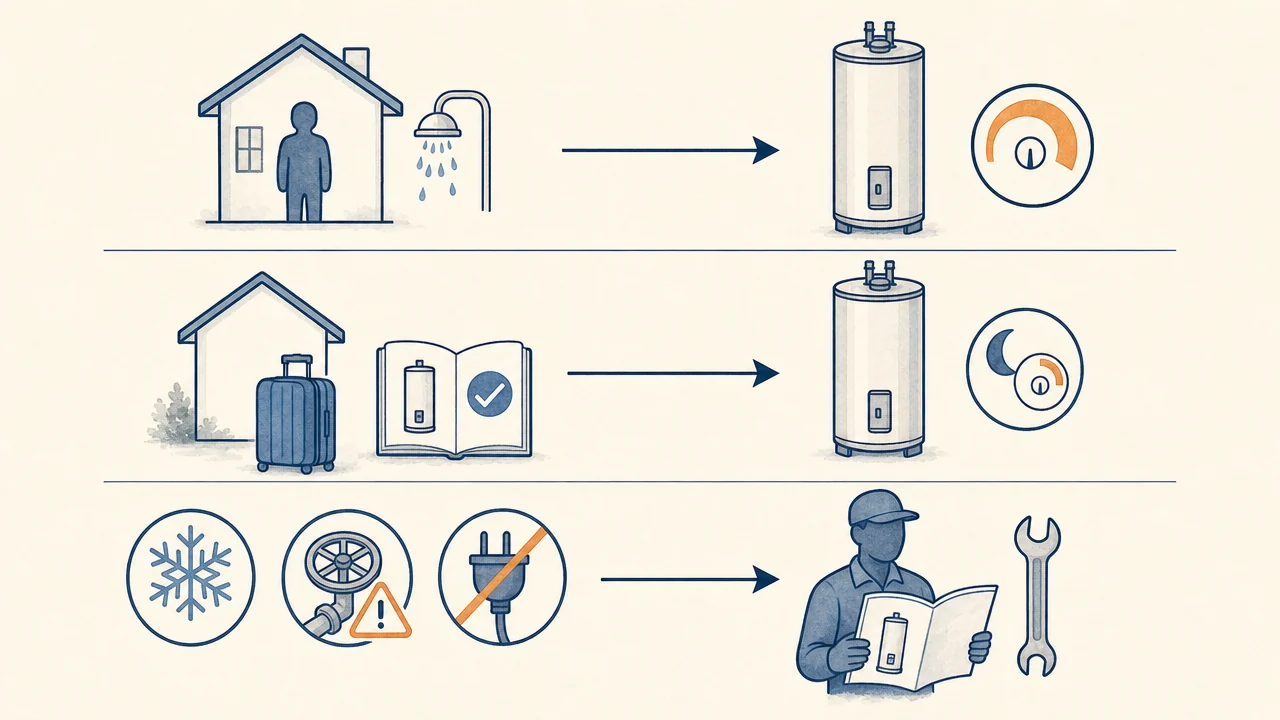
- Normal operation: Someone staying at the house needs hot water, or an established household water-management plan calls for the usual operating settings. No documented away setting is another reason to avoid improvising a low-temperature setting.
- Documented vacation mode: The house will have no hot-water demand, the heater's instructions permit away operation, and its required water, energy supply and installation conditions will remain in place.
- A professional shutdown or winterization plan: The building could freeze, required electricity or gas may be unavailable, the water supply will be shut off, or the vacancy falls under the manufacturer's extended-shutdown guidance. A plumber coordinates the heater, piping and return-to-service requirements.
There is no universal number of away-days that moves every home from one choice to another. A weekend in a heated house and a seasonal cabin exposed to freezing are different decisions, even with the same heater.
The manufacturer's extended-shutdown section matters as much as the away-mode menu. For example, Rheem's Gladiator operating manual treats extended shutdown separately and calls for qualified service checks after a long shutdown. It does not assign one duration to every installation.
How controls differ by water heater type
Fuel alone does not identify the controller. A model number, the matching owner's manual and the actual control installed on the unit determine the available settings. Our electric-versus-gas comparison explains the equipment categories if the difference between electric resistance, heat-pump and gas storage is unfamiliar.
Gas storage water heaters
A gas tank may have a temperature dial with a vacation marking, a low setting or an electronic control. Different controls can appear within the same manufacturer's manual family.
The variation is large enough to rule out a standard vacation temperature. American's legacy Ultra Low NOx Flame Guard gas-control instructions describe VAC at approximately 55°F. Bradford White's atmospheric-vent control-setting diagrams show approximately 85°F for the pictured White-Rodgers mechanical gas controls on page 18, figures 2–3. That page also shows separate ICON/SIT electronic controls with different vacation markings. The 85°F illustration does not establish a setting for every Bradford White heater or current RG model. Neither example is a recommended temperature for other heaters.
PILOT, LOW, VAC and OFF are not interchangeable instructions. Use the away function documented for the installed control. Selecting an ordinary user setting does not require experimenting with pilot-light or gas-valve procedures.
Electric resistance storage water heaters
Some electric tanks have an accessible electronic vacation control. Others have no dedicated away mode. A thermostat behind an access cover is a different task from choosing an option on a user display; leave adjustments requiring panel access to a qualified professional.
Rheem's Gladiator XE40M12CS45U0 uses a vacation setting that lowers the tank temperature. Its electronic-control instructions do not specify that lower setpoint. To leave vacation mode, its user control selects the desired normal temperature. It does not promise an automatically remembered former setting or a timed return.
By contrast, A.O. Smith's residential electronic-thermostat vacation-mode instructions specify a fixed 50°F vacation/cabin setting and a timer that switches back to standard mode when eight hours remain in the selected vacation period. That temperature and return timing belong to that manual family, not every electric tank.
Heat-pump water heaters
A heat-pump water heater still stores water in a tank. Its efficient everyday heating mode and its vacation mode serve different purposes. Selecting heat-pump operation alone does not necessarily lower the storage target for an absence.
Rheem's ProTerra PROPH50 T0 RH120-M offers vacation/away scheduling for 2–28 days or an indefinite hold. Its matched use-and-care manual lists Vacation mode without assigning it a numeric temperature in the text, caption or table. A numeric away temperature cannot be inferred from its control illustration or another heat-pump model.
That model requires an indoor installation protected from freezing. A long hold on the controller does not waive installation or extended-shutdown requirements. Our heat-pump installation guide explains the separate room-air, condensate and commissioning considerations.
Tankless water heaters
Tankless equipment heats water on demand instead of maintaining a large hot reservoir. It therefore avoids the storage tank's standby heat loss, as a DOE-hosted tankless-water-heater brief explains. Controls, recirculation and freeze protection can still consume energy while the house is empty.
Unplugging a tankless heater can disable protection you are relying on. For example, Rinnai's RSC160i/RSC160e and RSC199i/RSC199e indoor/outdoor models need gas and 120-volt power for their specified freeze protection. That protection also depends on the manual's indoor/outdoor air-temperature limits and protection from direct wind; air movement reduces protection. It does not cover external piping or valves. The current RSC product documentation links manual 100000773(01), January 2023, which states these conditions on page 21, section 4.3.5.
A tankless absence plan follows that model's instructions, including any circulation controls. It cannot be borrowed from a storage-tank shutdown procedure.
How much energy and money can vacation mode save?
Vacation mode mainly addresses idle heat loss. While nobody is home, the heater is already avoiding the energy normally used to replace hot water drawn for showers, dishes and laundry. Do not count those absent draws again as savings caused by the setting.
The additional savings depend on tank insulation, the temperature difference between the water and the room, the away-mode behavior, fuel cost and reheating after the trip. A more efficient heater can have a smaller dollar opportunity even when the setting reduces heat loss.
An illustrative electric-storage example, using kilowatt-hours (kWh), makes the scale clearer:
0.5 kWh of avoided idle electricity per day × 7 days × $0.20/kWh = $0.70
Those are assumed inputs, not a typical savings claim. The calculation covers avoided electricity during the absence; the difference in return-home reheating energy also belongs in the net result. Actual savings can be higher or lower. A universal percentage of the annual water-heating bill would mix standby loss with normal hot-water use.
Vacation settings also leave utility fixed charges in place. Turning off a heater does not make those charges disappear, and a small potential saving is a poor reason to abandon required freeze protection.
Include recirculation in the away plan
A hot-water recirculating pump has a separate job: moving water through a loop so fixtures get hot water sooner. Its schedule may continue when nobody needs that comfort. Changing the heater's setting does not automatically change every pump or loop controller.
For an ordinary single-family comfort system, include the pump's documented away or scheduling controls in the same plan. Our recirculating-pump guide explains timer, demand and continuous controls. A centralized building system needs the responsible manager's water-management plan; residents should not change circulation or storage settings themselves.
Before leaving: settle water supply and freeze protection
Vacation mode is not permission to close the water supply and leave a heater operating. Rheem's Gladiator and ProTerra manuals prohibit turning on the heater unless the tank is full and the cold-water supply shutoff valve is open. The Gladiator safety precautions and ProTerra safety precautions make that boundary explicit.
A whole-house water shutoff for leak protection and the heater's operating requirements need one coordinated plan. A full tank at departure does not override the manufacturer's restrictions. A plumber can resolve an unclear water-off arrangement before the trip.
Freezing is a whole-building issue. Keeping the tank warm does not protect pipes in exterior walls, crawlspaces or other cold locations. Appliance freeze protection also depends on its specified conditions remaining available throughout the absence.
For a seasonal home, an unheated building or an unreliable winter energy supply, arrange model-specific winterization. Draining can be part of that work, but it is not a routine vacation-mode step. Tankless equipment can have condensate traps, pumps and other components that require attention beyond the water connections.
Leaks, damage, freeze exposure and control faults need service rather than an away-mode workaround. For a gas odor, follow the manufacturer's emergency instructions: leave the area and contact the gas supplier or emergency services from a safe location. Do not attempt a restart.
Returning home: separate reheating from water quality
For an intact heater left in documented vacation mode with its required supplies maintained, the ordinary return action is restoring the established household operating mode through its documented user control. For a manual return, select the desired normal temperature rather than assuming a former setting was remembered. Automatic return applies only where the particular control documents it; an indefinite hold is different.
Plan hot-water availability around the model's recovery behavior. Tank size, starting water temperature, heating capacity and selected operating mode affect recovery. There is no universal one-hour wait, and raising the thermostat above the household's established setting is not a safe shortcut.
A heater that was shut down, drained, frozen, damaged or left with interrupted supplies follows its separate return-to-service requirements. Long-shutdown service checks and full-tank requirements are not replaced by selecting a menu option.
Stagnant water and scald risk
Water sitting in the home's pipes can allow germs, including Legionella, to grow. Exposure can occur through water mist. The CDC's household germ-prevention guidance addresses outlets that have gone unused and the needs of people at higher risk. Its example of a week or longer is not a universal safe-vacancy cutoff.
Normal reheating does not establish that the tank and plumbing have been disinfected. Household precautions depend on the plumbing and occupants. For someone with a weakened immune system or chronic lung disease, discuss absence and return precautions with their healthcare provider and a qualified plumbing professional. Follow water-utility advisories where applicable.
Temperature choices must balance germ control with burns. The Consumer Product Safety Commission's tap-water scald guidance warns that even 120°F water can cause severe burns with prolonged exposure. Where higher storage temperatures are appropriate, correctly selected and installed mixing or tempering controls reduce tap-water scald risk, especially for children and older adults. A vacation setting supplies neither a universal safe storage temperature nor a thermal-disinfection program.
Hydrogen is a separate nonuse hazard
Some storage-heater manuals warn that extremely flammable hydrogen can develop after prolonged nonuse, generally two weeks or more. A.O. Smith's nonuse safety warning places that caution alongside its vacation-mode instructions.
This is separate from bacteria and scalds. The precautions in the matched manual belong in the return plan before using hot-water-connected appliances. If the instructions are unclear, qualified service personnel handle the return to use. A generic flushing or temperature-raising sequence cannot stand in for those precautions.
Our recommendation
Use the heater's documented vacation setting for an eligible no-demand absence. Keep normal operation when hot water is still needed, and coordinate water shutoff, prolonged vacancy and freeze exposure as separate planning decisions. Modest idle-energy savings should never decide the safety plan.
If the equipment or installation no longer suits your home, use our heat-pump versus tankless comparison to plan an upgrade around energy use, recovery and installation fit.