Published: August 13, 2026
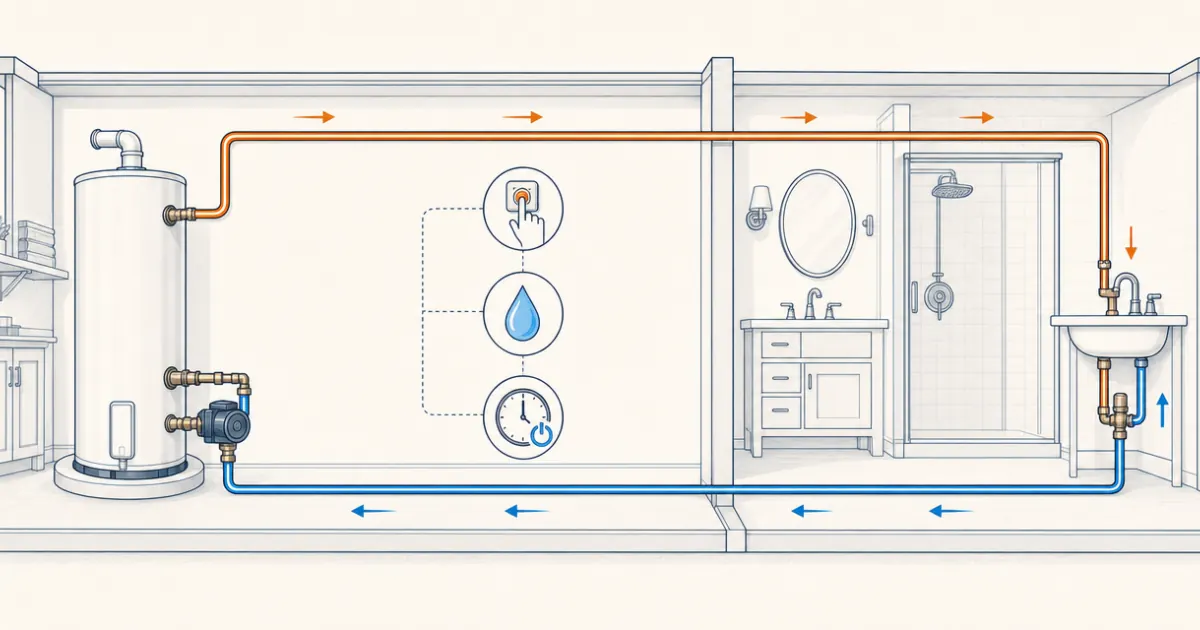
Waiting a minute for a hot shower feels minor until the gallons sent down the drain begin to add up. A hot water recirculating pump can shorten that wait, yet the same pump can increase water-heating energy use when it keeps long pipes hot all day. We separate the decision into two parts: the path that returns cooled water to the heater and the control that decides when the pump runs. Those choices determine the comfort, cost, and energy result.
The quick answer
For a single-family home, our preferred setup is a demand-controlled pump with a temperature shutoff and insulated hot-water piping. It runs when someone requests hot water, primes the line, and stops. That preserves most of the water-saving benefit without turning the plumbing into an all-day radiator.
The right return path depends on the house:
| Home and plumbing | Best-fit system | Main tradeoff |
|---|---|---|
| New construction or walls already open | Dedicated insulated return line with demand control | More pipe and a higher upfront cost, with the cleanest separation between hot and cold water |
| Existing tank water heater, no return line | Retrofit pump with an under-sink crossover valve and demand control | Faster, cheaper installation, with temporarily warm water possible at the affected cold tap |
| Tankless water heater | Only a recirculation layout approved for the exact heater | Pump flow, controls, and warranty compatibility vary by model |
| Heat pump water heater | Demand operation only | Continuous circulation can erase much of the heater's efficiency advantage |
The best fit is a home with several daily draws at distant fixtures. Short waits, rare remote use, and return piping that requires major finish work weaken the case.
Pros and cons at a glance
| Pros | Cons |
|---|---|
| Cuts the water sent down the drain while distant fixtures warm up | Can raise water-heating energy use when the loop stays hot for long periods |
| Delivers hot water faster at long plumbing runs | Adds equipment, installation, and eventual repair cost |
| Demand-controlled retrofit systems can avoid a new return pipe | A cold-line crossover can briefly make the affected cold tap lukewarm |
| Demand control keeps pump runtime low | Tankless and heat pump water heaters need compatible layouts and controls |
What a hot water recirculating pump actually changes
The pump does not make the water heater heat faster. Between uses, water in the hot pipe cools. The next draw normally sends that water down the drain while fresh hot water clears the pipe and warms it.
A recirculation system closes that path. Cooled water returns through a dedicated pipe or crosses into the cold line, keeping it in the plumbing system. A temperature sensor stops a properly controlled pump when the loop is primed. ENERGY STAR's explanation warns that continuous systems can consume more energy than they save.
“Instant hot water” needs a qualifier. A continuously hot loop offers almost no delay. A demand system avoids faucet waste but still needs a short priming period. Pressing a button before a shower is more precise than heating the loop for hours.
Choose the return path first
The pump and return path form one system. Buying the circulator first is an easy way to end up with the wrong kit.
Dedicated return line
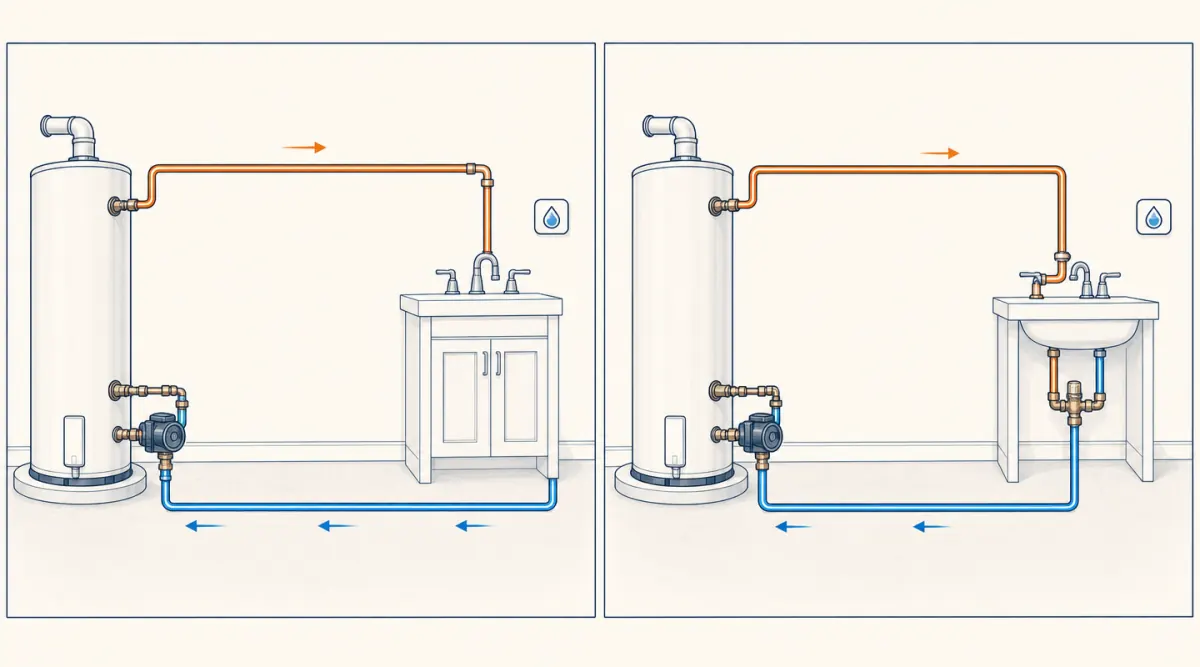
A dedicated return runs from the far end of the hot-water trunk back to the heater. The cold plumbing remains cold, and a well-designed loop can serve several short branches. This is the stronger layout for a new build or a renovation with open walls.
Adding a return to a finished home may mean routing pipe through a basement, crawlspace, attic, wall, or ceiling. The new pipe can cost far more than the pump. Every foot of hot supply and return also adds heat-loss area, so insulation and demand control belong in the design.
Cold-line crossover retrofit
A crossover valve connects the hot and cold supplies under a distant sink. While the valve is open, the pump sends cooled hot-line water back through the cold line. The valve closes when warmer water arrives.
This layout avoids a new return pipe, but it creates three practical limits:
- The cold branch near the crossover can be lukewarm during and shortly after a cycle.
- One valve serves only the plumbing path that flows through it. Split wings or separate hot-water trunks may need another valve or a different design.
- Tankless compatibility is model-specific. Some retrofit kits explicitly exclude tankless heaters, while some tankless heaters provide their own approved crossover mode.
The valve belongs near the hydraulically farthest fixture on the branch, which is not always the fixture that looks farthest on a floor plan.
Choose the control: demand is our default
Return-line type controls installation cost. Control type controls operating cost.
| Control strategy | How it runs | Comfort | Energy consequence | Our take |
|---|---|---|---|---|
| Continuous | Runs around the clock | Fastest delivery | Maximum pump runtime and continuous pipe heat loss | Avoid in a single-family comfort system |
| Timer | Runs during scheduled blocks | Good when routines are predictable | Heats the loop even when nobody draws water during the block | Better than continuous, especially with temperature shutoff |
| Temperature only | Restarts whenever the loop cools | Keeps the loop warm | Can cycle all day because cooling pipe becomes the trigger | A limiting control, not true demand control |
| Learning schedule | Predicts periods of use | Convenient after it learns a stable routine | Still runs for expected draws that may not happen | Useful when manual activation would be ignored |
| Manual demand | Starts from a button, app, or voice command | Short wait after activation | Runs only for requested events | Most precise option |
| Presence or flow demand | Starts from occupancy or a hot-water action | More automatic | False triggers are possible, depending on sensor placement | Good when paired with temperature and maximum-runtime limits |
Demand activation and temperature shutoff solve different problems. The first prevents unrequested cycles. The second stops a requested cycle once hot water reaches the sensor. A maximum runtime limits a failed sensor or stalled loop.
That combination also appears in the 2024 IECC model code. Its demand-recirculation provisions start the pump from user action, presence, or hot-water flow, then require temperature-based shutoff, a maximum five-minute run, and a lockout before the next cycle. Actual requirements follow the code adopted where the home is located.
Estimate the water you can save
Wait time alone is a weak savings measure because faucet flow changes it. Pipe volume gives a better starting point.
The 2024 IECC pipe-volume table lists water stored per foot of common tubing. These examples convert its figures for 50-foot runs:
| 50-foot hot-water run | Water sitting in the pipe |
|---|---|
| 1/2-inch PEX | 0.46 gallon |
| 1/2-inch Type L copper | 0.61 gallon |
| 3/4-inch PEX | 0.92 gallon |
| 3/4-inch Type L copper | 1.26 gallons |
Fittings and manifolds add volume. The amount discharged before water feels hot can exceed the static volume because the pipe absorbs heat and water mixes at the leading edge.
For a first-pass annual estimate:
cooled pipe volume × full-wait hot draws per day × 365 = gallons available to save per year
Consider a 50-foot, 3/4-inch PEX run with 0.92 gallon in the pipe. If it fully cools before eight hot-water starts each day:
0.92 × 8 × 365 = about 2,686 gallons per year
That is an upper planning case. Back-to-back uses save less because the line is already warm.
Water-bill savings are straightforward:
gallons avoided ÷ 1,000 × combined water and sewer rate = annual bill savings
At an illustrative combined rate of $15 per 1,000 gallons, 2,686 gallons is about $40 per year. Water savings alone rarely create a fast payback for an expensive new return line. Comfort, drought conditions, wastewater charges, and the severity of the wait often carry more weight than simple payback.
Calculate pump electricity, then account for pipe heat loss
The pump motor is the easy part to calculate:
pump watts × operating hours per day × 365 ÷ 1,000 = annual kWh
For a 25-watt example pump:
| Operating pattern | Pump electricity | Cost at $0.18/kWh |
|---|---|---|
| Continuous, 24 hours per day | 219 kWh/year | $39/year |
| Timer, 2 hours per day | 18.3 kWh/year | $3.29/year |
| Demand, ten 5-minute cycles per day | 7.6 kWh/year | $1.37/year |
The nameplate wattage and actual runtime replace the example values. Variable-speed pumps do not necessarily draw their rated maximum throughout a cycle.
The harder cost sits outside that formula. Each cycle heats the pipe and surrounding material. Continuous circulation replaces that heat every time it escapes, so the water heater runs more. Long uninsulated loops through a garage, crawlspace, attic, or exterior wall amplify the loss. Heat released inside conditioned space may offset a little winter heating, then adds to cooling load in summer.
Control choice can outweigh motor efficiency. In a DOE-sponsored field study of two multifamily buildings, demand control reduced domestic-hot-water fuel use by 7% against constant circulation. Combining demand and temperature modulation reduced it by 15%, and pump runtime fell to 14 minutes or less per day. The study used multifamily buildings, so its percentages do not forecast savings for one house. It still shows why a low-watt pump running constantly can be the wrong energy choice.
Insulation slows the loss after each cycle. The 2024 IECC calls for insulation on hot supply and dedicated return piping in circulation systems. It does not turn an always-on loop into an efficient one, and it does not eliminate the first wait after a long cooldown.
Match the pump to the water heater
Storage tank water heater
A tank heater is usually the simplest match. The layout still needs the right return connection, flow direction, check valve, temperature control, and potable-water-rated pump.
Tankless water heater
Tankless compatibility cannot be inferred from the word “recirculating” on a pump box. The heater has a minimum activation flow, approved piping arrangements, control logic, and maximum loop limits. Some units include a pump and dedicated-return or crossover modes. Others need approved accessories, and some external retrofit kits are prohibited.
A recirculation cycle also fires the heater, so a broad timer schedule gives up some of the standby advantage that made tankless attractive.
Heat pump water heater
Heat pump water heaters are especially sensitive to recirculation load. ENERGY STAR installation guidance says to use on-demand, motion, or occupant activation and warns against continuous circulation, which can force some units into electric-resistance operation and increase energy use.
That makes demand control part of a good heat pump water heater installation, along with the correct return connection and an insulated loop.
Central multifamily or health-care system
Single-family comfort advice does not transfer to a building-wide water-management system. Temperature, circulation, stagnation, and disinfectant control affect water quality. CDC home guidance explains the tension between temperatures that suppress Legionella and temperatures that raise scald risk.
A recirculation timer is not a safe shortcut for changing water temperature. Central systems and homes with occupants at elevated health or scald risk need a water-management design that coordinates storage temperature, return temperature, mixing valves, and local code.
What a hot water recirculating pump costs
Angi's current cost guide places a basic hot water recirculating system at $200 to $400 on average. That is a useful equipment benchmark, not a universal installed price.
Installation scope creates the larger spread:
| Cost item | Lower-scope case | Higher-scope case |
|---|---|---|
| Return path | Existing compatible return or under-sink crossover | New return pipe through finished areas |
| Pump and control | Basic timer or demand kit | Smart control, multiple activation points, or multiple branches |
| Plumbing | Accessible threaded or flexible connections | Pipe cutting, new valves, balancing, difficult access, or heater repiping |
| Electrical | Existing compliant receptacle and plug-in pump | New receptacle, hardwiring, or electrician scope |
| Finish work | None | Drywall, paint, cabinet, or tile repair after routing pipe |
| Permit | No separate permit in the adopted local process | Plumbing or electrical permit and inspection |
When the pump is bundled with a new heater, our water-heater replacement cost guide helps separate the base replacement from recirculation, electrical, and finish work.
A quote for a finished-home dedicated return is a plumbing-remodel quote. Comparing it with the price of a bypass kit hides the main cost difference. Our water-heater permit guide explains why permit scope varies even for related work on the same appliance.
What belongs in a good pump package
A complete selection is more than pump horsepower. It includes:
- A defined return path. Dedicated return and cold-line crossover kits are not interchangeable assumptions.
- Demand activation. Manual, presence, or flow activation should match how the household actually uses hot water.
- Temperature shutoff and a runtime limit. These prevent a requested cycle from becoming continuous operation.
- Water-heater compatibility. Tankless and heat pump models need particular attention.
- Potable-water approval. Pumps and wetted components belong in drinking-water service, with materials and certifications suitable for the application. NSF drinking-water standards cover contaminant leaching and lead content.
- Correct hydraulic sizing. The pump must overcome loop resistance at the required flow. An oversized circulator adds noise, electricity use, and unnecessary pipe velocity.
- Serviceable valves and controls. Isolation, check, balancing, crossover, and purge provisions depend on the layout, but buried or inaccessible controls make later repairs harder.
- Insulated hot and return pipes. Accessible hot piping and every dedicated return section should be treated as part of the energy system.
A plug-in crossover kit on an accessible tank heater can be a compact job. A dedicated return, multiple branches, hardwired pump, tankless integration, or water-heater repiping is professional plumbing and sometimes electrical work. The installation manual, adopted code, and final piping diagram govern placement and orientation.
Our recommendation
Choose the control before choosing a brand. For most single-family homes with a real long-run problem, the best balance is demand activation, temperature shutoff, a maximum runtime, and insulated hot piping. Use a dedicated return when it already exists or can be added during open-wall work. Use a crossover retrofit when avoiding a new pipe matters more than perfectly cold water at that branch.
For one remote, lightly used sink, a point-of-use mini-tank may make more sense than warming a whole loop. In a new home, compact plumbing and smaller pipe volume prevent the wait at its source. A recirculation pump also cannot raise shower pressure or fix a failed crossover valve.
If the water heater is also changing, choose the two systems together. Start with our water-heater comparison, then specify a demand-controlled recirculation layout supported by the selected heater.