Last reviewed: September 30, 2026
What does “110V mini split” mean?
Yes, lower-voltage mini-splits exist. In U.S. shopping language, 110V, 115V and 120V generally describe the same residential supply class. A model may be labeled 115V even though the home's nominal supply is 120V. The equipment's specified voltage range controls compatibility.
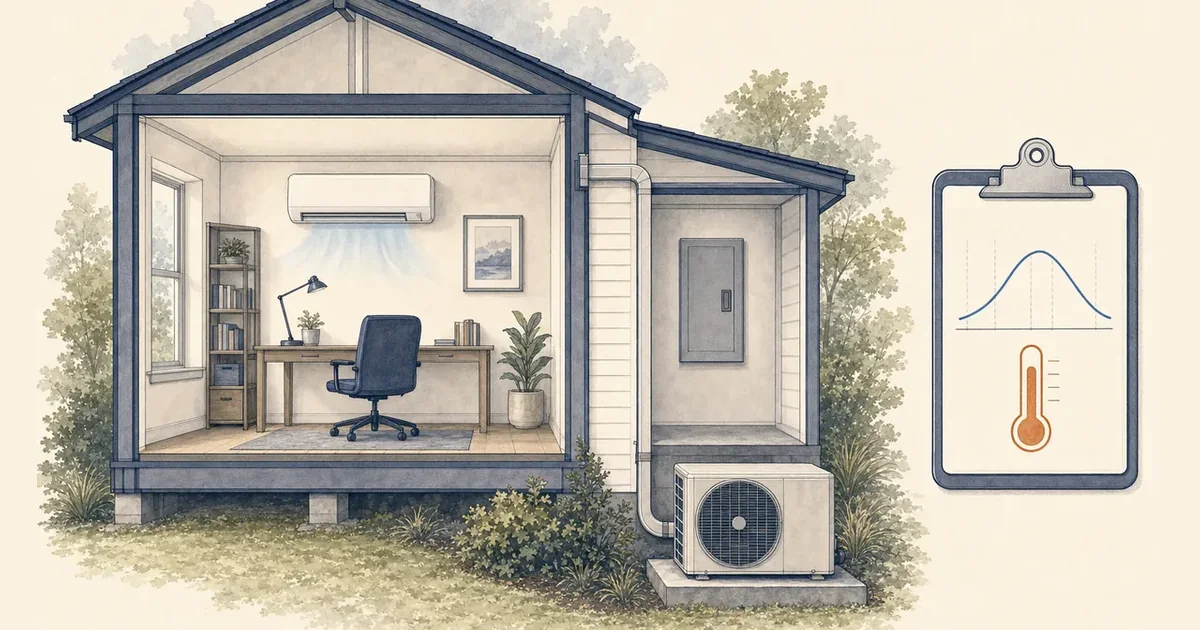
Current single-zone examples include 9,000 and 12,000 British thermal units per hour (Btu/h) of nominal cooling capacity. A single-zone system has one outdoor unit and one matched indoor head. Heat-pump versions provide heating as well as cooling.
Lower voltage does not mean an ordinary shared outlet is suitable. Daikin's outdoor instructions and MRCOOL's installation instructions require separate, dedicated supply circuits for the systems compared here. A 115V unit can still require a new circuit and professional electrical work.
Our ductless installation guide explains the wider job, including placement, drainage, refrigerant work and startup.
Size the room before choosing the voltage
Capacity is the rate at which a system moves heat. Voltage is an electrical supply requirement. Neither a voltage label nor a room-area claim establishes that a unit can keep your space comfortable.
A shaded, insulated bedroom and a garage with a sunlit door can have very different loads even when their floor areas match. Windows, ceiling height, insulation, air leakage, outdoor temperatures and moisture loads all affect equipment selection. Pacific Northwest National Laboratory's sizing guidance calls for heating and cooling load calculations for the space and selection of matched equipment.
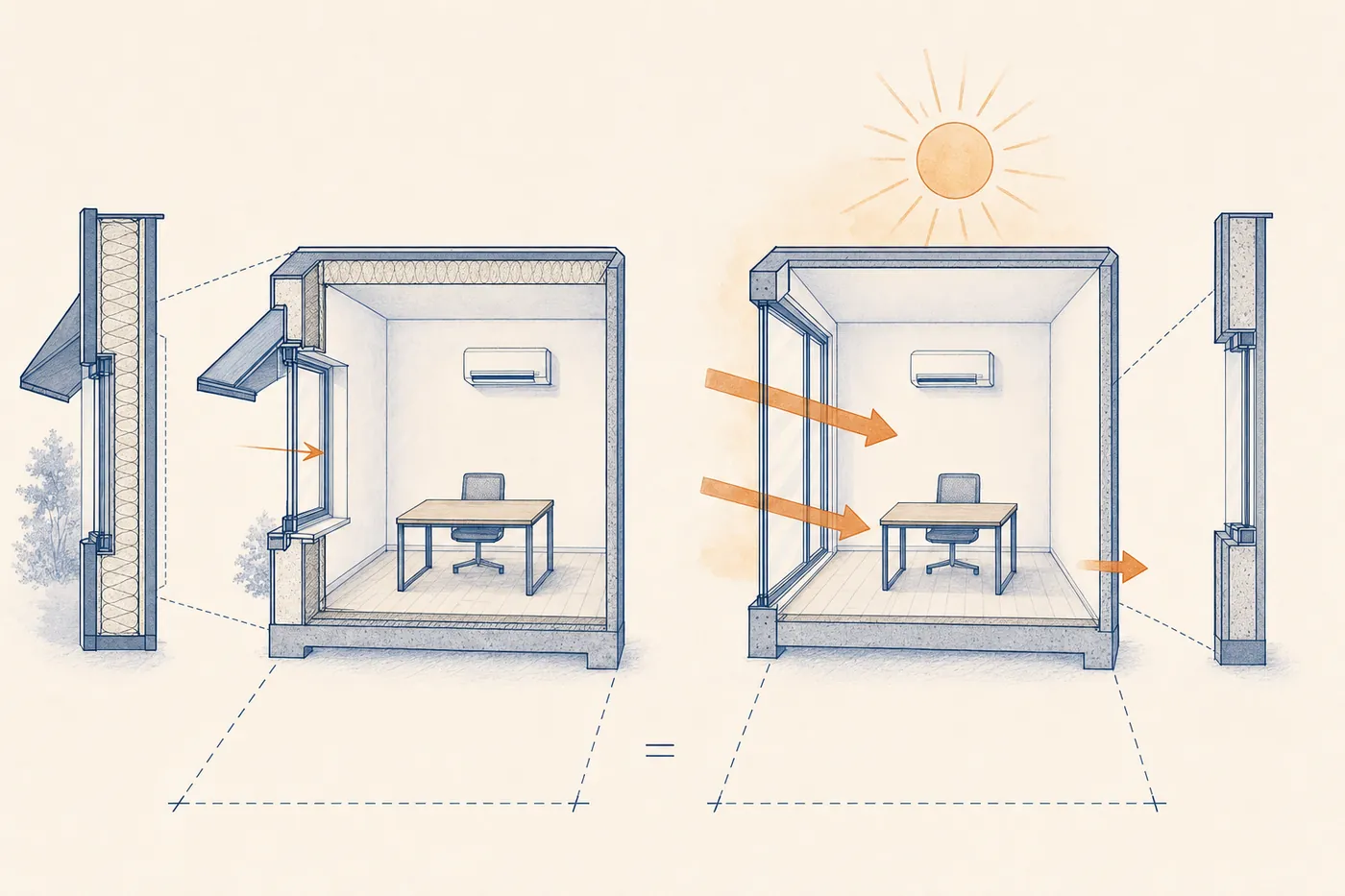
Simplified layout, not wiring instructions.
Have the installer put these details in the proposal:
- The space served: one room, an open zone or several separate rooms, including whether doors usually stay closed.
- The calculated heating and cooling loads: expressed in Btu/h, with the local outdoor design temperatures used.
- The system's role: supplemental comfort while existing heating, ventilation and air conditioning (HVAC) remains, or the room's sole heating and cooling source.
- The selected capacity range: both available output at demanding conditions and minimum output during mild weather.
A larger unit is not automatically safer. Oversizing can cause cycling and poor humidity control. Variable-speed equipment can reduce its output, but each model has a lower limit. A small room already served by central HVAC may need less added capacity than its square footage suggests.
The examples here establish that 9,000 and 12,000 Btu/h lower-voltage choices exist. They do not establish a universal largest 110V mini-split or a square-footage ceiling. If the room's calculated needs exceed the suitable lower-voltage options, the equipment search should include higher-voltage systems.
One indoor head also needs an airflow path to the space it serves. A high capacity rating does not solve closed-door room distribution. A multi-room project may need a different layout, which our ductless versus ducted comparison covers.
Winter heating needs its own capacity answer
“Heats down to −13°F” describes an operating-temperature limit. It does not say how much heat reaches the room at −13°F.
For example, the 115V Pioneer Quantum Ultra WYT009ALSI24RL pairs indoor unit WT009ALSI24HLG with outdoor unit YN009ALSI24RPG. Its matched-system submittal lists these heating figures:
- Nominal heating rating: 10,000 Btu/h
- 17°F outdoors: 8,000 Btu/h
- 5°F outdoors: 7,100 Btu/h
The same submittal lists a −13°F heating operating limit without a capacity figure at that temperature. Treating its 10,000 Btu/h nominal rating as output at −13°F would overstate the information available.
In a hypothetical room needing 8,000 Btu/h at a 5°F design temperature, the published 7,100 Btu/h figure is 900 Btu/h short. That comparison is a reason for the installer to document a different equipment choice or supplemental heat. It is not a prediction of this model's performance in every installation.
Northeast Energy Efficiency Partnerships' cold-climate selection guide uses manufacturer performance at local design conditions and distinguishes an isolated room from whole-home heating replacement. The proposal should state the capacity available at your design temperature, how defrost affects the heating plan, and what supplies any remaining load.
An ENERGY STAR Cold Climate designation adds another useful distinction. Its low-temperature performance requirements include efficiency and retained heating capacity at 5°F, plus controls verification. An operating-temperature endpoint alone does not establish that designation, and certification does not replace room sizing.
What circuit does a 110V mini-split need?
A dedicated circuit serves the specified equipment rather than sharing its supply with unrelated household loads. The installation's electrical requirements come from the exact matched system, its nameplate and instructions, and the locally adopted rules.
Two terms help you read an electrical scope:
- Minimum circuit ampacity (MCA): a circuit-design value the electrician uses when determining the required conductor capacity. It is not the unit's normal operating current or an estimate of its electricity use.
- Maximum overcurrent protection: the equipment's permitted upper limit for a fuse or circuit breaker, using the manufacturer's terminology. It is not permission to replace an existing breaker with a larger one.
These current 115V examples show why “all 110V mini-splits need a 15A breaker” is unreliable. Circuit values use A for amperes.
| System and exact indoor + outdoor pair | Nominal cooling | Outdoor MCA | Published breaker requirement or limit |
|---|---|---|---|
| Daikin OTERRA, FTXQ09ASBU9 + RXQ09ASBU9 | 9,000 Btu/h | 14.9A | 15A breaker size |
| MRCOOL Advantage 5th Gen, A-09-HP-WMAH-115D-O + A-09-HP-C-115D-O | 9,000 Btu/h | 18A | 20A maximum fuse/breaker |
| MRCOOL Advantage 5th Gen, A-12-HP-WMAH-115D-O + A-12-HP-C-115D-O | 12,000 Btu/h | 19A | 20A maximum fuse/breaker |
Daikin's residential catalog lists its matched pair, cooling capacity and MCA; its official OTERRA 115V flyer specifies a 15A breaker size. MRCOOL's 9k condenser specifications and 12k condenser specifications give the outdoor circuit values; its paired-system brochure lists the matched indoor and outdoor units.
The table distinguishes Daikin's specified breaker size from MRCOOL's maximum fuse/breaker limits. It is not a breaker or wire-sizing recipe. Other models and generations can have different requirements, even at the same voltage and nominal capacity.
The installer and electrician should document the permitted supply, dedicated circuit, disconnect, grounding, and any required ground-fault protection. They also determine whether an existing circuit is suitable, including its condition and route. A nearby receptacle or a breaker with a familiar number does not settle that question.
Keep wiring, circuit changes and panel work with a licensed professional authorized for that scope. Do not use an extension cord, power strip or adapter to substitute for the specified supply. The Daikin outdoor manual and MRCOOL installation manual prohibit shared supply and extension cords for these examples. Any model marketed as plug-in still needs a manufacturer-approved connection and an installation that satisfies local requirements.
Does 115V mean you can avoid a panel upgrade?
Sometimes a suitable lower-voltage system can reduce a particular project's electrical changes. It cannot guarantee that the panel or service needs no work.
There are three separate questions:
- Equipment compatibility: does the available supply match this model's permitted voltage?
- Branch-circuit suitability: can an existing dedicated circuit serve it, or is a new circuit needed?
- Panel and service capacity: can the home's electrical system support the added equipment alongside other loads?
An empty breaker position answers none of those questions by itself. The U.S. Department of Energy's electrical assessment guidance covers panel capabilities and electrical-load and service-capacity needs when adding appliance circuits. The practical implication is that voltage alone cannot establish whether an upgrade is necessary.
Have the electrical assessment account for existing loads and planned additions, such as an electric vehicle charger or electric water heater. The written quote should distinguish a new branch circuit, panel modifications and a service upgrade instead of treating them as one vague allowance. Our electrical panel guide explains those project differences.
115V versus 208–230V: compare the whole installation
In shopping conversations, the higher-voltage class may be called 220V, 230V or 240V. The exact equipment rating still controls; those labels are not blanket permission to connect a unit to any higher-voltage supply.
A same-capacity example makes the current tradeoff concrete. MRCOOL's 115V condenser specifications and 208–230V condenser specifications give these circuit values for its Advantage 5th Gen 9,000 Btu/h systems:
| Exact outdoor model | Supply | Outdoor MCA | Maximum fuse/breaker |
|---|---|---|---|
| A-09-HP-C-115D-O, paired with A-09-HP-WMAH-115D-O | 115V | 18A | 20A |
| A-09-HP-C-230D-O, paired with A-09-HP-WMAH-230D-O | 208–230V | 12A | 15A |
Both have nominal cooling of 9,000 Btu/h and nominal heating of 10,000 Btu/h. The higher-voltage version has a lower MCA in this comparison. That does not mean it uses less energy: circuit-design amperes and billed kilowatt-hours measure different things.
Voltage alone also does not determine seasonal efficiency. These two systems have published Seasonal Energy Efficiency Ratio 2 (SEER2) ratings of 21.5 for the 115V version and 21.2 for the 208–230V version. MRCOOL's paired-system ratings list both exact pairs, capacities and efficiency figures, which agree with the model-specific condenser specifications. Those are equipment ratings, not a forecast of either system's bill in your room.
We would keep a 115V option in the comparison when it meets the room's loads, winter requirements and electrical assessment. We would broaden the search to 208–230V equipment when the project needs a different capacity, configuration or low-temperature performance. Neither voltage deserves an automatic preference.
Request comparable installed prices that include equipment, electrical work, line-set and drain routing, outdoor support, permits, commissioning and finish repairs. If both options need a new circuit, the lower-voltage label alone does not establish a labor saving. If one quote assumes reuse of a circuit, the professional assessment and the price if reuse is unsuitable belong in writing.
Permits still matter at lower voltage
A 115V label does not establish a permit exemption. Mechanical and electrical requirements depend on the jurisdiction and scope.
For example, Portland's permit rules list mini-split systems among projects requiring a residential mechanical permit and say most mechanical-equipment projects also need an electrical permit. That is a local example, not a nationwide permit package.
The contract should assign permit applications, required inspections, corrections and closeout to the appropriate parties. It should also account for outdoor-unit placement, drainage and any local siting restrictions. Our mini-split permit guide explains the planning questions without assuming the same rules apply everywhere.
Questions to put to your licensed installer
Before buying equipment, ask for written answers to these six questions:
- Which exact indoor and outdoor models are included? The proposal should identify the matched pair, supply voltage and manufacturer documents used for selection.
- What are this room's heating and cooling loads? Include design temperatures, insulation and window assumptions, and the contribution of existing HVAC.
- What heating output is available at our winter design temperature? Include the supplemental-heat plan where output is insufficient.
- What electrical work is included? Identify the dedicated circuit, model-specific circuit ratings, disconnect and protection requirements, responsible licensed professional, and panel/service assessment.
- Who owns permits and startup? Include inspections, corrections, commissioning, warranty documentation and homeowner handoff.
- What could change the price? Name assumptions about circuit reuse, panel work, routing, drainage, outdoor support and finish repairs.
A 110V mini-split fits when the room, climate and electrical scope all support the exact model. Use our contractor question checklist to turn that fit into a written installation proposal.