Last reviewed: October 29, 2026
What is an air-to-water heat pump?
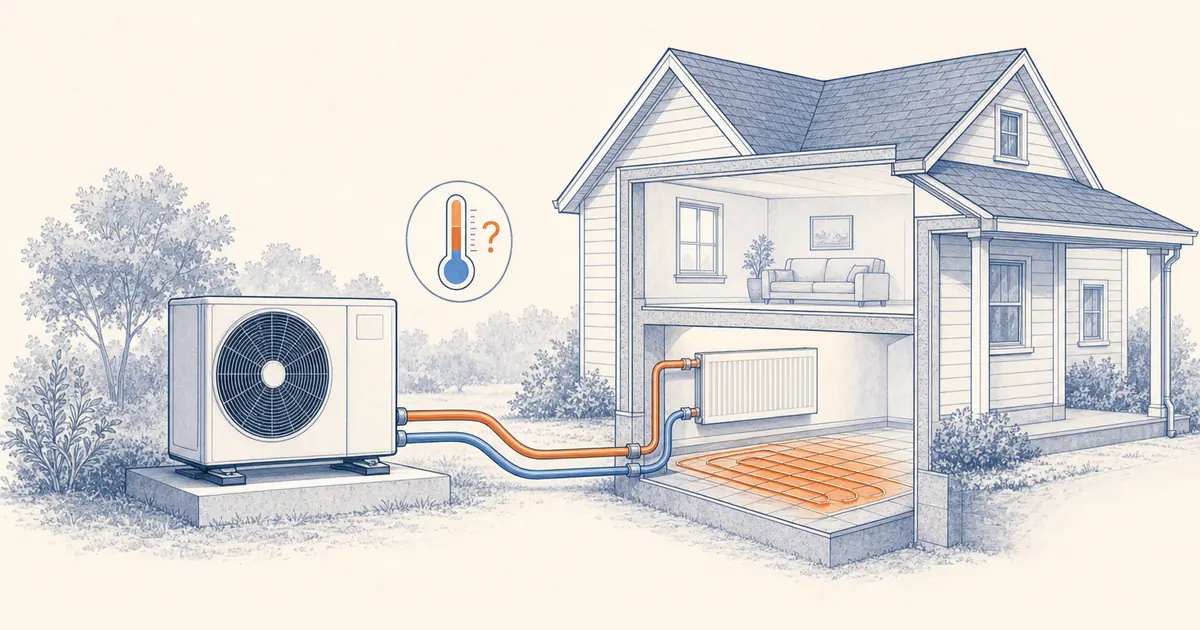
An air-to-water heat pump collects heat from outdoor air and transfers it through a refrigerant-to-water heat exchanger. Pumps circulate the heated water, or a water-and-antifreeze mixture, through a closed hydronic loop. Radiant floors, panel radiators, hot-water baseboards, or hydronic air handlers release that heat into rooms.
The distinction is the distribution system:
| System | Where the heat goes | What it can replace |
|---|---|---|
| Air-to-water heat pump | A hydronic fluid loop serving room emitters | Some or all boiler space heating, with a compatible design |
| Air-to-air heat pump | Indoor air through ducts or room units | Furnace heating and air conditioning |
| Standalone heat-pump water heater | A tank of domestic water | Water heating for showers, sinks, and appliances |
Electric resistance baseboards have no circulating-water loop to reuse. Steam radiators also require a different conversion project. Our home heat-pump guide covers ducted and ductless alternatives when hydronic distribution is absent or expensive to adapt.
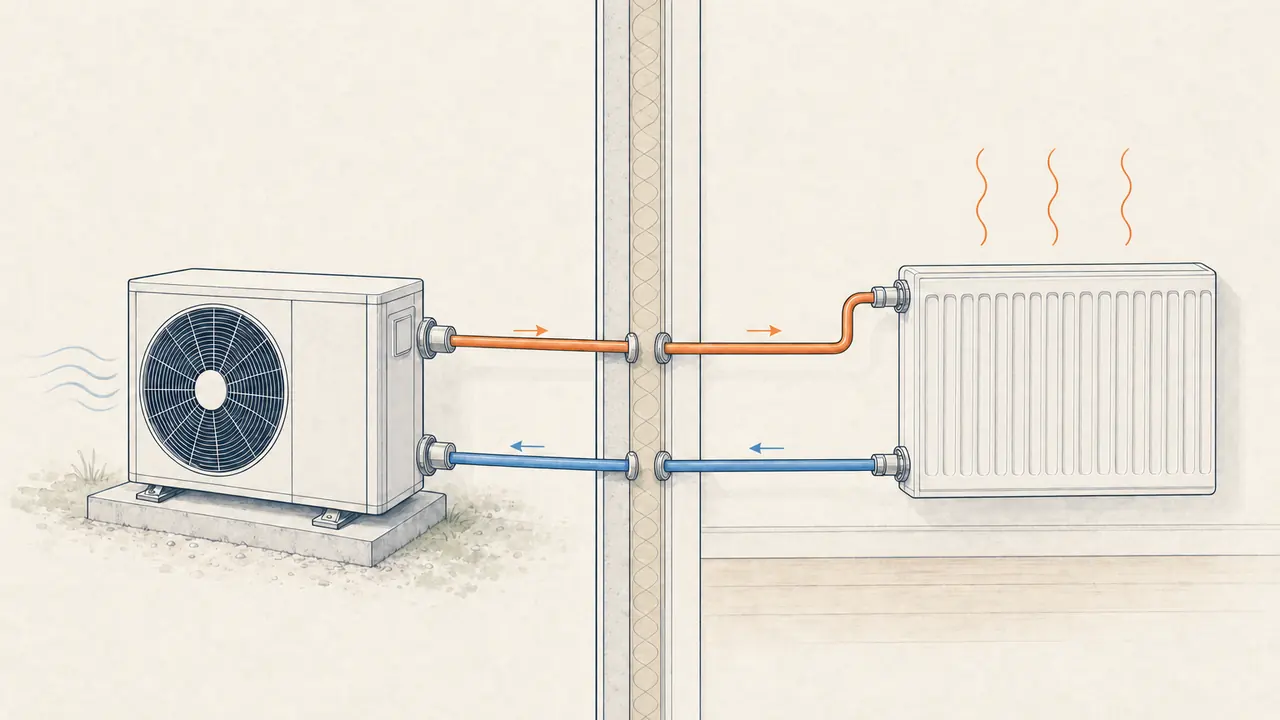
Simplified layout, not wiring instructions.
Monobloc versus split systems
A monobloc keeps the refrigerant circuit and refrigerant-to-water heat exchanger outdoors. Hydronic supply and return pipes enter the house. A split system connects outdoor refrigerant equipment to an indoor heat exchanger.
That choice changes installation and freeze protection. A factory-sealed monobloc can avoid field refrigerant connections, yet still needs hydronic, electrical, and control work. Its outdoor water circuit needs a manufacturer-approved freeze-protection design that remains effective during an equipment failure or power outage. Insulation and powered circulation alone do not protect water indefinitely when power is unavailable.
Is your home a good fit?
We favor air-to-water when preserving usable hydronic distribution is worth the project cost and a local team can design and service the complete system.
| Home situation | Decision implication |
|---|---|
| Low-temperature radiant floors or generously sized hot-water radiators | A promising starting point, subject to room-by-room heat output |
| Older fin-tube baseboards or radiators using high-temperature boiler water | Emitter upgrades, weatherization, or a hybrid design may be necessary |
| A sound boiler with expensive fuel | A heat pump can serve part of the load while the boiler remains available |
| No hydronic piping, or existing ducts already suited to heating and cooling | Include an air-to-air proposal in the comparison |
| New construction or major renovation | Low-temperature emitters and piping can be designed together from the start |
Outdoor equipment needs airflow, snow clearance, a suitable base, defrost-water drainage, and separation from bedrooms or neighbors where sound matters. Indoors, tanks, pumps, valves, and service access take space. An outdoor unit that fits beside the house does not establish that the complete system fits.
Can the heat pump reuse your radiators or baseboards?
Often, but compatibility is a heat-output calculation. A radiator that heats a room with 180°F boiler water can deliver much less heat with cooler water. Raising the heat pump's water temperature also changes its capacity and efficiency.
The designer needs a room-by-room heat-loss calculation, using a recognized residential method such as the Air Conditioning Contractors of America's Manual J method, plus emitter output at the proposed supply and return temperatures, flow, and indoor temperature. Planned insulation and air sealing belong in those load assumptions.
| Existing emitter | What the design must establish |
|---|---|
| Radiant floor | Output with the actual tubing, floor construction, coverings, and allowable surface temperature |
| Cast-iron or panel radiator | Output from its size and rating data at the proposed lower water temperature |
| Fin-tube baseboard | Output per foot at the proposed average water temperature and flow, then total usable length in each room |
| Hydronic fan coil or air handler | Heating output at the selected water temperature, flow, and fan speed; cooling output if included |
A room-level example: suppose a bedroom needs 6,000 British thermal units per hour (Btu/h) on the design winter day, while its existing emitter provides 4,000 Btu/h at the proposed water temperature. The 2,000 Btu/h shortfall remains even if the outdoor unit has plenty of capacity. More emitter area, a suitable fan-assisted emitter, lower room heat loss, or a separately designed heat source must close that gap.
The proposal should name which emitters stay, which change, and the water temperature needed in the hardest-to-heat room. A blanket “works with existing radiators” statement leaves the main retrofit risk unresolved.
Winter performance needs two temperatures
Air-to-water sizing depends on outdoor air temperature and supply-water temperature together. “Operates to -22°F” describes an operating boundary. “Produces 140°F water” describes another capability. Neither establishes how much heat the exact model delivers, or how much electricity it consumes, at your home's required combination.
Require a winter design schedule containing:
- The local outdoor design temperature and chosen indoor temperature.
- The home's calculated heat loss in Btu/h at that condition.
- Required supply and return water temperatures.
- Exact-model heating capacity and electrical input at those conditions, with fluid and flow assumptions.
- How the performance estimate accounts for defrost and system accessories.
Coefficient of performance, or COP, is heat delivered divided by electrical energy consumed. A COP of 3 means three units of heat for each unit of electricity at the stated conditions. One favorable test point cannot stand in for a winter or annual average.
For an illustrative design, a home needing 40,000 Btu/h at 5°F has an 8,000 Btu/h gap if its selected heat pump supplies 32,000 Btu/h at 5°F air and 125°F water. A nominal 48,000 Btu/h rating at milder conditions does not close that gap.
Backup heat is part of the design
Backup may be an electric boiler or resistance heater, a retained fuel boiler, or another coordinated heating system. Its role can be supplemental heat during peak demand, full emergency heat after a heat-pump failure, or both. Those roles require different capacities.
The thermal balance point is the outdoor condition where heat-pump capacity meets the home's heating load. Below it, supplemental heat may be needed. A fuel-price-based switchover can occur at a different temperature. The control schedule should state when each heat source runs, whether they can run together, and how defrost and domestic water heating affect operation.
Electric backup belongs in both the electrical load calculation and the running-cost forecast. A retained gas or oil boiler normally still needs electricity for controls and circulation, so it is not automatically an outage-heating solution.
Mild weather matters too
The heat pump's minimum output can exceed the demand of one small open zone. The hydronic design must maintain the model's minimum flow and water volume as zone valves close. A buffer tank can help some systems avoid frequent starts and stops; it is not a mandatory component of every installation.
Outdoor reset control lowers the target water temperature as weather becomes milder. The installer should set its curve around the actual emitters rather than hold the system at its coldest-day temperature all season.
Cooling and domestic hot water are separate scope choices
Cooling requires suitable indoor equipment
A reversible air-to-water heat pump can produce chilled water. Existing heating radiators and baseboards do not thereby become a complete air-conditioning system.
Hydronic fan coils or air handlers can provide cooling and moisture removal when designed with appropriate coils, airflow, condensate drains, and insulated piping. Radiant cooling needs surface-temperature and dew-point control, plus a way to manage indoor humidity. Dew point is the temperature at which moisture condenses on a surface. Cold floors and exposed chilled-water pipes can become wet if the design ignores it. The Department of Energy's radiant-system field research documents this condensation and dehumidification constraint.
A heating-only conversion can leave existing air conditioning in place. If cooling is included, its room coverage, humidity control, drains, piping insulation, and controls belong in the price.
Domestic hot water needs its own storage and controls
Some systems can heat an indirect domestic-hot-water tank. The closed heating loop transfers heat through a coil or heat exchanger; its fluid remains separate from water used at faucets.
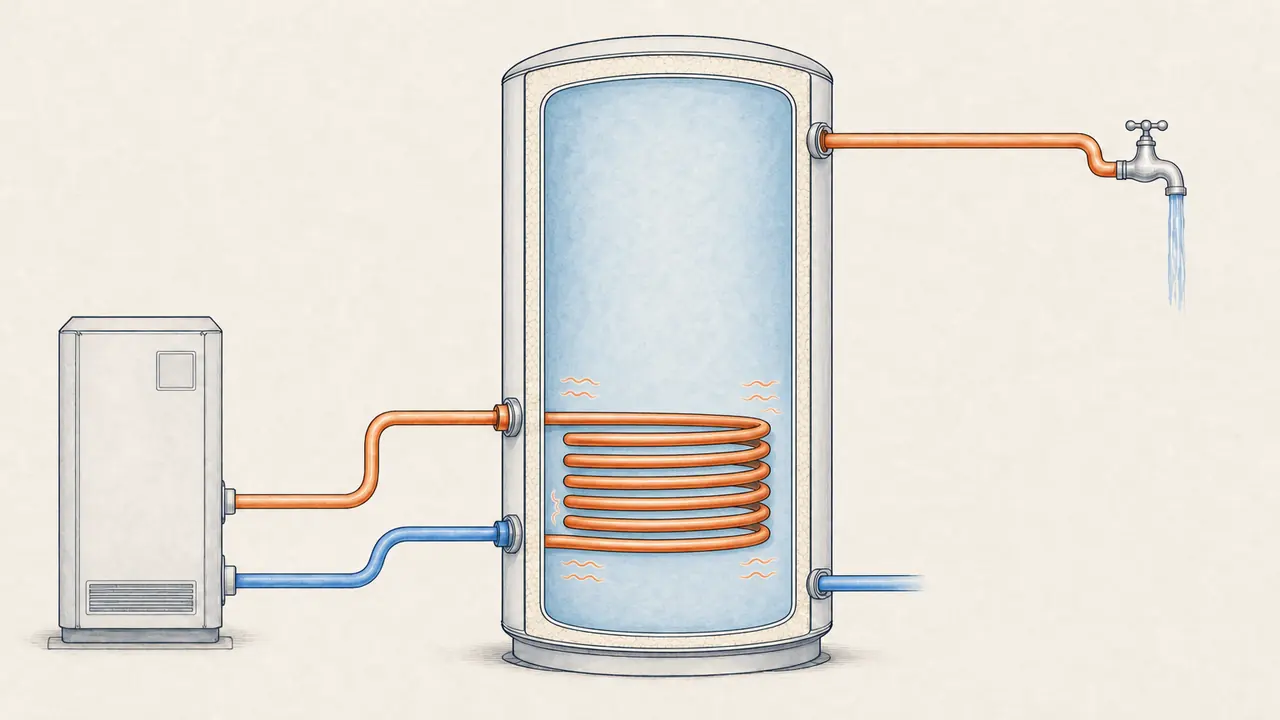
Simplified layout, not wiring instructions.
The design needs a compatible tank and heat exchanger, recovery capacity for the household's peak demand, valves, controls, and any temperature-boost equipment. It also needs a professional plan for safe storage temperatures, hygiene, and scald protection.
Domestic-hot-water priority can temporarily divert heat-pump output away from space heating or cooling. A proposal should explain that behavior on a cold morning when showers and room heating overlap. “Hot-water preheat” supplies part of the water-heating load and can retain another appliance to finish the job.
A separate heat-pump water heater is another route. Include that option when integrating domestic water would complicate an otherwise useful space-heating retrofit.
What does an air-to-water heat pump cost to install?
The outdoor-unit price leaves out much of a hydronic retrofit. A useful budget comes from complete local proposals with the same heating, cooling, hot-water, and backup scope.
For a dated U.S. reference, the Center for Energy and Environment's Minnesota installation study reported these four projects installed between November 2021 and April 2022. Its equipment/labor breakdown shows how scope changes the total:
| Historical project scope | Equipment | Labor | Installed total |
|---|---|---|---|
| Heating only, site 1 | $14,508 | $4,276 | $18,784 |
| Heating only, site 2 | $12,086 | $2,859 | $14,945 |
| Heating, cooling, and hot-water preheat, site 3 | $33,229 | $7,931 | $41,160 |
| Heating and cooling, site 4 | $32,469 | $7,516 | $39,985 |
These are four historical projects, not a current national price range. The study did not obtain competing bids at each site, and different equipment and distribution work contributed to the totals.
Require these installation line items
| Cost category | What belongs in the proposal |
|---|---|
| Design | Heat-loss calculation, emitter schedule, hydronic layout, and winter performance selection |
| Heat-pump equipment | Exact outdoor and indoor models, controls, freight, and handling |
| Hydronic work | Piping, pumps, valves, air/dirt separation, expansion and safety equipment, buffer or isolation heat exchanger where needed |
| Emitters | Reused equipment, replacements, added radiators or fan coils, and room restoration |
| Freeze protection | Approved fluid, concentration, insulation, and outage strategy |
| Electrical | Load calculation, circuits, disconnects, backup-heat supply, and any necessary service work |
| Outdoor placement | Base or footing, snow clearance, drainage, access, and sound-related placement |
| Optional loads | Cooling drains and pipe insulation; domestic-water tank, valving, boost heat, and controls |
| Backup and removal | Retained-system integration or new backup; old equipment, fuel-system, and venting work |
| Completion | Trade labor, any required permits and inspections, commissioning, warranty registration, and homeowner handoff |
A panel upgrade is not automatic. Its need follows the electrical load calculation, including backup heat and other household loads.
Compare the heat-pump project with the replacement you would otherwise buy: a boiler alone, a boiler plus air conditioning, or a boiler plus cooling and water heating. Our boiler replacement guide helps separate a necessary replacement from an early elective upgrade. Charging the heat pump with three services while pricing the alternative for heating alone distorts the comparison.
Keep gross installed price, incentives, financing charges, and projected annual savings on separate lines. For equipment placed in service in 2026, the federal Section 25C Energy Efficient Home Improvement Credit is unavailable under the IRS credit termination rules. State or utility incentives have their own equipment, contractor, income, and reservation requirements; a generic heat-pump rebate amount does not establish air-to-water eligibility.
Compare running costs on equal delivered heat
We compare the same annual heating service across fuels. A seasonal system COP uses total delivered heat and total electricity over the season, including the equipment within its stated boundary. It should reflect local weather, water temperatures, defrost, circulation, standby use, and electric backup rather than a brochure's peak COP. Electricity is measured in kilowatt-hours (kWh).
The basic calculations are:
Heat-pump electricity = annual delivered heat in kWh / seasonal system COP
Fuel use = annual delivered heat in Btu / (Btu per fuel unit × seasonal heating efficiency)
Use efficiency as a decimal, such as 0.90 for 90%, then multiply the resulting electricity or fuel use by the applicable price. The U.S. Energy Information Administration's fuel conversion factors give 3,412 Btu per kWh, 100,000 Btu per therm, 91,452 Btu per gallon of propane, and 138,500 Btu per gallon of heating oil.
An illustrative annual heating comparison
Assume 60 million Btu of delivered heat per year, about 17,585 kWh of heat. The prices and efficiencies below are planning assumptions, not national averages or equipment predictions. Costs cover heating energy only and are rounded to the nearest dollar.
| Heating system | Assumed price and performance | Annual energy cost |
|---|---|---|
| Air-to-water heat pump | $0.20/kWh; seasonal system COP 3.0 | $1,172 |
| Air-to-water heat pump | $0.20/kWh; seasonal system COP 2.0 | $1,758 |
| Electric resistance | $0.20/kWh; heat/electricity ratio 1.0 | $3,517 |
| Natural-gas boiler | $1.50/therm; 90% seasonal efficiency | $1,000 |
| Propane boiler | $3.00/gallon; 85% seasonal efficiency | $2,316 |
| Oil boiler | $4.00/gallon; 85% seasonal efficiency | $2,039 |
At these assumptions, the COP-3 heat pump saves about $866 against oil and $1,143 against propane, while costing about $172 more than gas. Savings use unrounded calculations, explaining the $1 difference from subtracting the displayed rounded totals. The gas break-even seasonal system COP is about 3.517 (roughly 3.52). Changing either energy price changes that threshold.
Backup can materially change the result. In a simplified case where the heat pump delivers 90% of the annual heat at COP 3 and resistance backup supplies 10% at COP 1, blended electricity costs about $1,407 at $0.20/kWh before any additional loads excluded from those COPs. Ten percent refers to heat delivered, not operating hours.
Our electricity-cost guide explains rate and billing boundaries. An air-to-water forecast also needs its hydronic water-temperature assumptions. Time-of-use prices must follow when the system actually runs.
For the full ownership comparison, add cooling and domestic-water energy consistently, maintenance, financing, and any fixed charges that change. Retaining gas for backup usually retains the gas customer charge. Removing the last gas appliance may eliminate it. Annual heating cost divided by twelve is a budget average, not a prediction of each winter bill.
How to evaluate local equipment and installer proposals
U.S.-market equipment exists. A product page or online price does not establish local stock, service coverage, or a design suited to your home. We put the installer-and-system proposal ahead of a brand ranking.
Require a comparable equipment data package
The package should identify the exact model and U.S. configuration, refrigerant, voltage, included components, installation manual, and applicable safety listing. Performance tables should state outdoor air temperature, leaving and entering water temperatures, fluid, flow, capacity, and electrical input.
Ratings need the same conditions and system boundary to be comparable. The Air-Conditioning, Heating, and Refrigeration Institute's water-package rating standard includes air-to-water heat pumps within its scope. That does not establish a certificate or equivalent seasonal heating score for every residential model. A proposal should identify the actual certification, covered mode, and test conditions. A cooling certificate alone does not demonstrate winter heating output.
Require a local service and completion plan
- Hydronic experience: completed projects using similar emitters and climate conditions, plus responsibility for the load, piping, and controls design.
- Availability: named supplier, equipment lead time, replacement-parts channel, and a local service contact after installation.
- Qualified trades: verified trade licensing for the work performed, appropriate insurance, and assigned responsibility for any permits and inspections required by the local authority having jurisdiction. The U.S. Environmental Protection Agency's refrigerant certification requirements apply to work that can open the refrigerant circuit and release refrigerant; a sealed outdoor circuit does not waive other trade requirements.
- Written warranty: exact-model parts and compressor terms, labor coverage, registration or contractor conditions, exclusions, and who handles a claim.
- Commissioning record: measured flow, supply/return temperatures, fluid protection, zone operation, backup staging, and applicable cooling drainage and domestic-water controls. Include documented settings and alarm responses.
- Handoff: operating instructions, maintenance responsibilities, emergency contact, and a cold-weather follow-up when startup weather cannot demonstrate design-day behavior.
A proposal with a low price and no emitter calculation is incomplete. So is one promising savings without seasonal performance, local rates, or backup use. Clear exclusions are useful; missing responsibilities become change orders.
Choose the replacement path before signing
An air-to-water project earns its place when it can heat every room at an achievable water temperature, cover winter demand with an explicit backup plan, and justify its complete cost against the alternative. Cooling and hot water can add value when their equipment and controls are included from the start.
Once the design and gross price are clear, browse our incentives to find the location-based programs that may support your upgrade.