Last reviewed: October 30, 2026 (Pacific time)
What a bidirectional EV charger does
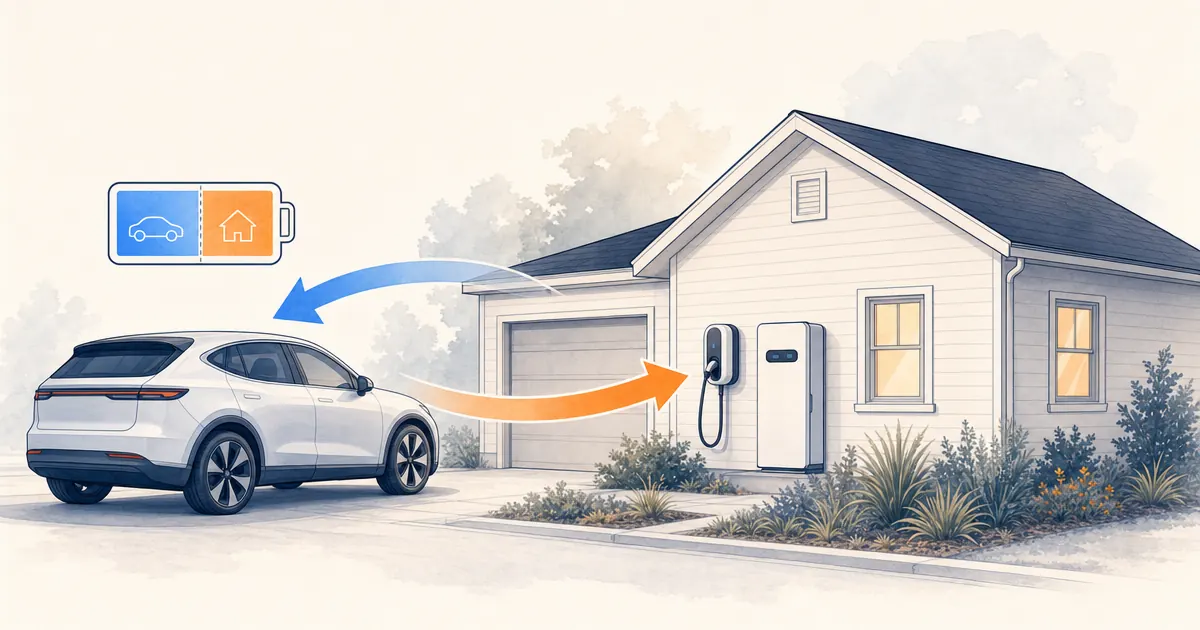
A bidirectional EV charger supports two-way electricity flow into an EV battery and back out through compatible equipment. A standard home charger sends electricity toward the vehicle only. Two-way power needs support from the vehicle and the rest of the system, so adding a charger cannot give an unsupported car home-backup capability.
Three terms describe different jobs:
| Capability | What it powers | What the homeowner needs |
|---|---|---|
| Vehicle-to-load (V2L) | Individual devices through vehicle outlets or a supported adapter | A vehicle with the relevant outlet or adapter capability, within its output limits |
| Vehicle-to-home (V2H) | Home circuits, including outage backup when the system supports it | A compatible vehicle, charging equipment, home controls, and approved backup design |
| Vehicle-to-grid (V2G) | The operating utility grid | Export-capable equipment, utility-approved interconnection, and an eligible program for paid participation |
Vehicle-to-everything (V2X) is an umbrella term. It does not establish which of these jobs a particular system can perform. The Department of Energy distinguishes building backup from grid-connected power export, which brings additional utility requirements.
V2L can be enough for a few portable devices. It does not establish that a vehicle can power a home electrical panel. Likewise, a V2H installation does not automatically qualify for V2G payments.
Home backup requires safe separation from the grid
During an outage, a home-backup system must isolate its backed-up circuits from the utility before supplying them from the EV. That separation prevents power from flowing onto utility lines. Tesla's isolation and interconnection requirements, for example, prohibit bypassing the Gateway relay. The required controls may be called a gateway, home hub, transfer device, or islanding controller, depending on the system.
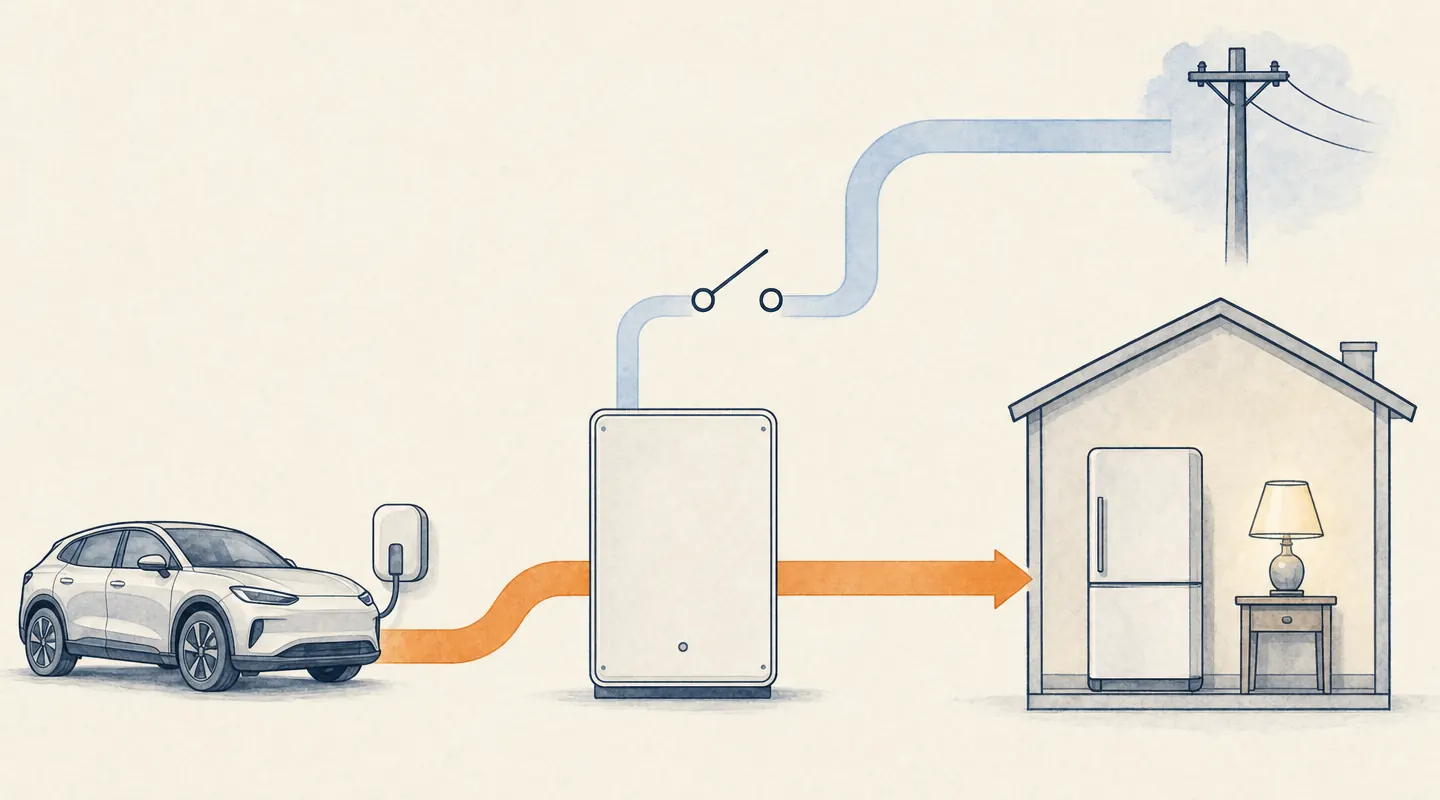
Simplified layout, not wiring instructions.
A qualified installer designs and installs that arrangement, following the equipment's professional installation requirements and local approvals. Never improvise outlet-based backfeeding to send vehicle power into home wiring through a household receptacle. This warning concerns reverse power into the house; ordinary Level 1 charging draws power from an outlet toward the car.
The distinction between AC and DC architectures concerns where battery direct current (DC) becomes household alternating current (AC). An AC system uses a compatible vehicle's onboard inverter. A DC system uses external conversion equipment. Neither approach makes compatibility universal. Connector fit, charging speed, and support for a communications standard are insufficient on their own.
Ordinary EV charger load management solves a separate problem: controlling how much electricity charging draws from the home. It does not create reverse power flow or outage backup.
Which vehicle and home-equipment combinations work?
The useful buying unit is the complete system. Its eligibility depends on the exact vehicle, model year, trim, software, home equipment, and market. These U.S. examples show why “bidirectional-ready” is too broad a purchase specification.
GM Energy: selected GM EVs with a dedicated V2H kit
GM's arrangement pairs an eligible EV with the PowerShift Charger and V2H Enablement Kit. The V2H Enablement Kit includes the home hub, inverter, and dark-start battery needed for its backup system, with up to 9.6 kilowatts (kW) of backup output.
GM's model-year eligibility list identifies these vehicle families:
| Listed vehicle family | Listed model years |
|---|---|
| Chevrolet Bolt EV | 2027 |
| Chevrolet Blazer EV | 2024, 2025, 2026, 2027 |
| Chevrolet Equinox EV | 2024, 2025, 2026, 2027 |
| Chevrolet Silverado EV | 2024, 2025, 2026, 2027 |
| GMC HUMMER EV SUV | 2026, 2027 |
| GMC HUMMER EV SUT (pickup) | 2026, 2027 |
| GMC Sierra EV | 2024, 2025, 2026, 2027 |
| Cadillac CELESTIQ | 2026, 2027 |
| Cadillac VISTIQ | 2026, 2027 |
| Cadillac ESCALADE IQ | 2025, 2026, 2027 |
| Cadillac OPTIQ | 2025, 2026, 2027 |
| Cadillac LYRIQ | 2024, 2025, 2026, 2027 |
The list names vehicle families and does not establish eligibility for every trim. Hardware, operating-system versions, and software affect capability. Some eligible 2024 vehicles require a dealer or over-the-air update, a caveat GM flags on its 2024 Blazer EV and LYRIQ entries. The Home Hub's service/disconnect rating limit is 200 amps.
All 2027 GM EVs use native North American Charging Standard (NACS) ports. With the PowerShift system, these vehicles need two separately sold adapters: a GM PowerShift AC Charging Adapter for home charging and a GM CCS1 DC Adapter for residential V2H discharge. The charging adapter alone does not enable home backup.
The equipment has current retail listings. Listed manufacturer's suggested retail price (MSRP) is $1,999 for the charger and $6,999 for the kit, or $8,998 for the charger plus kit only. That base-pair price excludes the separately sold adapters, any other required equipment, installation, taxes, and fees. A listing does not guarantee delivery stock. This pairing is home-backup equipment, without a general V2G-payment promise.
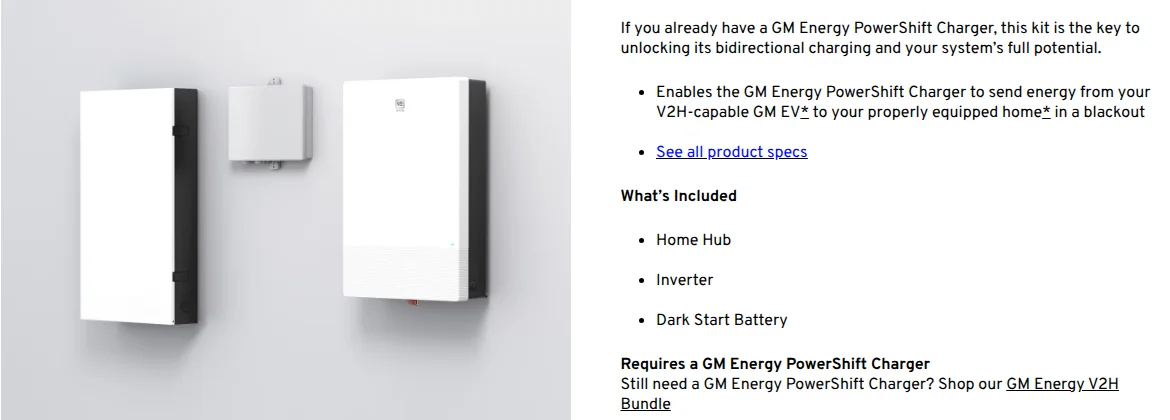
Tesla Powershare: Cybertruck and Powerwall configurations differ
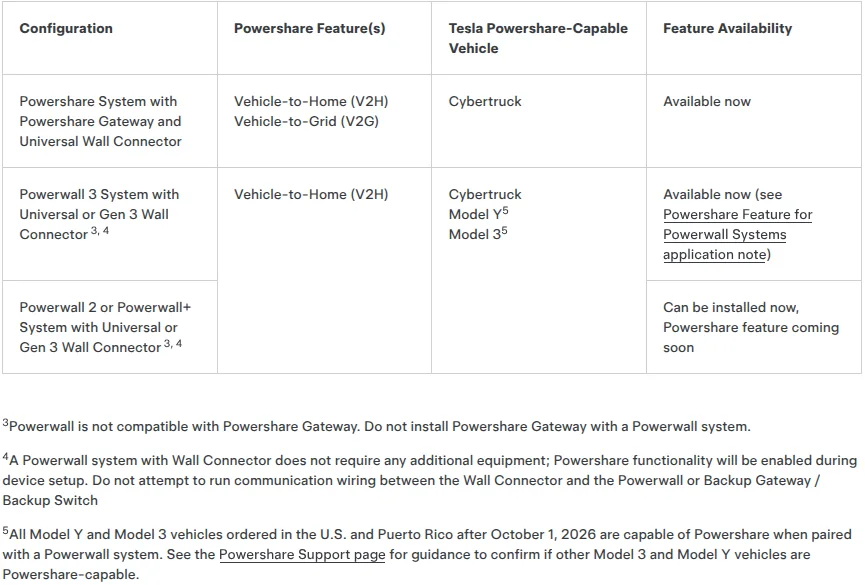
Tesla's system configuration manual lists Cybertruck, Powershare Gateway, and Universal Wall Connector for home backup and grid support. Backup output is up to 11.5 kW. The Cybertruck hardware bundle is listed at $1,970, excluding professional installation, and is out of stock. Its installation guidance specifies a panel rating below 225 amps and parking within 20 feet of the installation location.
A separate Powerwall 3 configuration uses Powerwall 3 with a Universal or Gen 3 Wall Connector for V2H with Cybertruck and eligible Model 3 or Model Y vehicles. All Model 3 and Model Y vehicles ordered in the U.S. or Puerto Rico after October 1, 2026 are capable of Powershare when paired with the specified Powerwall system. Earlier vehicles have individual eligibility requirements. The $1,970 Cybertruck bundle is not a price for a new Powerwall 3 installation.
Powerwall 2 and Powerwall+ configurations have Powershare functionality described as coming soon. Tesla's grid-support program is invitation-only and limited by utility and region. Home-backup capability does not establish enrollment or earnings.
Wallbox Quasar 2: 2024/2025 Kia EV9 eligibility and a stock conflict
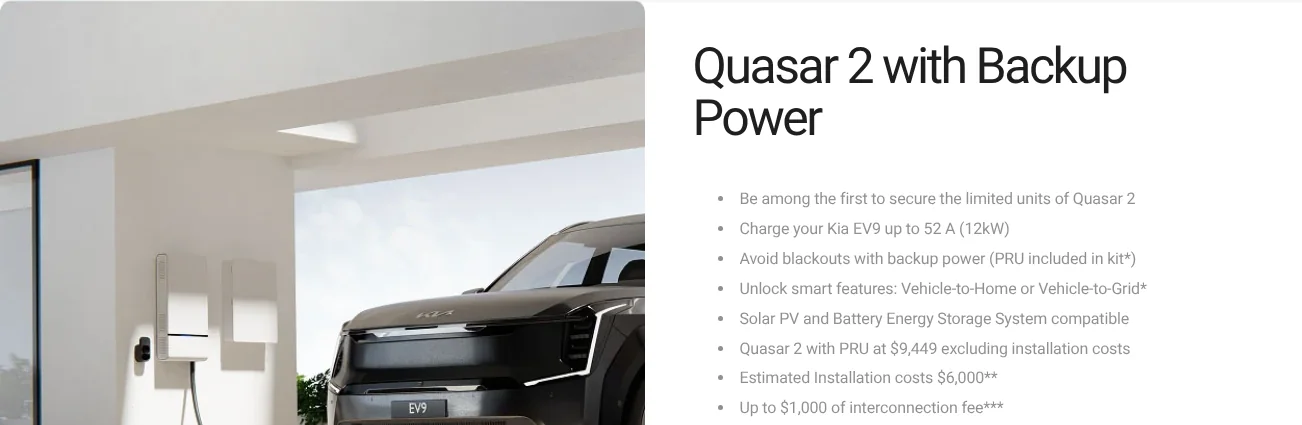
Kia's Vehicle to Home requirements currently list 2024 and 2025 EV9 model years. The feature requires activation through the Kia Connect Store and a Kia Connect subscription; complimentary subscriptions may omit features. Availability varies by model year and trim. Kia also warns service may be unavailable for vehicles purchased or sold in Massachusetts. The purchase file needs confirmation for the exact vehicle identification number (VIN) and trim, regional Kia Connect eligibility, feature activation, and subscription coverage. This does not establish eligibility for every EV9.
Wallbox offers an order and home-fit request for EV9 owners and lessees. Its backup arrangement requires Quasar 2 plus the Power Recovery Unit (PRU) and home electrical service no greater than 200 amps. Quasar 2 uses the Combined Charging System type 1 (CCS1) connector, but charging compatibility is broader than approved bidirectional support. Another car's CCS1 port does not establish home-backup eligibility. These listings also do not establish Kia V2G-program eligibility.
The official availability statements conflict. Kia's blackout-backup equipment disclaimer says the required PRU is unavailable for purchase. Wallbox's PRU-inclusive hardware package is listed at $9,449 before installation, labeled “in stock, ready to ship.” That package price is neither an installed quote nor confirmation that a complete working backup system can be fulfilled. An order or home-fit request does not resolve the conflict or guarantee delivery.
Ford and Sunrun: a legacy pairing for existing Lightning owners
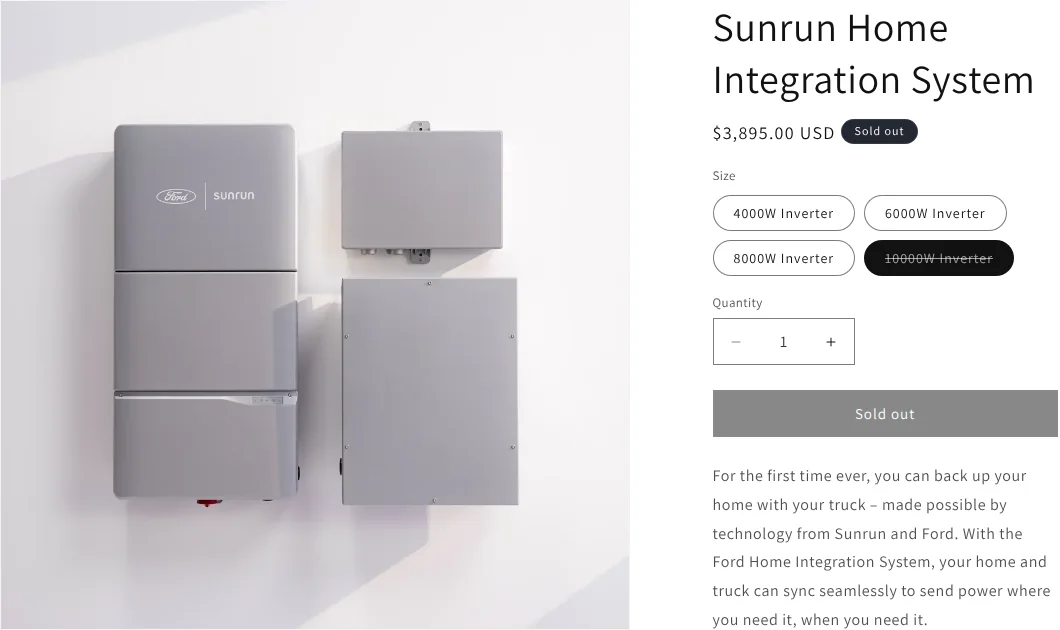
Ford's home-power system overview identifies the established F-150 Lightning arrangement: Ford Charge Station Pro and a Home Integration System, with the compatible truck and required software. Sunrun's Home Integration System listing says its system works only with Charge Station Pro and Ford no longer sells that charger. Ford says the Lightning is no longer orderable in its current form.
Sunrun's storefront marks the system sold out overall, with the 10,000-watt inverter variant unavailable. Its variant-level data marks the 4,000-, 6,000-, and 8,000-watt versions available, but provides no stock quantity or delivery confirmation. Those inconsistent signals do not establish that any variant is orderable.
For an existing owner, the proposal needs the correct integration equipment for the truck and home, with confirmed supply of the complete compatible package. A used charger listing is not a complete backup installation.
Future features belong outside the purchase case. For example, Enphase's February 2026 announcement targets IQ Bidirectional EV Charger volume production in the fourth quarter of 2026. A production target is different from a deliverable, approved installation for a specific car and address.
How much of the house can the EV power?
Two electricity measurement units answer different questions:
- Kilowatts (kW) measure power: how much the system can supply at once.
- Kilowatt-hours (kWh) measure energy: how much battery energy is available over time.
A large vehicle battery can still have a modest home-output limit. Charging input also differs from backup output. A charger's high charging rating does not mean it can supply the same power to the house.
Critical loads versus whole-home backup
A critical-load design serves selected circuits, such as refrigeration, lights, internet equipment, and suitable heating controls. Whole-home backup connects a broader set of circuits, but simultaneous demand must still stay within the system's output and startup limits.
“Whole-home” is not a promise that air conditioning, electric heat, a range, water heating, and a dryer can all run together. Motor-starting demand can matter even when normal running demand fits. A well pump or sump pump deserves explicit inclusion in the installer's load schedule.
The proposal should identify:
- the circuits served and those excluded;
- the largest supported startup load;
- any automatic load shedding or operating restrictions;
- continuous backup output for the exact configuration;
- the expected interruption when backup begins.
These systems are not automatically uninterruptible power supplies. GM specifically advises against powering medical devices with its charger-and-kit system.
A realistic runtime example
Start with usable battery capacity, the charge present when the outage begins, and the driving reserve. Then allow for conversion losses and system limits.
For an illustrative 80 kWh usable battery, assume an 80% starting charge and a 30% driving reserve:
80 kWh × (80% − 30%) = 40 kWh available before losses.
If an illustrative 90% of that reaches the home, the energy budget is 36 kWh. The 90% assumption is a planning example, not a measured efficiency for the systems above.
| Average backed-up demand | Illustrative runtime from 36 kWh |
|---|---|
| 0.5 kW | 72 hours |
| 1.5 kW | 24 hours |
| 3 kW | 12 hours |
Weather and battery condition can reduce the available energy budget. Average demand includes appliances cycling on and off. This calculation addresses energy duration only. A large startup load could exceed the output limit even with plenty of charge remaining.
The EV must also be home and connected. If it leaves during the outage, its battery leaves with it. Homes that need backup while everyone is away have a different planning problem from homes with an EV usually parked overnight.
Can solar extend the backup?
Solar can charge an EV while the grid operates without making the house outage-ready. Our solar-to-EV charging guide covers that everyday energy supply.
During an outage, solar requires a compatible, designed backup arrangement to continue operating and recharge the vehicle. The Department of Energy explains why solar backup needs include properly configured conversion and storage equipment. The quote needs to describe how the existing solar inverter, EV system, home controls, and any stationary battery work together. Integration cannot be inferred from having solar panels and a bidirectional charger at the same address.
Stationary storage also changes the fit decision: it stays home when the car leaves. An EV battery can add substantial available energy, but it does not automatically replace every function of a stationary battery.
Compare total installed costs
The hardware is only one part of the bill. We would compare bids using the same backup load schedule and vehicle configuration, with these items separated:
| Quote item | What should be included |
|---|---|
| Charging and backup hardware | Exact charger, inverter, gateway or hub, transfer equipment, and required accessories |
| Installation | Labor, cable route, trenching if needed, mounting, and circuit work |
| Home electrical changes | Critical-load panel, load controls, panel replacement, or service work |
| Approvals | Permit, inspection, utility application, interconnection fees, and responsibility for each |
| Commissioning | Required software enablement, configuration, and documented handover |
| Ongoing costs | Any subscription, maintenance, program charges, and warranty exclusions |
Tesla's typical installation costs include line items of $1,800–$2,100 for the Gateway and $600–$900 for the Universal Wall Connector. It lists a possible $2,000–$4,000 panel-upgrade addition. These figures are not a guaranteed total. Quote boundaries matter, particularly whether hardware is included, so the bundle must not be counted twice.
Our Level 2 installation costs provide context for ordinary charging work. Bidirectional backup adds different equipment and approval needs. An electrical panel upgrade can also become a broader service project rather than a simple box replacement.
Permits, utility rules, and incentives
A licensed electrician or approved installer assesses charging capacity, backup loads, equipment ratings, and the local permit path. Outage-only backup and export while the grid operates can have different utility treatment.
California's Pacific Gas and Electric Company (PG&E) illustrates that distinction: its V2X program requirements include eligible vehicle-and-charger combinations. Backup testing requires islanding capability. Discharging while the grid operates requires the appropriate interconnection approval. Those are PG&E rules, not nationwide eligibility.
Incentives belong in a budget only when the project has an applicable award or documented eligibility, payment conditions, and enrollment terms. Utility programs may limit equipment, installers, funds, rates, and participation. Grid-export revenue must also cover the electricity used to charge the vehicle and associated losses.
The federal residential charger tax credit, Section 30C, ended for property placed in service after June 30, 2026. An installation placed in service now cannot use that credit. Older credit descriptions are unsuitable for a new-project budget.
Equipment warranty and vehicle-battery warranty are separate
GM's home-products limited warranty lists three years for the PowerShift Charger and ten years for the inverter, Home Hub, and Dark Start Battery. Tesla's Powershare equipment warranty lists ten years for its Gateway and four years for the Universal Wall Connector. Conditions and exclusions apply.
Those equipment warranties do not establish the vehicle battery's terms. The purchase file needs the applicable vehicle warranty treatment for backup use and, separately, any grid-export program. A general statement about battery life cannot replace model-specific coverage.
The pre-purchase project brief
A bidirectional installation is ready for a purchase decision when these six pieces are documented:
- The job: portable devices, selected outage loads, broader home backup, or participation in a named export program.
- The eligible pairing: exact vehicle and model year, trim or VIN, required software, charger, and home controls.
- The load design: circuits served, power and startup limits, critical-load or whole-home scope, and interruption behavior.
- The energy budget: starting-charge assumption, driving reserve, expected average demand, and runtime without assuming solar recharge.
- The approval path: permits, inspections, utility requirements, equipment availability, and responsibility for completion.
- The full price and terms: itemized installed cost, documented incentives, equipment warranty, vehicle-battery terms, and ongoing charges.
The strongest fit is a compatible EV that is regularly home, an affordable backup design for the loads that matter, and clear approvals. If the goal is only everyday charging, a conventional charger can meet that need with a smaller project. If continuous backup while the car is away is essential, stationary storage or another professionally designed backup source belongs in the comparison.
Bring this six-part brief to a qualified installer for an itemized home-backup quote.