Last reviewed: 2026-07-27 (UTC)
The Tesla Universal Wall Connector is the best home EV charger for most mixed or changing EV households because one captive cable works with both J3400/NACS and J1772 vehicles. The Emporia Classic is the better value when one connector type will cover the household, and the Emporia Pro is the most useful upgrade when limited panel capacity, solar, or whole-home energy management is the real problem.
Those are starting points, not universal answers. A charger that misses your utility's approved-equipment list, has the wrong connector, exceeds the car's onboard AC limit, or requires an avoidable panel upgrade is not the best choice for your home.
Prices below were checked on manufacturer sites on July 27, 2026. They exclude tax, installation, added metering equipment, and promotions. Watt Wallet did not perform hands-on charger tests. We compared current manufacturer specifications and safety listings, then used independent long-term tests and owner research for cable, app, weather, and ownership context.
The best home EV chargers at a glance
| Charger | Best for | Price checked | Output and installation | Connector | Cable | Warranty | Main tradeoff |
|---|---|---|---|---|---|---|---|
| Tesla Universal Wall Connector | Best overall; mixed or changing EVs | $600 | Up to 48A; hardwired | J3400/NACS with captive J1772 adapter | 24 ft | 4 years for normal personal use | Hardwire only; premium price |
| Emporia Classic | Best value smart charger | $449 J1772; $479 J3400/NACS | 48A hardwired or 40A plug-in | Choose J1772 or J3400/NACS | 25 ft | 3 years | Solar needs a Vue; whole-home PowerSmart needs a Vue plus paid upgrade |
| Emporia Pro | Best for limited panel capacity | $599 | 48A hardwired or 40A plug-in | Choose J1772 or J3400/NACS | 25 ft | 3 years | Requires an energy monitor in the panel |
| ChargePoint Home Flex | Best app and utility-rate experience | $494 hardwired; $539 plug-in sale price | Up to 50A hardwired or 40A plug-in | Choose J1772 or J3400/NACS | 23 ft | 3 years | No built-in power sharing; one connector at a time |
| Wallbox Pulsar Plus | Best compact charger with advanced energy options | $649.99-$699.99 | 48A hardwired or 40A plug-in | Choose J1772 or J3400/NACS | 25 ft | 3 years | Energy-management meter costs extra |
| Grizzl-E Classic | Best simple, rugged charger | $299.99 | Up to 40A; plug-in or convertible to hardwire | J1772 | About 25 ft | 3 or 5 years | No app; J1772 only |
The maximum output is only a ceiling. The charger's configured current, circuit, home capacity, and vehicle's onboard AC charger all have to support it.
How Watt Wallet chose these chargers
We started with a hard gate: the exact model must be listed by a nationally recognized testing laboratory to the applicable home EV charging standard. A logo in a marketplace image is not enough. ENERGY STAR's current EV charger guidance warns that some chargers sold by large online and storefront retailers are not safety certified.
The remaining criteria were:
- connector fit for the current vehicle and likely next vehicle
- usable output on common home circuits, not maximum amperage alone
- plug-in and hardwire options
- cable reach, enclosure rating, and operating temperature
- smart scheduling, utility integration, solar, and load-management options
- warranty, replacement path, independent test history, and owner satisfaction
Independent evidence helped break ties. MotorTrend's 2026 comparison draws on a dozen chargers used across more than 100 EVs and plug-in hybrids. Car and Driver's testing adds charging efficiency, app, and cable observations. The 2026 J.D. Power home charging study put Tesla first and Emporia second in the permanently mounted Level 2 charger segment. Those results inform the picks, but no single test can account for your electrical service or utility program.
1. Tesla Universal Wall Connector: best overall
The Tesla Universal Wall Connector combines both common home-charging connectors in one captive cable. Its handle uses J3400/NACS, while a captive adapter docks into the unit for J1772 cars. There is no loose adapter to find every time a different vehicle parks in the garage.
It delivers up to 48A or 11.5 kW on a suitable 60A circuit, has a 24-foot cable, works indoors or outdoors, and carries a four-year warranty for normal personal use at a single-family home. After registration to a Tesla Account and connection to home Wi-Fi, the Tesla app provides charging control, schedules, and 12 months of session history. Wi-Fi also enables automatic firmware updates and remote diagnostics. Access control can restrict Tesla vehicles, but not non-Tesla EVs. Multiple Wall Connectors can coordinate their electrical load.
This is the strongest fit when:
- the household has both J1772 and J3400/NACS vehicles
- the next vehicle may use a different connector
- two chargers may eventually need coordinated power
- one permanent hardwired installation is preferable to adapter swapping
The universal connector has a $600 list price, and it is hardwire only. When checked on July 27, Tesla's direct shop restricted checkout to Tesla vehicle owners and showed the charger out of stock; Tesla says some Certified Installers can supply a Wall Connector with installation. Confirm current availability before choosing it. Its Type 3R enclosure is suitable for rain and sleet, but it does not offer the broader dust and hose-directed-water protection associated with Type 4 equipment. ChargePoint and Emporia also provide more detailed charging-cost views.
Skip it if one connector will cover the household for years and minimizing hardware price matters more than all-vehicle convenience. It is also a poor fit for a renter or likely mover who wants a plug-in charger that can be removed easily.
2. Emporia Classic: best value smart charger
The Emporia Classic covers the features most homeowners will use without the premium attached to deeper home-energy controls. The current shop price is $449 with J1772 or $479 with J3400/NACS. It delivers 48A when hardwired or 40A through a NEMA 14-50 configuration and has a 25-foot cable, Type 4 enclosure, smart schedules, energy and cost tracking, and a three-year charger warranty.
Choose either a J1772 or J3400/NACS version. This is not a captive dual-connector design like Tesla Universal, so the current vehicle and likely next vehicle matter.
The Classic is the value pick because it works as a complete smart charger without another subscription or required energy monitor. It can also be upgraded later with Emporia's Vue monitor and PowerSmart software if the home develops a load-management need.
That upgrade path is also the main caveat. Solar charging needs a separate Vue monitor, while whole-home PowerSmart needs a Vue plus a paid software upgrade. Independent testers generally like the performance and value but find the app and separate wall holster less polished than the Tesla or ChargePoint experience.
Skip it if the electrician already knows the service needs dynamic load management. Starting with the Pro bundle is simpler. A mixed-connector household that wants to avoid adapters should also choose Tesla Universal.
3. Emporia Pro: best for a panel with limited capacity
The Emporia Pro costs $599 and bundles the charger with a Vue 3 whole-home energy monitor and PowerSmart. Sensors in the electrical panel measure the home's demand, and the system adjusts EV charging so the service limit is not exceeded.
That makes it the strongest pick when the load calculation, not the number of empty breaker slots, is blocking a normal Level 2 installation. The same system can manage excess solar, peak demand, and multiple Emporia chargers.
PowerSmart does a different job from a normal charging schedule. A schedule decides when charging starts. A listed power-control system decides how much current the charger may use as other loads turn on and off. UL's explanation of energy-management systems describes how approved controls can limit the EV load counted on a service or feeder. The electrician and local inspector still need to approve the design.
The Pro has the same basic charger choices as the Classic: up to 48A hardwired or 40A plug-in, a 25-foot cable, Type 4 enclosure, and separate J1772 and J3400/NACS versions.
Skip it if a proper load calculation shows ample capacity and all you need is charging and scheduling. In that case, the Classic saves about $120 to $150 and avoids another device in the panel.
4. ChargePoint Home Flex: best app and utility-rate experience
The ChargePoint Home Flex has the most complete home-and-public charging app in this group. It can use local utility rates to schedule charging, estimate cost, track home and public sessions together, and keep a saved schedule running if Wi-Fi drops.
Home Flex is also unusually flexible on current. A hardwired unit can be configured from 16A to 50A. Plug-in configurations support 32A or 40A on appropriate circuits. The unit has a 23-foot cable, Type 3R enclosure, UL listing, ENERGY STAR certification, and a three-year parts warranty. Choose J1772 or J3400/NACS; ChargePoint offers a cable conversion path if the household changes later.
This is the best choice when the app will be used, especially if ChargePoint appears on the utility's approved equipment list. For example, PG&E currently lists Home Flex for its Residential EV Charging rebate. Its separate managed-charging program supports some Level 2 ChargePoint chargers but is fully subscribed. That does not make Home Flex eligible everywhere, so check the local program before purchase.
The main limitations are multi-EV planning and price. ChargePoint says two Home Flex units cannot share one circuit, and it does not offer the built-in power-sharing path found in Tesla or optional Wallbox systems. It also supports only one ChargePoint account per home station.
Skip it if two chargers will need coordinated power or a mixed-connector household wants one cable with no loose adapter. Homeowners who will never use the app may also get more value from Emporia Classic or Grizzl-E Classic.
5. Wallbox Pulsar Plus: best compact charger with advanced energy options
The Wallbox Pulsar Plus is compact, has a 25-foot cable, and offers 40A and 48A configurations with separate J1772 or J3400/NACS connectors. Its app supports schedules and charging history. A $299.99 Wallbox Power Meter enables solar charging and dynamic load management; separate communication cabling enables static load management, or power sharing, between compatible Pulsar Plus units.
That combination makes it useful in a small garage or a two-EV plan where a Wallbox electrician is already designing the energy controls. The 40A unit can be plug-in or hardwired, while 48A is hardwired.
The added hardware is the catch. The Power Meter for solar charging and dynamic load management costs $299.99 before installation, and the charger itself listed from $649.99 to $699.99 when checked. That can put the complete system above Emporia Pro.
Skip it if the compact enclosure and power-sharing path do not solve a real constraint. Emporia is less expensive for basic smart charging, and Emporia Pro bundles its monitoring hardware for less than a Pulsar Plus plus meter at list price.
6. Grizzl-E Classic: best simple, rugged charger
The Grizzl-E Classic deliberately leaves out Wi-Fi, an app, and a cloud account. It delivers 16A, 24A, 32A, or 40A through a J1772 cable and uses a rugged outdoor enclosure. The cable is about 25 feet. Current units ship with a NEMA 14-50 or NEMA 6-50 plug and can be converted to a hardwired connection under the manufacturer's instructions.
It is a sensible choice when the vehicle already provides reliable scheduling, the utility does not require charger telemetry, and the owner would rather avoid another account and firmware layer. It is also one of the lower-cost established products in this group, at $299.99 on the current product page when checked.
The tradeoffs are real: there is no charging history, utility-rate integration, solar control, or dynamic load management. Current is adjusted less conveniently than on an app-based charger, output tops out at 40A, and the Classic is J1772-only. Before ordering, verify the exact SKU, safety listing, warranty term, and return policy at checkout.
Skip it if the utility requires a connected charger, the household needs J3400/NACS without an adapter, or future load management is likely.
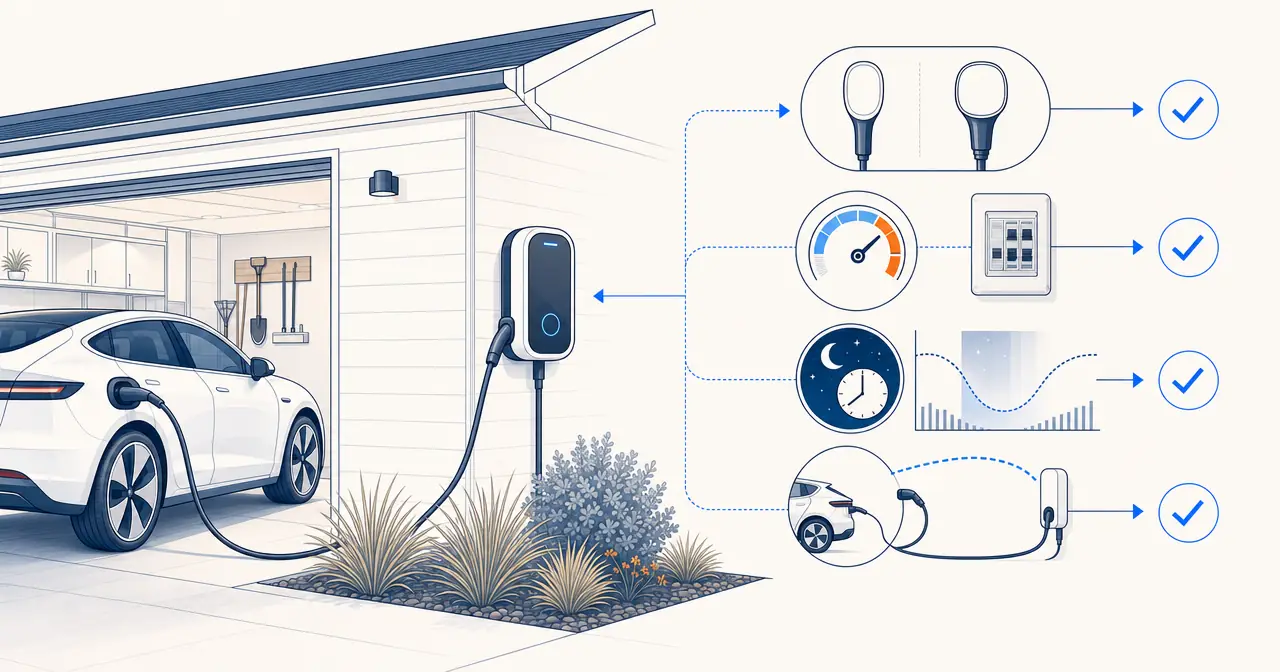
Choose the circuit and connector before the brand
The fastest way to avoid an expensive mismatch is to make the decisions in this order.
1. Decide whether Level 1 already covers the routine
A full battery EV driven most days usually benefits from Level 2, but a plug-in hybrid, short commute, or regular workplace charging may not need a new 240V project. DOE's Alternative Fuels Data Center estimates roughly 5 miles of range per charging hour for Level 1 and about 25 miles per hour for a typical home Level 2 setup, with wide variation by vehicle and conditions.
Use Watt Wallet's Level 1 vs. Level 2 charger guide to decide whether new hardware is necessary before comparing models.
2. Match the connector to the current vehicle
J1772 remains common on vehicles already in driveways. J3400, the standardized form of the Tesla-style NACS connector, is arriving on more new models. The transition is not uniform by model year. Check the exact vehicle rather than assuming every 2025 or 2026 EV has the same inlet.
For one known car, the native connector is simplest. For a mixed household, Tesla Universal's captive adapter reduces daily friction. If using an adapter, make sure it is approved for that vehicle and for AC Level 2 charging. A DC fast-charging adapter is not interchangeable with a home AC adapter.
3. Check the vehicle's onboard AC limit
A 48A charger cannot make a vehicle with a 32A onboard AC limit accept 48A. Check the owner's manual or automaker charging specification before paying for a larger circuit. Higher output may still help a future vehicle, but it should be a deliberate future-capacity purchase.
4. Have an electrician size the circuit and calculate load
EV charging is treated as a continuous load. Common circuit and output pairings are:
| Maximum charging output | Common minimum circuit rating |
|---|---|
| 16A | 20A |
| 24A | 30A |
| 32A | 40A |
| 40A | 50A |
| 48A | 60A |
ChargePoint's 50A maximum is a product-specific exception that its table pairs with a 70A or 80A circuit. For most homes comparing high-power Level 2, 48A on a suitable 60A circuit is the more common top step.
Do not infer capacity from the main-breaker number or empty slots. Ask for a load calculation. A lower configured charging rate or approved EV charger load management system can sometimes solve a tight service without a panel upgrade.
Then decide NEMA 14-50 vs. hardwired. Plug-in can make sense when a compliant EV-ready outlet already exists and portability matters. Hardwire is usually the cleaner path for a new permanent installation, outdoor placement, 48A charging, or a local GFCI requirement that complicates the receptacle setup.
5. Check the utility's list before checkout
Some utilities accept vehicle data, some require a compatible charger, and some maintain separate lists for rebates and managed charging. A charger can have Wi-Fi and ENERGY STAR certification without supporting a specific utility integration.
Ask the utility four questions:
- Is eligibility based on the vehicle, charger, or both?
- Is the exact model on the current list?
- Can a rebate, managed-charging reward, and time-of-use electricity plan be combined?
- What connection, data sharing, and event-override rules apply?
Check before purchase. Approved-equipment lists and program terms change.
6. Measure the parking layout and exposure
The six picks use 23- to 25-foot cables, but the path still matters. Measure from the wall location to the charge port with the vehicle parked normally and backed in. Account for a second vehicle, garage-door clearance, the holster location, and a cable path that will not become a trip or tire hazard.
For outdoor installations, compare the full enclosure rating and operating range. Type 3R covers outdoor rain and sleet exposure. Type 4 adds protection against windblown dust and splashing or hose-directed water. Cable flexibility in cold weather can matter as much as the wall box. Do not plan to solve a short cable with an ordinary extension cord.
When a simple charger is enough
A simple charger can be the better buy when all five statements are true:
- the vehicle already provides dependable scheduled charging
- the utility does not require charger telemetry
- a load calculation confirms capacity without dynamic management
- there is no solar, peak-demand, or multi-charger control need
- the owner values fewer accounts, updates, and cloud dependencies
Paying for a smart charger makes sense when it unlocks a utility rebate or charging rate, provides listed dynamic load management, captures excess solar, coordinates two chargers, or gives the household cost data it will use.
The feature only creates value if it changes behavior. In J.D. Power's 2026 study, 46% of owners said they never schedule charging. Among owners who tried to charge off-peak, those who always scheduled reported an average $65 of home charging cost over 30 days, compared with $71 for those who never scheduled. That is an association, not proof that a $600 smart charger will pay for itself, but it is a useful reminder to buy for the routine you will follow.
Before you buy: homeowner checklist
- Verify the exact model and connector on the testing laboratory's certification listing.
- Ask the utility about approved equipment, rebates, rates, and managed charging before purchase.
- Get a written load calculation and installation quote from a licensed electrician.
- Confirm plug-in vs. hardwire, circuit size, conductor and termination requirements, local GFCI treatment, and inspection path.
- Measure cable reach and choose an enclosure for the actual exposure.
- Confirm the warranty, return window, replacement-cable options, support path, and what still works without Wi-Fi.
- If two EVs are likely, price the second circuit or power-sharing design now.
- Do not include a federal 30C credit for a charger that will first become operational in July 2026. The IRS says property placed in service after June 30, 2026, cannot qualify.
Use Watt Wallet's guide to whether you need a permit to install an EV charger before treating a hardware price as the project total. Permit and electrical-code requirements vary by jurisdiction.
Do not DIY a new 240V EV charging circuit. If an existing outlet, plug, or charger shows heat, discoloration, softening, melting, arcing, smoke, or loud buzzing, stop using it. Turn off the circuit only if you can do so safely, then call a licensed electrician.
Bottom line
Choose Tesla Universal Wall Connector when connector flexibility and a permanent all-vehicle setup matter most. Choose Emporia Classic for the best balance of price and useful smart features. Choose Emporia Pro when dynamic load management is the reason Level 2 charging fits the home at all.
ChargePoint Home Flex is the app-first alternative, Wallbox Pulsar Plus fits compact and power-sharing plans, and Grizzl-E Classic is the no-cloud option. Before ordering any of them, confirm the utility list, vehicle limit, load calculation, connector, and installed quote. Those five checks matter more than the biggest amperage number on the box.
Sources
- U.S. Department of Energy: Electric Vehicle Charging Stations
- U.S. Department of Energy: Charging Electric Vehicles at Home
- ENERGY STAR: Electric Vehicle Chargers
- ENERGY STAR: EVSE Key Product Criteria
- SAE J3400 Recommended Practice
- UL Solutions: EV Charging Infrastructure Standards
- PG&E: Residential EV Charging Equipment
- J.D. Power: 2026 U.S. Electric Vehicle Experience Home Charging Study