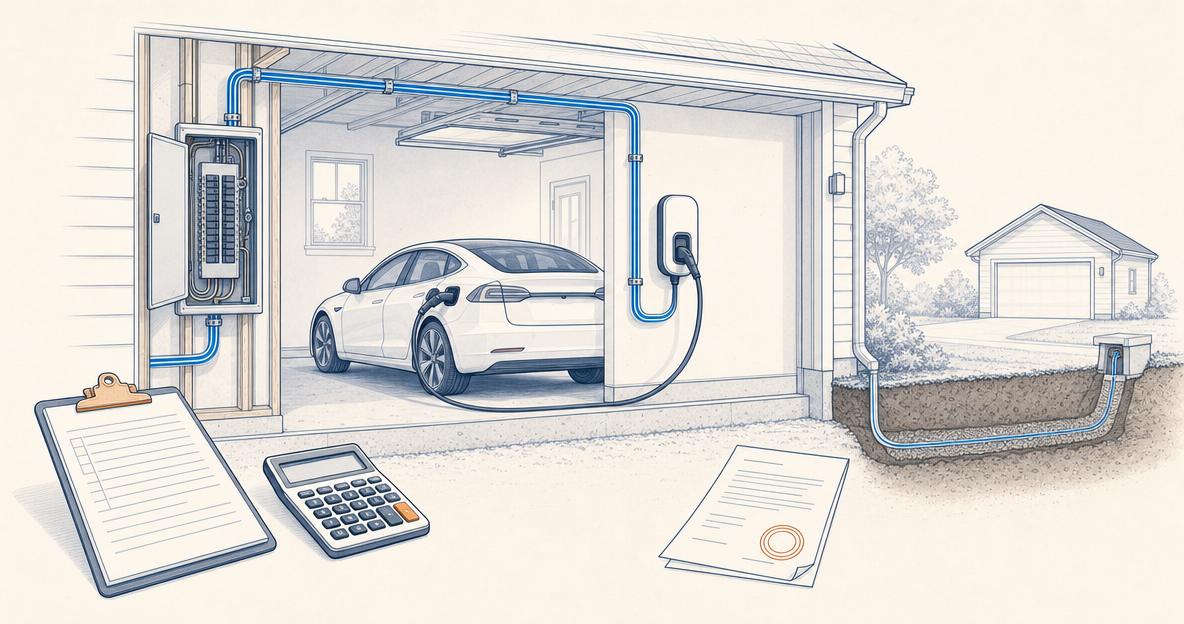
Most Level 2 EV charger cost surprises come from the work between the electrical panel and where you park, not from the charger itself. The route, your home's available capacity, the connection method, and permit scope decide whether this is a simple circuit job or a broader electrical project. Use a planning range first, then compare the same itemized scope across local quotes.
Electrical and cost note: A Level 2 charger is a 240-volt continuous electrical load. This guide helps you scope a quote, but a licensed electrician and your local permitting authority determine the circuit, permit, and code requirements for your home.
Level 2 EV charger installation cost at a glance
For a homeowner planning a Level 2 charger, budget $700 to $3,000 installed before incentives. The U.S. Environmental Protection Agency lists equipment at $400 to $1,000 and installation at $300 to $2,000, with the actual result shaped by charger output, route length, site access, and electrical upgrades. EPA's home charging guidance supports that broad planning range.
For a simpler reference point, PG&E currently lists $500 to $700 for the charger and $400 to $1,200 for installation. Adding those figures gives $900 to $1,900 for a straightforward equipment-and-installation budget. PG&E also flags cable length and electrical upgrades as variables that change the price. PG&E's Level 2 planning figures are useful for setting expectations, not for replacing a site assessment.
| Project situation | Planning number | What it means |
|---|---|---|
| Charger and ordinary installation | $700 to $3,000 | EPA's current equipment and installation components combined. The route and home's setup decide where a project falls. |
| Straightforward equipment-and-installation budget | $900 to $1,900 | PG&E's current $500 to $700 charger range plus its $400 to $1,200 installation range. |
| Charger already owned | $300 to $2,000 for installation | EPA's current installation component. Confirm whether the contractor includes mounting, breaker, wiring, conduit, permit handling, and inspection. |
| Panel or service work, long difficult route, or trenching | Price separately | These are scope changes. A single national add-on number would hide the work that needs pricing. |
Treat the gross project price as the decision number. A rebate, discount, or tax credit belongs on a separate line after the equipment, location, application timing, and program terms have been confirmed.
How to use an EV charger installation cost calculator
A useful calculator does not guess a single final price from your ZIP code. It turns the project into a scope an electrician can price. Start with this equation:
Gross project price = charger hardware + dedicated circuit + route and access work + permit and inspection + panel or load work + trenching and restoration, if needed.
Use four inputs before asking for quotes:
- Charging output. Choose the charger output your vehicle and overnight driving needs support. A larger unit can require a larger circuit. EPA's 125% sizing example uses a 40-amp charger on a dedicated 50-amp circuit because EV charging is a continuous load. Level 1 versus Level 2 charging can help you decide whether a lower-output Level 2 setup already meets your needs.
- Actual route. Mark the panel, charger location, parking location, and every wall, ceiling, crawlspace, attic, exterior run, or yard crossing between them.
- Panel result. Separate physical breaker space from electrical capacity. The installer should state whether the load calculation supports the proposed charger and what alternative they priced if it does not.
- Local process. State who handles permits, inspection scheduling, excavation, restoration, and any utility coordination.
The output is a better comparison than a generic total: two electricians can price the same home differently if one includes the permit, drywall repair, or final inspection and the other leaves it as an allowance.
Circuit distance is a route, not a ruler
Distance drives both material and labor, but the relevant distance is the installable route, not the straight line from panel to parking space. PG&E makes the same point: the farther the charging station is from the service panel, the more the installation can cost. A short exposed run on a garage wall and the same number of feet through finished walls are different scopes.
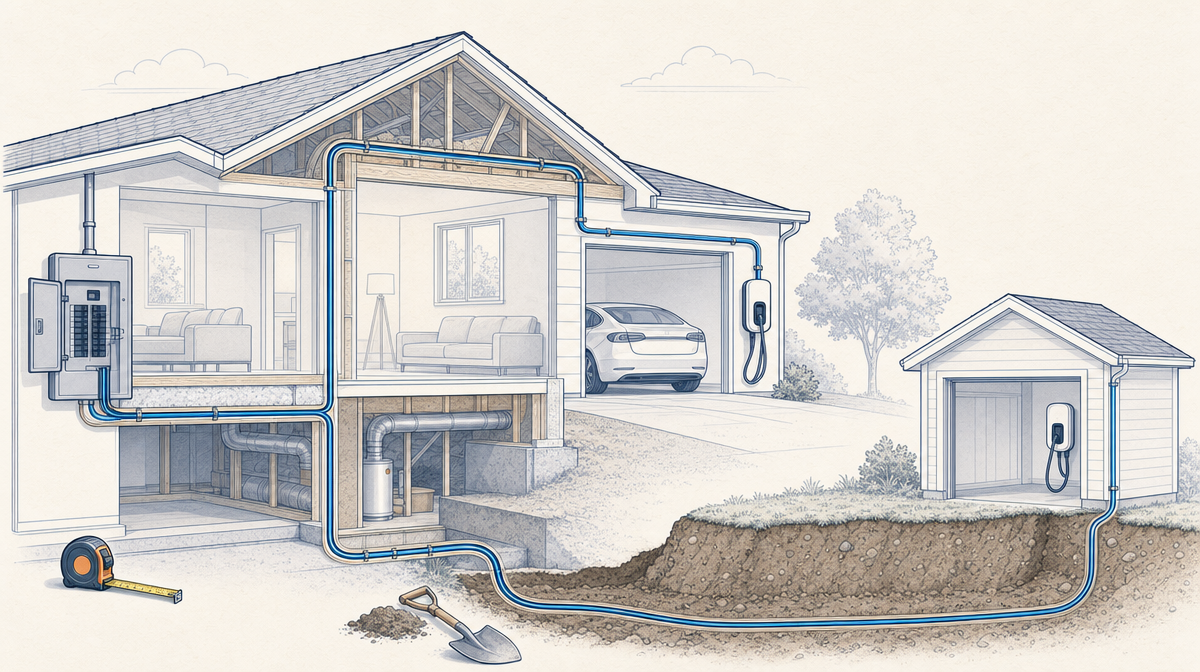
Ask each installer to identify:
- The route footage included in the quote.
- The wiring method, such as an accessible garage run, attic or crawlspace route, exterior conduit, or concealed finished-wall route.
- Openings, patching, painting, or access work included and excluded.
- The point where added footage or an obstructed path becomes a change order.
When trenching belongs in its own scope
A detached garage, pedestal, or parking area away from the house can require underground work. The quote should separately identify utility locating, excavation, conduit and conductors, backfill, surface restoration, and the final charger support or pedestal. It should also state whether concrete, asphalt, landscaping, irrigation, or hardscape repairs are included.
Do not compare a trenching quote with an attached-garage quote as though both were ordinary charger installations. They share a charger, not a construction scope.
Panel work starts with a load calculation
An empty breaker position does not prove that your home has electrical capacity, and a 100-amp service does not automatically require a replacement. EPA says even 100-amp service can be sufficient depending on the home's other loads, while an electrician's load calculation determines whether the proposed charger fits. The Alternative Fuels Data Center also identifies EV charging infrastructure as a continuous load under the National Electrical Code.
If the calculation is tight, ask the installer to price the right alternatives for your house:
- A lower-output Level 2 charger that still covers your overnight driving.
- A listed load-management or circuit-sharing setup that controls charging around other household loads.
- A panel or service upgrade when the calculation and future electrification plans justify it.
A subpanel can solve a routing or breaker-space problem. It does not create additional service capacity. Read our guide to EV charger load management before treating a full service upgrade as the only path.
Choose hardwired or NEMA 14-50 before quoting
A NEMA 14-50 is a four-prong 240-volt receptacle commonly used for plug-in Level 2 charging equipment. Hardwiring connects the charging equipment directly to the circuit. The choice changes the equipment, circuit rating, and scope a quote should show.
| Connection | Fits this situation | Quote details to require |
|---|---|---|
| Hardwired charger | You want a permanent installation, need 48 amps or more, or the charger is outdoors. | Exact charger model and output, circuit and breaker rating, conductors, conduit, mounting, and weather-exposure details. |
| NEMA 14-50 receptacle | You want a compatible plug-in charger and value being able to remove or replace it. | Exact receptacle and enclosure, circuit and breaker rating, the charger's maximum output, and any local protection requirements. |
EPA advises hardwiring for chargers rated at 48 amps or higher; the charger model and local code set the actual requirement. An outlet can offer more flexibility. EPA's 125% circuit-sizing example also explains why a 40-amp Level 2 charger uses a dedicated 50-amp circuit. Our NEMA 14-50 versus hardwired guide explains the decision in more detail.
Put permits and inspections on the quote
Permit rules vary by authority having jurisdiction, commonly called the AHJ. The Alternative Fuels Data Center says home charging equipment must comply with local and state rules and that permits may be required under those rules. A useful example comes from Prince William County, Virginia: it requires an electrical permit when a circuit or feeder is added or extended, or when the charger is hardwired; for systems above 20 amps, its application requires a load calculation that includes 125% of the charger's nameplate rating. The county's current EV guidance illustrates why local rules, rather than a generic online answer, govern your project.
Ask the contractor to state in writing:
- Who applies for the permit and whose name is on it.
- Whether permit fees, plan review, inspection, and any correction visit are included.
- Who schedules the inspection and provides the charger specifications.
- What happens if the AHJ requires a revised plan, additional protection, or panel work.
For the local process and homeowner questions to bring to an electrician, use Watt Wallet's EV charger permit guide.
Compare quote line items before signing
Compare the finished, permitted scope rather than a headline total. Each quote should buy the same project.
| Quote line item | It should state | Why it changes the price |
|---|---|---|
| Charger hardware | Make, model, connector, output setting, and whether it is included. | A lower quote may exclude the charging equipment or assume a lower-output model. |
| Dedicated circuit | Breaker rating, conductors, conduit, and route. | Charging output, continuous-load sizing, and material length affect the circuit. |
| Route and access | Included footage, walls or ceilings crossed, and repair scope. | Difficult access and finished-surface work can matter more than straight-line distance. |
| Panel and load work | Load calculation result, panel condition, and any alternate solution. | Breaker space, subpanel work, load management, and a service upgrade solve different problems. |
| Connection method | Hardwired or receptacle, plus the exact equipment needed. | The connection can limit output and changes the materials and protection required. |
| Permit and inspection | Applicant, fees, inspection, and correction responsibility. | A low bid can leave an essential local process outside the contract. |
| Outdoor or trench work | Excavation, conduit, restoration, pedestal, and weather protection. | Civil work needs its own scope and can exceed the charger portion when the route needs excavation and surface repair. |
| Incentives | Gross contract price and any program assumption shown separately. | Eligibility, funding, and application timing can change. They should not disguise the installed price. |
Be cautious with a quote that says only "standard installation," calls for a panel upgrade without showing the load result, treats a permit as an undefined extra, or leaves surface restoration out of a trenching allowance.
Do not subtract an expired federal credit from a new quote
The federal Alternative Fuel Vehicle Refueling Property Credit under Section 30C cannot be claimed for charging property placed in service after June 30, 2026. The IRS Form 8911 instructions state the cutoff directly. A contractor should not use that former federal credit to lower the current price you use for a decision.
State and utility offers can still matter, but their equipment lists, service territories, application timing, and funding rules are local. Keep the gross quote intact, then compare only the incentives supported by the official program terms.
Before you choose an installer, use Watt Wallet's guide to compare rebates, tax credits, and installer quotes so the scope and any savings stay separate.