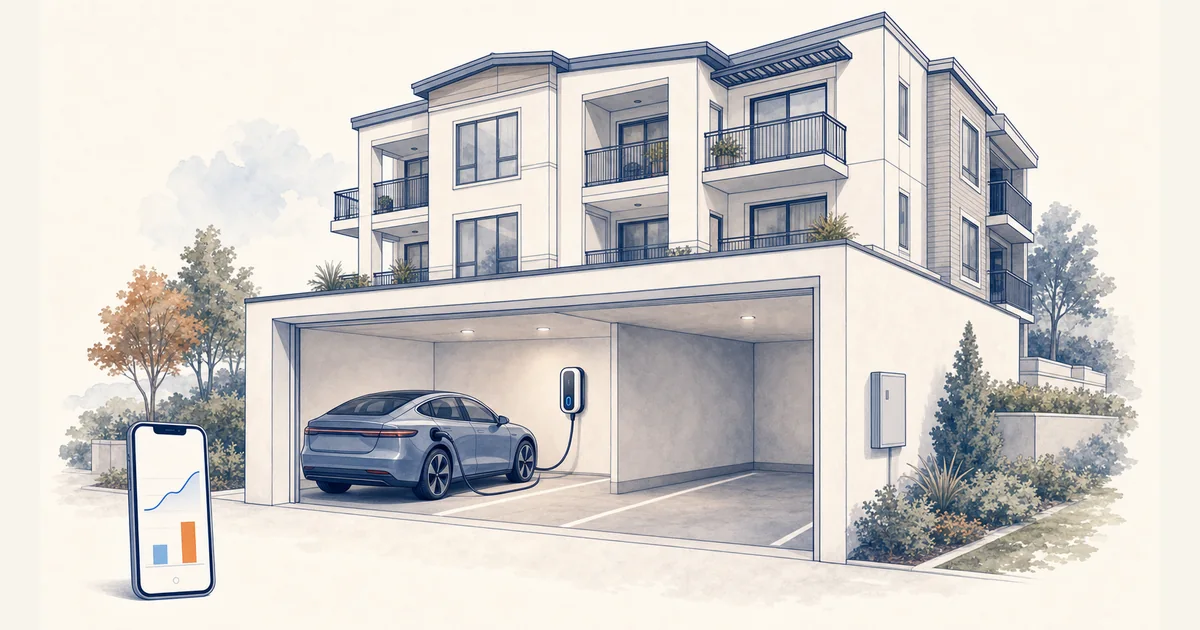
A private electric vehicle (EV) charger can make condo living much easier, until the proposed circuit crosses a shared wall, reaches an association-owned panel, or puts electricity on someone else's bill. The useful starting point is the parking space and the building around it. We recommend settling the approval, power, and payment questions before buying equipment so an installer can quote the project you can actually authorize.
Last reviewed: September 29, 2026
Can you install a private EV charger at your condo?
Yes, when four pieces fit together: the right to use the space, permission for the installation, a feasible electrical design, and an agreed way to pay for charging. Owning your unit alone does not settle those questions.
- Parking: Your documents identify the stall and your right to use it for charging.
- Approval: The required association consent covers equipment placement and the power route.
- Electrical feasibility: A qualified electrical contractor identifies an acceptable supply, route, and charging capacity.
- Payment and responsibility: The agreement names the electricity payer and assigns installation, maintenance, insurance, and removal obligations.
Start with the deed, condominium declaration, parking assignment, and charging policy. The everyday phrase “my parking space” can describe very different arrangements:
- Deeded space: The space is included in your ownership, but nearby walls, ceilings, and electrical equipment may belong to the association.
- Exclusive-use or limited common element: You have exclusive use of property that remains a common element. Equipment placement and alterations still need the applicable approval process.
- Assigned space: The assignment gives you use of a particular stall. Its permanence and installation rights depend on the documents and applicable law.
- Unassigned parking: A private charger needs a separate arrangement for its location and your access to it. A charger purchase cannot secure a parking right.
A private garage also needs a clear power and ownership arrangement. An enclosed space may still receive electricity from the association's account.
Separate association approval, permits, and utility permission
Association approval governs use and alteration of the property. Local permits and inspections govern the installation. Utility authorization becomes relevant when the proposal involves utility equipment, a service change, a new meter, or a special billing program.
Our EV charger permit guide explains the permit side. A board's approval does not replace it, and a city permit does not grant rights to alter common property.
Ask the association for its written charging policy, application requirements, approved equipment or billing requirements, and permission for a contractor to inspect the relevant electrical areas. This initial inquiry can happen before a detailed quote. A complete approval application can then include the contractor's design and scope.
What right-to-charge laws actually change
Some states limit an association's ability to prohibit or unreasonably restrict an owner's charger. Parking eligibility, reasonable conditions, deadlines, and owner obligations differ by jurisdiction. There is no nationwide approval deadline or universal insurance amount.
Two examples show why the details matter:
- California: Civil Code §4745 protects designated parking, including deeded and exclusive-use spaces, subject to reasonable restrictions and applicable standards. Common-area installations require association approval and written owner commitments covering architectural standards, licensed installation, insurance documentation, and payment. The statute's 60-day deemed-approval provision has an exception for reasonable requests for additional information. It also assigns duties to successive charger owners. These are California-specific charging rights.
- Florida: Condominium law protects installation within an owner's limited common element or exclusively designated parking area. It requires separately metered or embedded-metered electricity payable by the owner. It permits safety, architectural, qualified-installer, and insurance conditions, and assigns owner-paid installation, operation, maintenance, repair, and removal responsibilities. Its common-element easement is subject to the statute's requirements. Those conditions come from Florida condominium law.
For a refusal, request the reasons in writing. A contractor can address a documented electrical or routing concern. A condominium attorney can resolve disputed parking rights, approval conditions, or cost allocations under the applicable law and documents. Silence alone is a poor basis for scheduling work.
Choose the power source and billing arrangement together
The source of power, measurement of energy, and collection of payment are separate decisions. A charger app that displays kilowatt-hours does not automatically provide accepted billing metering or a utility account.
-
Supply through your dwelling's meter
Payment: Charging appears on your existing electricity account.
Proposal requirements: An approved route and adequate capacity in the relevant electrical equipment.
-
Common-meter supply with owner reimbursement
Payment: The association receives the utility bill; you pay through an agreed measurement and billing arrangement.
Proposal requirements: Accepted usage measurement, the rate calculation, billing responsibility, and every recurring fee.
-
New dedicated utility meter
Payment: The utility bills charging through its approved meter and account arrangement.
Proposal requirements: Utility acceptance, meter and service space, installation scope, tariff, and fixed charges.
-
Utility-approved EV submeter billing
Payment: An approved submeter separates EV consumption for utility billing under that utility's program.
Proposal requirements: Program availability, approved equipment and data services, enrollment, and required account-holder agreements.
The first option can avoid a separate reimbursement process, but a distant unit panel or meter location may make the route difficult. Common power may be closer to the stall, yet introduces an ongoing payment agreement. Neither arrangement is automatically cheaper.
Utility submetering also differs from private reimbursement. For example, PG&E's EV submetering program requires approved equipment, an approved data-service provider, and agreement from both account holders when the primary-meter and submeter owners differ. This is a utility-specific arrangement, not a feature every smart charger supplies.
For common-meter charging, get the agreement to name:
- The usage record accepted for billing and who can access it.
- The electricity rate or formula, including how rate changes apply.
- Monthly network, administration, data, or minimum fees.
- Who issues the bill and handles missing readings or billing disputes.
- What happens when the charger, communications service, or payment provider is unavailable.
Load management controls demand, not payment
A fixed charging limit caps output. Dynamic load management adjusts charging as other electrical demand changes. Load sharing divides available capacity among compatible chargers. These functions do not establish who owes the electricity bill.
Our EV load management guide explains the distinctions. For a condo proposal, the contractor must identify which upstream equipment the control protects and whether the equipment and design meet local requirements. A device monitoring your dwelling's demand does not automatically manage a shared building supply.
Find the retrofit blockers before choosing charger speed
A parking space close to an electrical room can still require an expensive route. A feasible design must account for the equipment supplying it, the property crossed, and the work needed to restore those areas.
Electrical capacity
An empty breaker position does not prove that charging capacity is available. The professional assessment must address the relevant panel, feeders, service, and any utility constraints.
Bring your vehicle model, normal daily driving, and usual parked hours. A lower-output charger or an approved managed design may meet your needs, depending on the site's constraints. Our Level 1 versus Level 2 comparison helps frame charging needs without assuming the largest charger is necessary.
The approved route
The quote should price the actual route through the building or parking area, including access, conduit, trenching, penetrations, and restoration. Existing conduit needs professional assessment; its presence does not prove it is usable. Walls and access restrictions can turn a short distance into a long run along permitted surfaces.
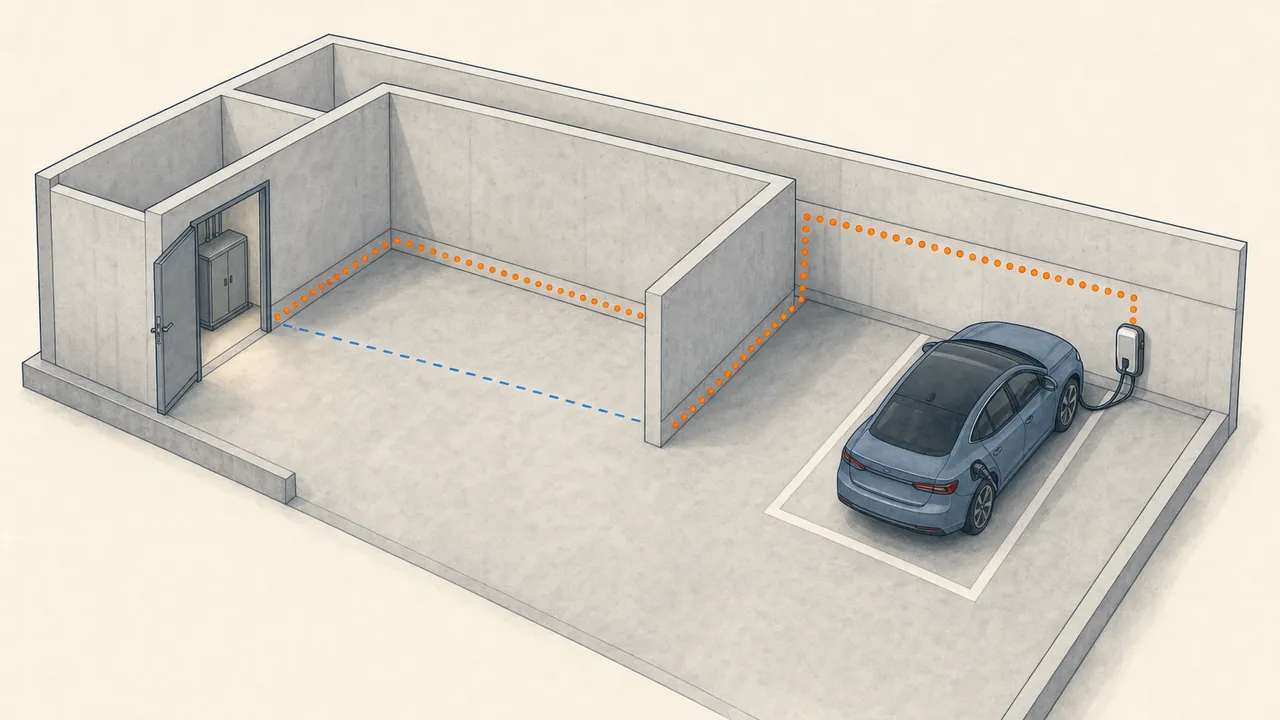
Simplified layout, not wiring instructions.
Fire-rated walls and floors deserve explicit treatment. The design and quote should identify any required penetrations, firestopping, and restoration.
Placement, access, and communications
The charger and cable need to reach your vehicle without obstructing required routes, neighboring spaces, or access aisles. Weather exposure, vehicle impact protection, and mounting permissions can change the equipment and installation scope.
Private residential accessibility requirements differ from public charging layouts. The U.S. Access Board distinguishes privately owned multifamily housing, which may fall under the Fair Housing Act, from facilities covered by the Americans with Disabilities Act. Avoid applying a public-stall diagram to every private condo space; the designer must address the property's residential accessibility requirements.
If billing or load controls depend on communications, the scope must also cover connectivity at the stall and the equipment's behavior during a connection failure.
Put shared electrical work in a separate cost agreement
Paying for your charger and branch circuit is a different commitment from funding a shared panel, service upgrade, or electrical route that future owners could use.
Keep three scopes separate in the quote:
- Your installation: Charger, circuit, mounting, permits, and work serving your stall.
- Shared work required for your installation: Changes to common equipment or property needed to make your project feasible.
- Optional future capacity: Larger or additional infrastructure intended for later installations.
Neither ownership of a stall nor the fact that other owners could benefit establishes who pays for the shared work. The governing documents, applicable law, approvals, and written agreement determine the allocation. Do not assume the association must fund every upgrade or that future charger owners will reimburse you.
- Upfront costs: Your contribution, association-authorized work, and the party paying each contractor or utility charge.
- Ownership: Who owns the charger, circuit, controls, and any new common equipment.
- Maintenance and damage: Who arranges repairs, pays for failures or damage, and provides access.
- Insurance: Required coverage, certificates, and any attributable premium reimbursement.
- Removal or transfer: Removal and restoration costs, buyer disclosures, and how obligations transfer on sale.
- Future reimbursement: Any expressly agreed repayment, its trigger, and how the amount is calculated.
A promised “credit when more people install” needs written terms before it belongs in your budget.
Prepare this packet before requesting installer quotes
You do not need to produce an electrical design yourself. Your job is to give the contractor the documents, access, and charging needs required to produce one.
- Parking records: Stall number, deed or assignment, relevant declaration provisions, and any relocation conditions.
- Association requirements: Application form, charging policy, equipment and billing rules, architectural conditions, and the person authorizing access.
- Power and account information: Your utility account and meter identification, the known garage electricity payer, and available building electrical plans. Supply bills with unnecessary personal details removed.
- Location information: Photos of the stall, mounting area, and accessible route taken without opening electrical equipment or entering restricted rooms.
- Charging needs: Vehicle model and connector, typical driving, overnight parking window, and whether another vehicle will use the charger.
- Responsibility terms: Proposed electricity payment arrangement, insurer requirements, and any written shared-work allocation.
The contractor or design professional supplies the load assessment, equipment schedule, route, and permit documents. San Diego's multifamily permit process illustrates why a condo project can require reviewed plans and calculations beyond a simple home installation. Its requirements include load calculations, equipment information, and the point of supply in the electrical plan package.
Require quotes to price the same scope
Each proposal should identify the power source, designed charging output, equipment, metering, controls, and exact work included. It should also name:
- Utility work and whether its cost or timing remains unresolved.
- Shared equipment changes and approval dependencies.
- Penetrations, firestopping, trenching, surface repairs, and finishes.
- Permits, inspections, commissioning, and handover documents.
- Billing or connectivity setup and recurring fees.
- Exclusions, allowances, and responsibility for additional work discovered on site.
A low quote excluding utility work and common-area restoration is not comparable to one including them.
Budget for the installed project and ongoing charges
Budget from an itemized, site-specific installation quote. Route length, trenching, wiring, electrical upgrades, labor, and permitting are recognized installation cost drivers. The charger price is only one line item.
Build two budgets: the upfront total, including your agreed share of common work, and ongoing electricity, service, maintenance, and insurance costs.
For a hypothetical monthly bill, 250 kilowatt-hours at an agreed $0.20 per kilowatt-hour costs $50. A $15 service fee brings it to $65 before other charges. Scheduling off-peak charging only changes that calculation if the actual billing arrangement passes the lower rate through to you.
For a new October 2026 installation, exclude the federal Alternative Fuel Vehicle Refueling Property Credit under §30C. The Internal Revenue Service limits eligible property to the period ending June 30, 2026; property placed in service afterward does not qualify. Buying equipment earlier does not extend the federal credit deadline.
Treat state or utility assistance as separate from the base budget until the program administrator provides eligibility and timing terms for your address, applicant, and equipment.
If a private charger is not feasible
A project remains unresolved when you lack a stable charging location, an approvable route, sufficient electrical capacity, an accepted billing arrangement, or an affordable allocation of shared work.
Already-approved shared charging, dependable workplace charging, or public charging can bridge that gap. Compare access hours, availability, parking restrictions, and the full price against your weekly driving needs. A future building project is a possibility, not a charging plan available today.
An existing garage outlet is an option only with authorization and a qualified electrician's assessment of its suitability. Never use extension cords or multiplug adapters for EV charging. Do not charge with visibly damaged equipment. Use equipment certified by a nationally recognized testing laboratory and follow its instructions. These are federal charging safety recommendations.
Frequently asked questions
Does a Tesla need a different condo approval process?
The same parking, property, power, and billing questions apply. Equipment selection must match the vehicle's alternating-current (AC) charging connection and any approved adapter requirements, along with the association's metering or network requirements. A brand-specific charger does not resolve common-area permissions.
Can I take the charger when I sell my condo?
That depends on ownership and removal terms. Removing your equipment may leave circuit work, restoration obligations, or shared controls behind. The written agreement should distinguish what transfers to a buyer, what can be removed, and who pays for restoration.
Turn an approved plan into a charging budget
Use our home charging cost guide to build the electricity portion of your monthly budget, then add the condo arrangement's meter, network, administration, and insurance charges.