Last reviewed: September 24, 2026 (UTC)
Evaporative cooler vs. AC: the short answer
At Watt Wallet, we start with the air your home must handle and the service you need. A direct evaporative cooler adds moisture as it cools. Refrigeration AC removes heat and can remove moisture while it runs. An air-source heat pump cools like AC and can also heat the home.
Use this first screen:
- Consider direct evaporation when summer air is hot and dry, outdoor air is clean, water and drainage are acceptable, and a relief path is possible.
- Choose refrigeration AC when humidity, smoke, pollen, dust, security, or closed-window comfort matters more than the lowest wattage.
- Compare a heat pump when the project needs heating and cooling. Match the scope first: a portable cooler serving one room is a different service from fixed whole-home equipment.
How the cooling methods differ
Direct and indirect evaporative cooling
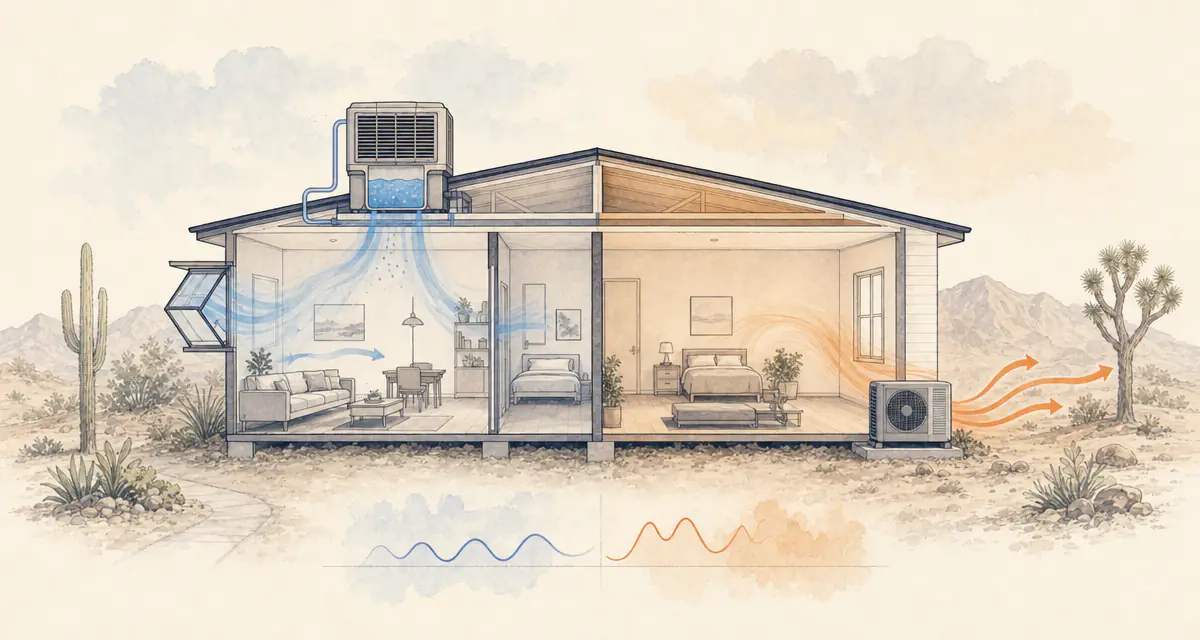
A direct evaporative cooler moves air across wet pads. Water evaporates into the airstream, lowering dry-bulb temperature while adding moisture. Most portable air coolers and common whole-home swamp coolers are direct systems.
An indirect evaporative cooler uses a heat exchanger and separate wet airstream, so primary supply air can cool without the same direct moisture increase. It is less common in ordinary residential buying decisions. ASHRAE's evaporative-cooling chapter explains both processes.
Refrigeration AC and heat pumps
An air conditioner uses a compressor, refrigerant, coils, and fans to move heat outside. When the indoor coil is cold enough and the system runs long enough, water vapor condenses and drains away. Central AC recirculates indoor air through ducts. Portable AC sends heat outside through an exhaust hose.
An air-source heat pump uses the same refrigeration process in cooling mode. A reversing valve lets it heat the home in winter. ENERGY STAR's heat-pump guide covers layouts and sizing.
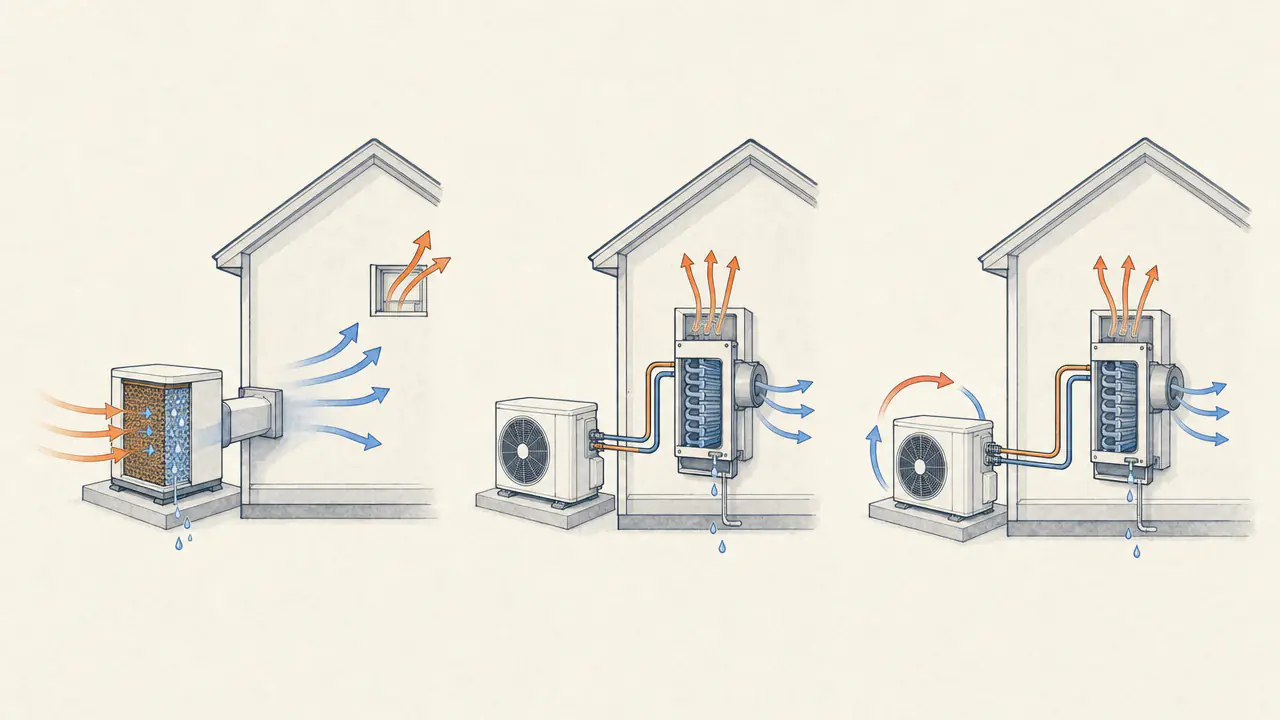
Simplified system paths, not installation instructions.
Climate and humidity decide whether evaporation has room to work
Direct evaporative cooling is limited by the entering air's wet-bulb temperature, the ideal lower limit for its dry-bulb temperature. Real equipment gets partway there, based on effectiveness, airflow, pad condition, and water distribution.
A useful planning estimate is:
leaving dry-bulb temperature ≈ entering dry-bulb temperature − [effectiveness × (entering dry-bulb temperature − entering wet-bulb temperature)]
For example, air at 100°F dry-bulb and 65°F wet-bulb with 80% effectiveness has an estimated leaving temperature of 72°F. That is supply air, not a room-temperature promise. Solar gain, insulation, leakage, internal loads, airflow, and exhaust still determine comfort.
There is no useful nationwide relative-humidity cutoff. Relative humidity changes with temperature, and identical readings can have different wet-bulb conditions. Use summer design dry-bulb and wet-bulb or dew-point data when you screen a system.
| Summer pattern | Direct evaporative fit | Refrigeration AC or heat-pump fit |
|---|---|---|
| Hot and dry, with clean outdoor air | Strong candidate if water, drainage, and a relief path work for the home | Also works, with compressor electricity and stronger moisture control |
| Mixed or borderline humidity | May work for part of the season or at certain times of day; indoor humidity needs attention | More consistent across changing weather |
| Hot and humid | Often adds moisture faster than it can create useful cooling | Better match for temperature and humidity control |
The EPA humidity guidance recommends indoor relative humidity below 60%, ideally 30% to 50%. That is a moisture guardrail, not a performance cutoff. If a direct cooler leaves condensation or persistent high humidity, address that problem first. See our whole-house dehumidifier guide when dehumidification is the real need.
Compare portable, direct, and whole-home scope before capacity
Evaporative cooler can mean a small tank appliance, a window unit, or a roof-mounted ducted system. AC can mean a portable exhaust appliance, a window unit, a mini-split, or central equipment. These systems do not deliver the same service.
| Equipment scope | What it usually serves | Air-path and ownership reality |
|---|---|---|
| Portable evaporative cooler | One room or small zone | Easy to place, yet it adds moisture and is not whole-home AC. |
| Window or through-wall evaporative cooler | One room or connected zone | Needs an opening, water management, and a way for warm air to leave. |
| Fixed whole-home evaporative cooler | Several rooms through ducts or a large air path | Usually supplies outdoor air continuously, so relief openings are part of the design. |
| Portable AC | One enclosed room or zone | Must exhaust heat outdoors and should be matched to the room load. |
| Central AC or ducted heat pump | The whole home or designed zones | Operates with windows closed and needs matched equipment, ducts, drainage, power, and commissioning. |
Direct whole-home systems often need a relief opening because supply air is entering while indoor air is leaving. The DOE HVAC guide describes this air path. A portable recirculating cooler still adds moisture and cannot make outdoor air cleaner.
Comfort and capacity use different yardsticks
Evaporative coolers are described by airflow in cubic feet per minute, or CFM, water rate, and effectiveness. AC and heat pumps use Btu per hour, airflow, and ratings such as SEER2, EER2, or CEER for portable equipment. CFM is not a Btu-per-hour equivalent. Do not compare a portable cooler's fan wattage with a central AC compressor serving a different load.
For an evaporative quote, ask for the supply condition and CFM at local design conditions, water and bleed-off rates, media replacement interval, and intended room or whole-home air path.
For central AC or a heat pump, require a room-by-room Manual J load calculation, model numbers, matched-system ratings, duct airflow, and a condensate plan. Square-foot coverage is a screening clue, not a design result.
Energy savings can trade against water use
An evaporative cooler uses fan and pump electricity, plus water for evaporation and possibly bleed-off, overflow, or once-through operation. A refrigeration AC or heat pump uses compressor and fan electricity and produces condensate that must drain. Typical residential refrigeration systems do not have the same process-water stream.
The DOE's homeowner HVAC guide gives an older, broad comparison in which evaporative coolers can use about one-quarter as much energy as central AC and cost about half as much to operate. Treat that as class-level context. It does not transfer automatically to a portable cooler, a whole-home installation, or a humid-weather backup system.
Use your own rates and comparable service:
- Evaporative electricity:
(fan watts + pump watts) ÷ 1,000 × cooling hours × electricity rate. - Evaporative water and sewer:
total gallons used × combined water and sewer rate, including bleed-off and any once-through discharge. - AC or heat-pump electricity: use the matched system's rated efficiency as a starting point, then adjust for load, weather, thermostat, cycling, duct losses, and actual run hours.
The DOE's current water guidance gives evaporative equipment an efficiency range of 3 to 15 gallons per ton-hour of cooling and identifies 5 gallons per ton-hour as water-efficient. A ton-hour means 12,000 Btu of cooling delivered for one hour. This is an equipment-class rating, not a portable tank's refill schedule. The guidance also covers scale, bleed-off, leaks, flow, pads, pumps, and reservoirs. DOE's water guidance is a useful starting point for the water line in a quote.
Hard water, drought restrictions, wastewater rules, and water pricing can change the answer. A system that saves electricity yet sends a large bleed-off stream to the drain has a different ownership profile from a lower-water recirculating system.
Indoor air quality and wildfire smoke set a boundary
The outdoor-air path can flush heat and bring in fresh air when outdoor air is clean. It can also bring in pollen, dust, odors, and smoke. A wetted pad is not automatically a MERV- or HEPA-rated filter or a tested wildfire-smoke solution.
EPA says evaporative coolers increase ventilation and indoor relative humidity when operated with open windows. It also says to avoid using one when outdoor pollution is high unless the system has a high-efficiency filter. EPA's evaporative-cooler guidance supports treating outdoor air quality as a system-fit question.
During wildfire smoke, prioritize clean indoor air over the lower-energy option. Keep windows and doors closed, use AC in recirculation mode when available, and use high-efficiency filtration or a portable air cleaner. EPA's wildfire smoke guidance says homes without AC should close windows after the indoor air is cool and use an air cleaner. If the home cannot stay both cool and clean, use a cooler, cleaner space in the community.
AC and heat-pump filters are not automatically air purifiers. Check the actual rating, cabinet fit, pressure limits, replacement cost, and service interval. Use a separate room air cleaner for fine-particle or smoke reduction.
Installation and maintenance are part of the equipment
Evaporative cooler scope
A portable tank unit needs safe power, clean water, pad access, and regular cleaning. A fixed installation can add water supply, backflow protection, overflow and bleed-off drainage, structural support, flashing, ducts, relief openings, electrical work, and service access. Seasonal draining can prevent freezing and scale damage.
Plan for pad replacement, mineral cleaning, pump, reservoir, leak, and flow checks. Do not connect a fixed cooler to an arbitrary hose or drain. Manufacturer instructions and local plumbing requirements control the detail.
AC and heat-pump scope
A central system needs load-based equipment selection, matched models, duct and static-pressure review, refrigerant lines, condensate, electrical work, filter access, controls, clearances, and startup measurements. A ductless system adds indoor heads, line sets, condensate routes, mounting, and zone planning.
Maintenance includes filters, coils, condensate drains, electrical connections, and outdoor clearance. A heat pump adds winter operation, defrost water, reversing-valve controls, and backup heat. ENERGY STAR's maintenance checklist covers recurring refrigeration-system tasks.
Use a qualified installer for fixed water, roof, electrical, or refrigerant work. A low equipment price can leave leaks, undersized circuits, poor airflow, drain failures, or roof damage out of scope.
The heat pump is the third option worth pricing
If a home needs both heating and cooling, compare an air-source heat pump with AC before choosing a direct cooler. In cooling mode, it is a refrigeration air conditioner. Its extra value comes from reversing the cycle for heating.
An ENERGY STAR split-system heat pump currently needs at least 15.2 SEER2, 11.0 EER2, and 7.8 HSPF2. Cold-climate designation adds a COP of at least 1.75 at 5°F and at least 70% of 47°F heating capacity at 5°F, plus controls verification. These thresholds do not predict a home's bill. ENERGY STAR's current criteria and the home's heating load belong in the quote.
We prefer a heat pump when its heating service has real value, especially when both existing systems need replacement. A straight AC comparison makes sense when a newer furnace will stay and the project only needs cooling. Our heat pump vs. AC guide covers the whole-system comparison.
Verify 2026 cost, incentives, and permits before you buy
Use market data as a starting point
As of September 11, 2026, Angi reports a $2,543 average for swamp-cooler installation, with most reported projects between $1,544 and $3,759. Its 539 verified projects combine portable, window-mounted, roof-mounted, and whole-home work. It lists illustrative averages of about $300 for portable, $750 for window-mounted, $2,500 for roof-mounted, and $3,500 for whole-home or ducted installation. These are mixed-scope planning figures. Angi's 2026 cost data explains the sample and drivers.
Angi's July 9, 2026 central-air guide lists $5,900 as an average new central AC system cost and separately describes installation costs of $1,500 to $4,000. Treat both figures as broad benchmarks. Duct condition, equipment tier, electrical work, permits, access, and commissioning can move a quote far from a national average.
Compare the same service with this worksheet:
Installed equipment and labor
+ electricity for the expected cooling season
+ water, sewer, and bleed-off cost for an evaporative system
+ pads, filters, cleaning, and service
+ permits, electrical, duct, roof, water-line, drain, or structural work
− verified live rebates or incentives
= comparable first-season or ownership cost
The worksheet is only useful when the systems deliver similar hours, area, temperature, and humidity. A cheaper cooler that cannot meet the home's humid-day load is not a cheaper way to buy the same comfort.
Verify the program, date, and equipment
For a 2026 installation, do not include the former federal Energy Efficient Home Improvement Credit in the budget. The IRS credit guidance limits it to qualifying property placed in service before December 31, 2025, and the 2025 Form 5695 instructions exclude later property. A 2025 installation filed on a 2026 tax return is a separate tax-year question.
State, utility, Tribal, and local programs can still change the net price. DOE says Home Energy Rebates are available in select states and directs homeowners to state or territory energy offices for status and eligibility. Do not assume every cooling technology qualifies. Start with Watt Wallet's state heat-pump rebate guide or ENERGY STAR rebate finder, then confirm the exact equipment, income rules, contractor, timing, and stacking requirements. Our rebate versus tax credit guide separates savings from the gross quote. DOE's program page describes the current boundary.
Check your local authority before fixed work
Permit rules belong to the local authority having jurisdiction, or AHJ. A project can involve mechanical, electrical, plumbing, roof, zoning, HOA, backflow, drainage, noise, or wastewater requirements. Equipment type, location, structural changes, utility connections, and adopted code determine the boundary.
Local examples show the variation. Phoenix says adding or relocating AC or an evaporative cooler may require a permit, while same-size, same-location replacement may not. Phoenix's residential permit brochure is not a national rule. Denver lists residential AC and evaporative units as eligible mechanical quick-permit work under its own conditions. Denver's quick-permit page shows why the local process matters.
Before buying or signing, ask your building department whether the specific portable, window, replacement, roof, or new fixed installation needs mechanical, electrical, plumbing, roof, or zoning approval. Ask the installer to put permit responsibility, inspection fees, backflow and drainage work, manufacturer installation requirements, and warranty conditions in the written scope.
Decision checklist for a homeowner quote
Use these questions to compare an evaporative cooler, AC, and heat pump on equal terms:
- What are the home's summer design dry-bulb and wet-bulb or dew-point conditions?
- Is the goal one room, a zone, or whole-home control, and can the home provide the required air path or relief openings?
- What indoor humidity range is acceptable, and how will it be measured?
- What is the delivered capacity at local design conditions: CFM and supply condition for evaporation, or Btu per hour and matched ratings for AC or a heat pump?
- For a direct cooler, what are the evaporation, bleed-off, overflow, drainage, hardness, water/sewer, filter, and smoke assumptions?
- Does the quote include the Manual J load, matched equipment, duct or zone plan, electrical work, condensate, structural work, startup testing, and service access?
- Which maintenance, rebates, AHJ approvals, HOA rules, and licenses belong to the owner or installer?
FAQ
Does a swamp cooler work in humidity?
Direct evaporation has less wet-bulb room to lower temperature in humid air and adds moisture. Use local wet-bulb or dew-point conditions plus indoor humidity. AC or a heat pump is usually the stronger match.
How much water does an evaporative cooler use?
There is no single daily number. Use depends on load, fan speed, wet bulb, pad, hardness, bleed-off, overflow, and system type. DOE gives 3 to 15 gallons per ton-hour as a class-level range and calls 5 water-efficient. Tank capacity is not hourly use.
Can an evaporative cooler cool a whole house?
Yes, a fixed system can serve multiple rooms in a suitable dry climate when airflow, relief, ducts, and layout are designed together. A portable tank cooler serves a room or spot.
Do windows have to be open for a swamp cooler?
Direct whole-home systems generally need open windows, doors, or relief openings so outdoor air can push warm air out. A portable unit may recirculate, yet it still raises moisture and is not closed-window AC.
Is AC cheaper than an evaporative cooler?
Evaporative equipment often costs less to buy and run in the dry climate it suits. Add water, sewer, pads, installation scope, and AC backup for humid or smoky weather.
Is a heat pump better than an evaporative cooler?
A heat pump is more complete when the home needs closed-window cooling, moisture control, and heating. Direct evaporation can fit hot, dry air when cooling-only service is enough.
Do I need a permit to install a swamp cooler?
Maybe. Portable, window, roof, replacement, and ducted work can fall under different rules. Ask the AHJ about equipment, location, utilities, zoning, and inspections.
Can I claim a federal tax credit for a 2026 installation?
Do not assume the former federal credit applies. IRS guidance limits it to qualifying property placed in service before December 31, 2025. Check current state, utility, Tribal, or local programs for the exact equipment and date.
Once you have itemized proposals, use Watt Wallet's questions to ask an HVAC contractor to close gaps in the load calculation, equipment match, water or condensate plan, permit scope, and final price before you sign.