An aging air conditioner can still cool reliably, while a younger unit can become expensive to keep running. The difficult part is deciding whether the next repair buys useful service or delays a replacement you already need. Start with the lifespan range for your equipment, then weigh its condition, repair history, and cooling costs. We use those pieces together so you can plan an upgrade without retiring a working system just because of its birthday.
Last reviewed: October 29, 2026
How long do air conditioners last by type?
Central air conditioners generally have a planning lifespan of about 15–20 years. Ductless, window, and portable units have different estimates. These ranges help with budgeting; they do not predict the failure date of an individual unit.
| Air conditioner type | Planning estimate | What supports the estimate |
|---|---|---|
| Central AC | About 15–20 years | Department of Energy (DOE) consumer guidance and Carrier's lifespan estimates |
| Ductless mini-split | About 10–15 years | The same Carrier guidance; DOE's consumer guide gives 12–15 years |
| Window AC | About 8–10 years | The same Carrier guidance; DOE separately estimates about nine years for the broader room-AC category |
| Portable AC | About 5–10 years, with weaker evidence | Danby's manufacturer estimate, rather than a measured national average |
The Department of Energy's home cooling guide supplies the central and ductless baselines. Its 10–15-year room-unit estimate combines window and portable equipment, so it cannot establish a separate lifespan for either type.
There is stronger field-based evidence for the broader room-AC category. DOE's room-AC lifetime analysis estimated an average of approximately nine years using historical shipments, housing stock, and reported appliance ages. That is an estimate of retirement across a population, not a requirement to replace a nine-year-old window unit.
Portable AC evidence is less certain. In its portable-AC lifetime model, DOE borrowed a room-AC lifetime distribution and used a 10.5-year average. It did not establish that average from portable-only field data. The 5–10-year manufacturer range is useful for planning, but neither figure promises how long yours will last.
Find the age of the equipment you actually have
The installation invoice is the clearest starting point for years in service. An accessible rating plate provides the model and serial numbers. The serial number may encode the manufacture date, as Carrier's age guidance explains, and the manufacturer may need to decode it. Manufacturing and installation dates can differ, so a build date alone does not establish years in service.
For a split central AC, keep separate records for the outdoor condenser, indoor cooling coil, and furnace or air handler. They may have been installed at different times. A new compressor or coil does not make the rest of the equipment new. Refrigerant handling or work that could breach the refrigerant circuit belongs with an EPA Section 608-certified technician.
A typical split system has an outdoor unit connected to an indoor coil by refrigerant tubing. A blower, often housed in a furnace, moves air through the coil and ducts. That split-system layout explains why an AC problem does not automatically mean the furnace needs replacing too.
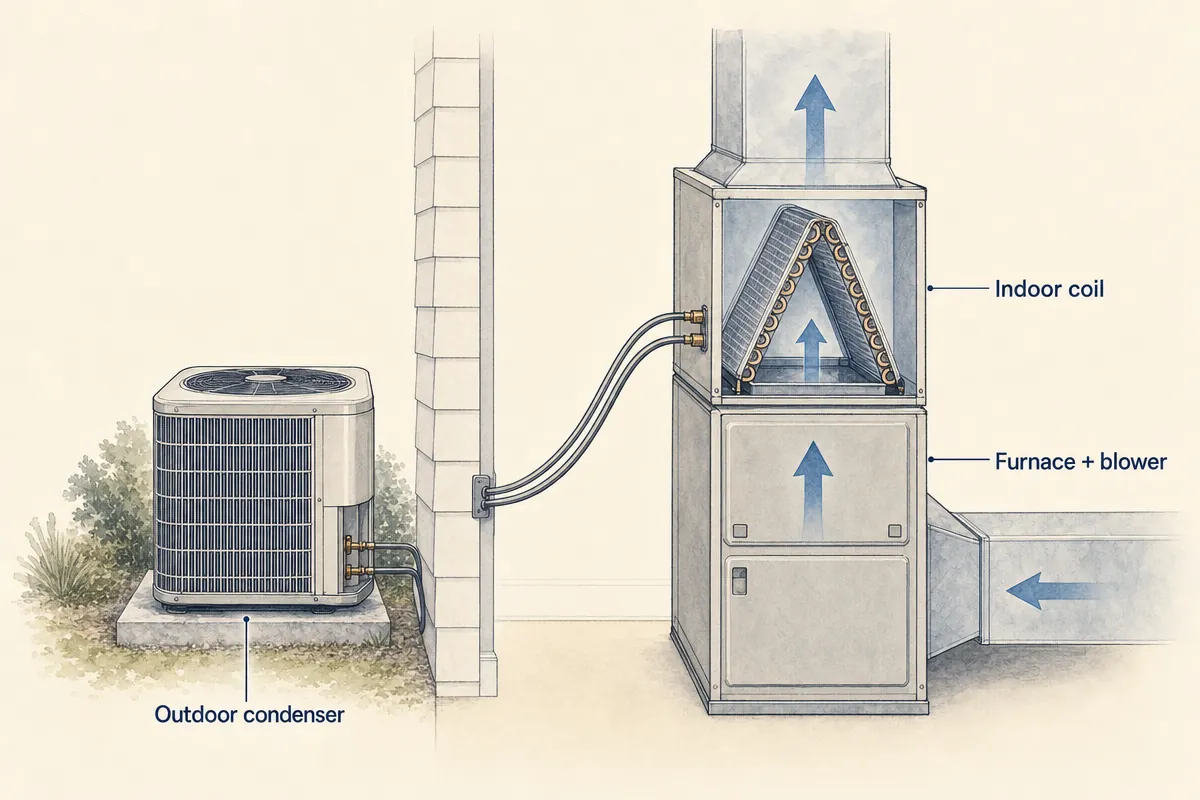
Simplified layout, not wiring instructions.
A useful service record includes each component's installation year, past repairs, refrigerant type, and remaining parts and labor coverage. Keep equipment cabinets closed; a qualified technician handles internal identification and diagnosis.
What makes an AC wear out sooner?
Calendar age leaves out how hard the equipment has worked. Carrier's wear-factor guidance identifies climate, use, installation, and exposure as factors. Several conditions affect service life:
- Climate and operating hours. Long, hot cooling seasons mean more use than short, mild summers. A system serving the whole house also has a different workload from one cooling an occasional-use room.
- Coastal exposure. Salt-laden air can accelerate corrosion of outdoor equipment. That guidance does not quantify a fixed number of years to subtract for coastal exposure.
- Sizing and installation. Incorrect capacity, poor airflow, and installation problems can undermine comfort and performance from the beginning.
- Filters, coils, and drainage. Restricted airflow and dirty coils make cooling harder. Unresolved drainage problems can cause damage around the indoor equipment.
These factors explain variation within a lifespan range. They do not support a promise that maintenance adds a particular number of years, or that one brand will always outlast another.
Signs your air conditioner needs attention
ENERGY STAR's replacement warning signs include equipment over 10 years old, frequent repairs with rising bills, and uneven comfort. Age is a reason to assess the options. It is not an automatic replacement deadline.
| What you notice | What it means for the decision |
|---|---|
| Repeated breakdowns | Repair history and the remaining equipment condition deserve more weight than one isolated bill |
| Cooling costs rise | Compare electricity use, rates, weather, and household changes before attributing the increase to the AC |
| Rooms stay hot or humid | Equipment operation, ducts, insulation, and sizing can all affect comfort |
| New noise or weaker cooling | Professional diagnosis is needed before choosing a repair or replacement |
| Repeat refrigerant additions | A leak needs a repair plan; repeated top-ups do not resolve it |
A bigger utility bill alone does not prove that the compressor is worn out. More expensive electricity, hotter weather, longer billing periods, or another household load can raise the total. Likewise, replacing the outdoor unit alone may leave a duct or insulation problem untouched.
Refrigerant handling and work that could breach the refrigerant circuit belong with an EPA Section 608-certified technician. EPA advises locating and repairing leaks rather than repeatedly topping off refrigerant.
Should you repair or replace your AC?
We recommend deciding in this order: get a professional diagnosis, define the repair's full cost, then compare it with a replacement that addresses the same need.
Keep using a healthy system, while planning ahead
A system that cools comfortably, has a manageable operating cost, and rarely needs repairs can remain useful beyond its planning range. A 20-year-old central AC deserves a replacement budget and a professional condition assessment. Its age alone does not establish that replacement is the better purchase today.
Planning before failure also leaves room to compare an AC-only replacement with a heat pump. Our heat pump versus AC comparison separates the cooling decision from the value of adding electric heating.
Repair an isolated problem when the rest is sound
Repair has a stronger case when the technician identifies a specific fault, the remaining equipment is in good condition, and the work restores reliable cooling at a manageable cost. Remaining warranty coverage can also lower the out-of-pocket bill.
The written repair estimate should identify the failed component, diagnosis, parts, labor, refrigerant if needed, and repair warranty. For a leaking coil, it should explain how an EPA Section 608-certified technician will resolve the leak. For a major repair, it should describe the condition of the other major components and any known unresolved problems.
Compare replacement when failures or costs accumulate
Replacement deserves a closer look when an aging unit needs a major repair, several components are deteriorating, breakdowns keep interrupting cooling, or comfort problems persist after their cause has been identified.
Here are two illustrative situations, not market-price estimates:
| Situation | Stronger next step |
|---|---|
| A 14-year-old central AC needs one $600 repair; the technician finds the rest sound, and cooling was comfortable | Consider the targeted repair and keep a replacement budget |
| A 14-year-old central AC needs a $3,000 major repair after repeated failures, with other deterioration documented | Compare a full replacement quote alongside the repair |
The same age produces different decisions because the condition and repair history differ. A large repair can still be reasonable if coverage reduces its cost and the rest of the system is sound.
Why the $5,000 rule is only a rough screen
Carrier's replacement guidance describes a $5,000 rule of thumb that multiplies equipment age by repair cost and favors considering replacement above $5,000. For the first example, 14 × $600 = $8,400. It would point toward replacement without considering the sound remaining equipment, warranty, or installed replacement price.
Carrier's AC guidance also uses a repair approaching half the replacement price as a rough screen. Both shortcuts omit parts availability, comfort, breakdown risk, and the scope of the proposed replacement. Neither provides a dependable verdict on its own.
Put cooling savings in dollars
A more efficient replacement can lower cooling electricity use. Whether those savings justify the purchase depends on how much cooling costs now and what the replacement costs beyond the repair alternative.
Separate cooling from the whole electricity bill. Count only avoidable cooling energy charges: the charges that fall when the AC uses fewer kilowatt-hours. Exclude fixed customer or service charges that remain the same. AC-specific energy data provides a clearer starting point when available. Comparing cooling-season usage with milder months gives a rougher estimate because other household loads also change.
For a simple comparison:
Annual cooling savings = annual avoidable cooling energy charges × estimated reduction in cooling energy use
An illustrative $1,200 in annual avoidable cooling energy charges and a 25% reduction produce $300 in annual savings, assuming the same electricity rate. The $1,200 excludes fixed utility charges. If replacement costs $9,000 and repair costs $1,000, the additional upfront cost is $8,000. Dividing $8,000 by $300 gives about 27 years to recover that difference through cooling savings alone.
Those assumed prices and savings are not a forecast for your home. This simple calculation excludes financing, future repairs, rate changes, incentives, and any heating savings from a heat pump. It shows why a percentage efficiency claim is insufficient to promise a quick payback.
Comfort, reliability, and avoiding another breakdown can still justify replacement. Keep those benefits separate from the energy-savings calculation.
Maintenance that supports useful service life
ENERGY STAR recommends annual pre-season professional maintenance and monthly central-system filter inspections in its cooling maintenance checklist.
Homeowner care stays simple: clean or replace accessible filters according to the equipment instructions, keep outdoor airflow clear of loose debris and vegetation, and report changes in cooling, sound, or visible drainage promptly. Window and portable units have model-specific filter, drainage, and storage requirements.
Professional service covers coils, airflow, electrical connections, controls, and condensate drainage. Refrigerant handling or work that could breach the refrigerant circuit belongs with an EPA Section 608-certified technician. Leave electrical compartments and other internal repairs to qualified technicians. Maintenance supports performance and can help avoid early failure; it cannot guarantee an extra five or ten years.
Two questions that affect older-system repairs
Does an expired warranty mean the AC is worn out?
No. Warranty length defines coverage, not equipment life. Parts coverage can remain active while labor is excluded, and eligibility can depend on registration, ownership, equipment, and the written terms. The repair estimate should state what coverage applies and which costs remain yours. Our parts and labor guide explains the distinction between manufacturer parts and installer labor coverage.
Do refrigerant changes force me to replace a working AC?
No. EPA permits continued use of existing R-22 equipment; its phaseout does not require owners to replace or retrofit it. EPA also permits continued use and repair of systems using hydrofluorocarbon refrigerants under its existing-system repair guidance. Refrigerant and component availability still belong in the repair estimate. Any refrigerant handling or repair that could breach the refrigerant circuit belongs with an EPA Section 608-certified technician. Rules for new equipment are a separate issue from whether your existing unit can remain in service.
Make the next quote answer the right question
For an aging AC, the useful question is how much reliable, comfortable service the proposed work buys. The answer combines diagnosis, remaining equipment condition, repair history, and the full price of each option.
If replacement is justified, a heat-pump option deserves a place beside the AC quote when its heating capability serves a real need. The comparison needs the home's heating requirements, existing furnace condition, utility rates, and duct and electrical scope. A heat pump is not automatically cheaper to run or longer-lived.
Before signing a replacement proposal, use our contractor quote questions to get the sizing, equipment, installation scope, and warranty answers in writing.