Published: August 13, 2026
Changing the cooking surface can trigger a new 208- or 240-volt circuit, gas-line work, cookware purchases, and a different ventilation plan. The burner technology also changes how quickly heat reaches the pan, how the kitchen feels, and what lands on the utility bill. A useful induction cooktop vs. gas range decision covers the whole project, from a weekday simmer to the electrical panel.
The short answer
We recommend induction for most households when the electrical scope is practical and the cook's main pans are compatible. It usually boils faster, changes heat input quickly, wastes less heat, cleans easily, and adds no burner combustion to the room. The pan, food load, power setting, and specific appliance still control how quickly food temperature changes.
Gas remains a reasonable choice when a compliant gas connection and effective outdoor-vented hood already exist, electrical conversion work is disproportionate, or the cook regularly uses a round-bottom wok on stable support approved by the range maker. Direct-flame techniques belong in the decision only when the appliance and cookware manufacturers permit them.
The annual energy bill rarely settles the choice. Using 2025 U.S. average retail energy prices and a hypothetical active-cooking load, our benchmark puts induction near $35 a year and gas near $26. That roughly $9 benchmark difference cannot repay major wiring work. A household decision needs the avoidable charges in its local tariffs, plus installation, ventilation, cooking habits, and the value of closing a gas account when the range is the final gas appliance.
First, compare the same appliance
A cooktop contains only the surface cooking zones. A range combines a cooktop and oven in one cabinet. The terms stove, cooktop, and range are often used interchangeably, but a project quote cannot mix them.
An induction cooktop replacing a gas range still needs an oven elsewhere. That can add cabinetry, another circuit, and a wall oven to the project. A full induction range is the like-for-like replacement for a full gas range. The cooktop comparison below concerns surface cooking. Oven capacity, convection features, and oven energy use belong in a separate line of the purchase decision.
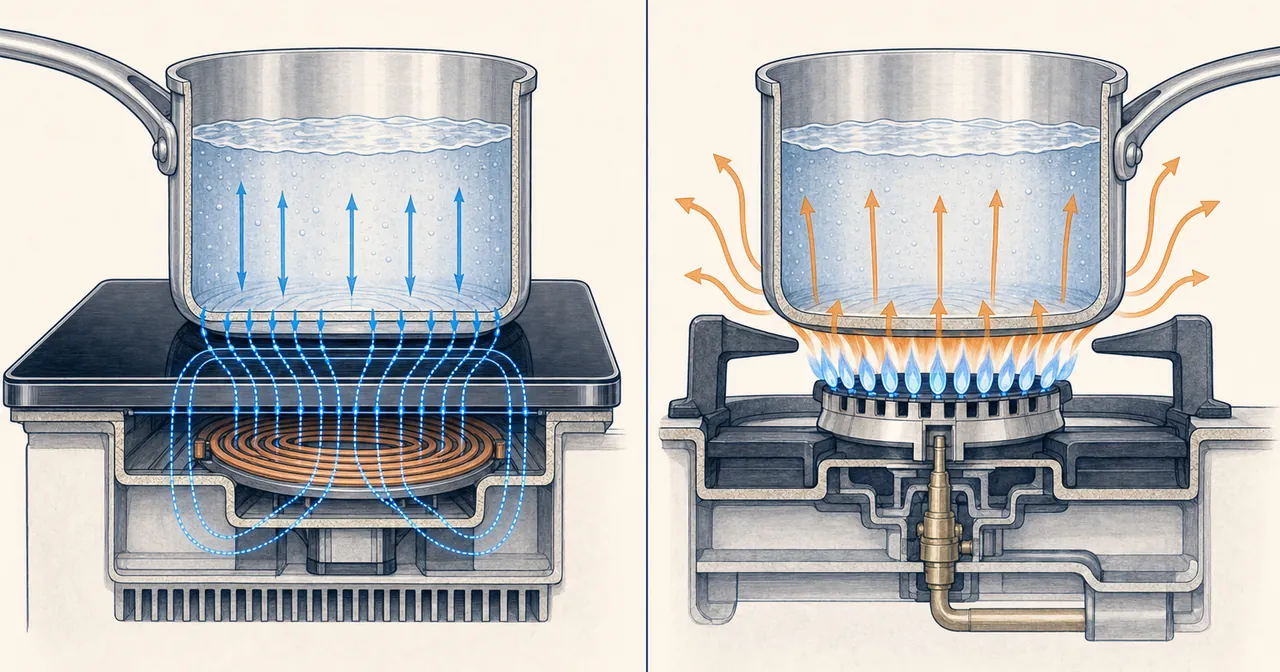
Induction sends alternating current through a coil below the glass. The resulting magnetic field creates heat in compatible cookware. Gas burns natural gas or propane below a grate, then the flame and hot combustion gases heat the pan. That extra step explains much of the difference in speed, kitchen heat, and efficiency.
Induction vs. gas at a glance
| Factor | Induction cooktop or range | Gas cooktop or range |
|---|---|---|
| Heating speed | Usually faster for boiling; pan, food, zone power, and model affect the result | Heat input responds quickly, while less burner energy reaches the pan |
| Control | Power changes quickly; actual pan and food temperature follow their thermal mass | Flame size changes quickly and gives visible feedback |
| Energy transfer | About 85% reaches the cookware under the cited test basis | About one-third reaches the cookware under the cited test basis |
| Kitchen heat | Less waste heat enters the room | More heat can escape around the pan |
| Air quality | No combustion at the burner; food still creates particles and vapors | Food emissions plus combustion pollutants whose amounts vary with equipment, use, and ventilation |
| Cookware | Requires a magnetic base and model-compatible size and shape | Accepts a wider range of materials and shapes when the cookware and grate support them safely |
| Cleaning | Flat glass is quick to wipe | Grates, burner caps, and ports take more work |
| Installation | Model-controlled 208/240-volt requirements commonly span roughly 30 to 50 amps | Needs a compliant gas connection, shutoff, and usually a 120-volt receptacle |
| Ventilation | Recommended for cooking emissions; the manual and local code control any legal requirement | Outdoor exhaust is the stronger plan for food and combustion emissions; the manual and local code control requirements |
| Power outage | Does not operate without electricity | The exact-model manual controls whether surface burners may be lit manually; modern ovens generally need power |
| Repair | Adds power electronics, sensors, fans, and glass; cost and serviceability vary by model | Surface-burner hardware is often simpler; oven electronics, parts, and service still vary by model |
| Best fit | Most everyday home cooking, easy cleaning, lower kitchen heat, and gas-free kitchens | Approved direct-flame uses, a safely supported round-bottom wok, or a home where electrical conversion is impractical |
Cooking performance: induction wins most daily tasks
Speed and heat-input response
Induction changes electrical power to the pan quickly because there is no resistance element or heavy grate to heat first. ENERGY STAR's cooking guidance says about 85% of induction energy reaches the cookware, compared with about one-third for gas, and says induction can boil water in nearly half the time.
That is a technology comparison, rather than a promise for every meal. Pan material and mass, flatness, zone size, starting temperature, food quantity, power sharing, and the specific model affect boiling and cooking time. Turning induction down changes heat input quickly, while the stored heat in the pan and food dissipates on its own schedule.
Gas heat input also changes quickly when the flame changes, and the visible flame is useful feedback. Its lower heat transfer means less burner energy reaches the pan under the cited test basis. Induction usually wins high-power water heating, while either technology can feel responsive with well-matched cookware and controls.
Simmering depends on the appliance, pan, and food
A capable induction unit can hold chocolate, sauces, and a low simmer with repeatable power settings. Less capable units may cycle power in noticeable bursts at low settings. The pan spreads and stores those pulses differently according to its materials and construction.
Gas burners also vary. A well-designed burner can hold a small stable flame, while a high-output burner may struggle near its lowest setting. Low-power behavior, control steps, zone design, cookware, and the food load are more informative than a broad claim that either fuel delivers instant temperature control.
Pan size matters more than the circle on the glass
The active induction coil can be smaller than its printed zone. A wide skillet over a small coil can develop a hot center and cooler edge. A sound purchase specification pairs the active coil diameter with the flat base diameter of the household's largest skillet, stockpot, griddle, or canner. Bridge zones help rectangular griddles, but their geometry still controls heat coverage.
Gas spreads heat beyond the burner head and up the pan's sides. That can help some oversized or curved cookware, while it also wastes energy and can overheat handles. Flame, pan, grate, and cookware instructions all need to agree.
Woks and direct flame need explicit approval
A round-bottom wok belongs only on a grate or wok support that the range manufacturer approves and that keeps the vessel stable through stirring and tossing. An improvised ring or an unstable standard grate creates a tip and spill hazard. Standard flat induction zones use flat-bottom cookware. Purpose-built curved induction wok units are a separate appliance category with their own pan and installation requirements.
Gas can provide radiant heat while a pan is lifted and an exposed flame for certain techniques. Those uses are appropriate only when the appliance manual and cookware maker allow them, the vessel remains stable, and the surrounding clearances and ventilation support the technique. A broiler or culinary torch is an alternative only within its own manufacturer instructions.
Power sharing and sound are model-and-pan issues
Boost ratings are rarely additive. Many induction units share a power module between paired zones, so two large pans may not receive maximum boost at the same time. The zone-pairing diagram and whole-appliance connected load matter more than the largest wattage printed beside one burner.
Induction can produce cooling-fan noise, relay clicks, and cookware buzz. Sound varies with the appliance, power level, pan geometry, magnetic layers, base flatness, and how the pan sits on the glass. No general construction label guarantees silence, so the pan and appliance need to be treated as a pair.
Induction vs. gas running cost
Efficiency and price answer different questions. Induction sends a larger share of purchased energy into cookware, while a local kWh can still cost much more than the gas needed to deliver the same pan heat.
The EIA figures below are average retail price benchmarks, rather than marginal or avoidable tariff rates. The 2025 electricity benchmark was 17.30 cents per kWh for U.S. residential customers. The 2025 residential gas benchmark was $15.34 per thousand cubic feet, or about $1.48 per therm using EIA's natural-gas conversion.
For a transparent cooktop-only illustration, we assume 200 kWh per year of active induction cooking. This is a hypothetical input, not a product rating. We then apply the cited 85% induction and one-third gas heat-transfer assumptions to calculate the gas needed to deliver the same useful pan heat.
The 200 kWh assumption is separate from the ENERGY STAR certification metric. ENERGY STAR caps certified electric cooking products at 195 kWh per year under a procedure based on 418 cooking events, and that annual metric includes active cooking and low-power energy. Treating the certification ceiling as 195 kWh of active pan heating would overstate the useful heat represented by the label.
| Hypothetical active-cooking benchmark | Annual energy input | Cost at EIA average retail benchmarks |
|---|---|---|
| Induction | 200 kWh | About $35 |
| Gas delivering the same useful pan heat | About 17.4 therms | About $26 |
| Benchmark difference | Gas about $9 lower per year |
This is a benchmark, rather than a predicted household bill. It excludes active oven cooking, installation, repairs, and the electricity used by gas ignition and controls. Cooking frequency, pan match, flame setting, model efficiency, and local tariffs can move the result in either direction.
The same heat-transfer assumptions produce this rate screen:
Break-even electricity price in $/kWh = gas price in $/therm × 0.087
At the $1.48-per-therm EIA gas benchmark, the break-even electricity price rounds to about 13 cents per kWh. Electricity below that rate favors induction for the assumed active cooking load. Electricity above it favors gas. The formula is a fuel screen and still excludes the gas range's auxiliary electricity.
For a household decision, the useful inputs are the avoidable local tariff charges that change with cooking use. Those can include supply, volumetric delivery, riders, and usage-linked taxes. A fixed monthly gas customer charge becomes avoidable only when the conversion allows the household to close the gas account. It remains when a furnace, water heater, dryer, fireplace, or other appliance still uses gas.
Time-of-use electricity calls for the rate that applies during cooking or a cooking-hour blend. Rooftop solar calls for the value of avoided grid imports or forgone export credits under the tariff. Solar electricity is not automatically free.
A gas-to-induction conversion is an electrical project
A same-fuel range replacement can be simple. A fuel switch adds infrastructure work, and that work can outweigh the appliance price.
Full-size induction cooktops and ranges commonly use 208- or 240-volt service with required circuits in a roughly 30- to 50-amp span. Some ranges use a 120/208- or 120/240-volt connection because controls and other components use the neutral. Outliers exist. The selected appliance's nameplate and installation manual control the exact voltage, connected load, overcurrent protection, conductor, receptacle or hardwired connection, neutral, and clearances.
An electrical load calculation determines whether the existing service has capacity. A new panel is not automatic. Some homes need only a branch circuit, while others need breaker-space work, a subpanel, load management, or a service upgrade. Our guide to the cost of a 200-amp upgrade explains the separate panel, service, utility, and permit scopes.
Local permit and inspection rules control the approval path. The appliance nameplate, installation manual, load calculation, adopted code, permit, and final inspection together determine a compliant installation.
An itemized conversion quote should include:
- exact appliance model, nameplate rating, and manual requirements
- load calculation, breaker size, conductor size, neutral, and circuit route
- receptacle or hardwired connection and appliance cord, where applicable
- gas shutoff, disconnection, and approved capping
- cooktop cutout, cabinet, drawer, countertop, and clearance changes
- separate oven and cabinetry scope when replacing a range with a cooktop
- hood, duct, make-up air, and electrical work required by the design, manual, and local code
- permit, inspection, delivery, haul-away, and finish repair
A portable 120-volt induction burner can show the basic controls, but its available power and zone layout do not represent a full-size unit. A gas range going into a kitchen without gas has the reverse infrastructure problem. New fuel piping, meter capacity, shutoff placement, leak testing, and ventilation can erase any appliance-price advantage. We would not add gas solely to chase a small benchmark energy-cost difference.
Air quality, ventilation, and safety
Gas combustion can emit nitrogen dioxide, carbon monoxide, ultrafine particles, and water vapor into the kitchen. The amount varies with burner design, fuel, flame condition, cookware, use, room size, and ventilation. EPA's nitrogen dioxide guidance identifies gas stoves as an indoor combustion source and recommends an exhaust fan vented outdoors over them. Induction removes combustion at the burner.
The pan and food still create emissions. Searing, frying, oils, and browned food can produce particles and volatile compounds on either cooktop. In one controlled 2024 laboratory comparison, researchers cooked one defined meal three times for each cooktop-and-hood setup. In that experiment, induction used about half as much energy and produced no discernible nitrogen oxides compared with gas. The recirculating hoods reduced particles with both cooktops. That focused protocol does not represent every meal, burner, pan, room, or hood.
We recommend effective kitchen ventilation over induction for moisture, grease, odors, and food-generated pollution. Whether a hood or outdoor exhaust is legally required, along with its airflow, duct, clearances, and make-up air, depends on the appliance installation manual and locally adopted code. For gas, we treat outdoor-vented exhaust as the stronger project plan because it also addresses combustion pollutants.
Induction removes an open flame and usually stops energizing a zone when compatible cookware leaves it. The glass can still get hot because a hot pan transfers heat back into the surface. Residual-heat indicators and ordinary burn precautions still matter. Heavy cookware can crack the glass if dropped.
Pacemakers and other implanted devices
Induction cooktops generate electromagnetic fields. People with a pacemaker, implantable cardioverter-defibrillator, or another active implanted medical device need to follow the exact cooktop manual and obtain personal direction from their clinician or device manufacturer before purchase and use. Separation guidance can vary by implant and appliance, so a distance published for another device or cooktop is not a safe substitute. AHA device-interference guidance explains why magnetic and electromagnetic fields require device-specific advice.
Cookware, cleaning, repairs, and outages
Cookware compatibility
Cast iron, enameled iron, carbon steel, and magnetic stainless steel commonly work on induction. Plain aluminum, copper, glass, and some stainless steel do not, unless the pan has a compatible magnetic base. A refrigerator magnet that sticks firmly across the flat base is a quick initial screen. The cooktop manual, cookware maker, base dimensions, and stable contact still control compatibility.
Compatibility alone does not guarantee even heating or quiet operation. The base should be flat and appropriately sized for the active coil. Pan layers and construction affect heat spread and noise, while the pan and cooktop combination determines the actual result. Gas accepts more materials and irregular shapes only when the cookware maker approves open-flame use and the grate holds the vessel securely.
Cleaning and durability
Induction's smooth top is easier to wipe because there are no grates or burner ports and spills are less likely to bake onto the cooler surrounding glass. Cast iron is compatible with many models, while lifting it instead of sliding it protects the surface. Gas grates and caps tolerate different handling, while spills can clog ignition ports and baked-on residue takes longer to remove.
Repairability varies within both categories
Gas surface-burner hardware is often mechanically simpler. Modern gas ranges can still contain electronic ignition, sensors, fans, and oven control boards. Induction adds power electronics, cooling fans, sensors, and a glass top. A failed board or broken glass can be expensive, yet the actual repair price and repairability depend on model design, parts availability, warranty, labor, and local service coverage. Fuel type alone does not establish reliability or lifetime cost.
Power outages are model-specific
Induction stops during a power outage. For gas, the exact-model manual controls whether a surface burner may be lit manually and the required procedure. Some models permit it, while safety-equipped models can prevent gas flow without power. Modern gas ovens generally need electricity for the igniter, controls, and gas valve, so a gas range is not a universal outage solution.
Which one should you choose?
Choose induction when:
- fast boiling, quick heat-input changes, and a cooler kitchen matter
- easy cleaning and the absence of burner combustion are priorities
- model-compatible, flat-bottom cookware suits the household's cooking style
- the nameplate load and electrical project fit the home
- the project helps remove the final gas appliance and its fixed account charge
Keep gas in the decision when:
- a manufacturer-approved support safely holds the round-bottom wok used regularly
- appliance and cookware instructions allow the direct-flame techniques that matter
- the gas line and effective outdoor-vented hood already meet the project needs
- a new induction circuit would trigger disproportionate service or finish work
- local parts and service make the selected gas model the more repairable choice
For a typical kitchen remodel, we would install induction and put the buying effort into coil size, low-power behavior, physical controls, zone power sharing, electrical scope, and local repair support. Those details decide whether induction works well after the first fast boil.
FAQ
Does food taste different when cooked on induction?
The heat source does not add flavor to food in a pan. Browning depends on pan temperature, contact, ingredients, and technique. Gas changes the process for foods held directly in a permitted flame and for round-bottom wok techniques on manufacturer-approved stable support.
Can induction cookware be used on a gas stove?
Often. Cast iron, carbon steel, and magnetic stainless steel commonly work on gas as well as induction. The cookware maker's heat-source limits still control, especially for bonded bases, coatings, and handles that flame can damage.
Does an induction cooktop need a hood?
We recommend effective ventilation because frying, searing, boiling, and oils still release moisture, particles, grease, and odors. Whether a hood or outdoor exhaust is legally required, and how it must be installed, depends on the exact cooktop manual and locally adopted code.
Is there a rebate for replacing gas with induction?
DOE's May 2026 Program Notice 26-2 removed fuel-switching retrofits from the federal High-Efficiency Electric Home Rebate program. Launched programs received three months to make the change, and existing approved reservations may proceed. Separate state, local, and utility programs can follow different rules.
Before pricing the conversion, use our induction stove rebate guide to identify the incentive path that still fits the project.