Last reviewed: October 30, 2026 (America/Los_Angeles)
Find which side of the window is wet
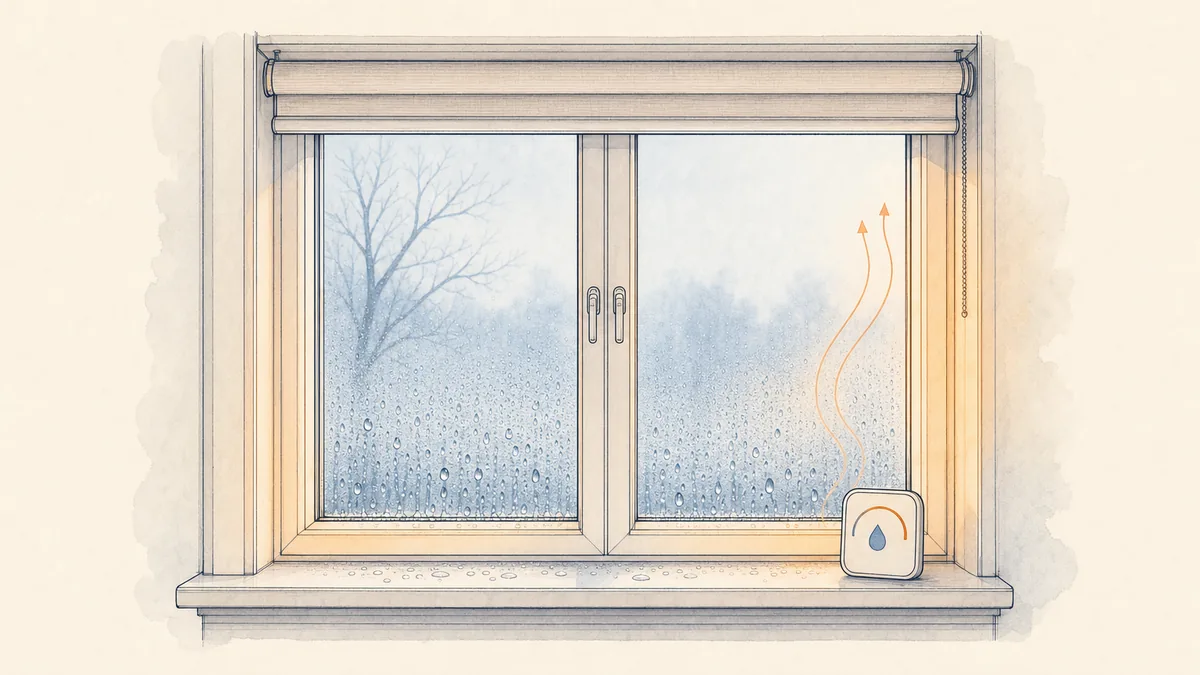
“Inside the window” can mean the room-facing surface or the sealed space between panes. Those are different problems.
| Water location | What it usually means | Appropriate response |
|---|---|---|
| Room-facing glass, where water wipes away from indoors | Indoor air is reaching glass cold enough for condensation | Reduce the moisture load and improve the window's surface temperature or airflow |
| Outdoor face, often around sunrise | Outdoor air is condensing on cool glass | Brief dew that clears as surfaces warm usually needs no repair; persistent, running, or damaging water needs assessment |
| Sealed space within double- or triple-pane glass | The insulating glass unit's edge seal has failed | Arrange glass-unit or sash repair, depending on the window's construction |
Natural Resources Canada's condensation guidance describes sunrise dew on the outdoor face. Transient outdoor dew alone does not establish a failed glass seal, nor do room-side droplets. Exterior condensation can also occur on air-conditioned buildings in hot, humid conditions. Persistent exterior wetting, running water, or damage deserves a window or building-envelope assessment. There is no need to climb outside to diagnose an upper-story window.
Water between a removable storm panel and the original window is another situation. That cavity is separate from a factory-sealed glass unit. Its moisture behavior depends on the assembly's air seals and drainage.
Water stains that appear with wind-driven rain, soft trim, or water entering around the frame need a leak investigation. A humidity adjustment cannot repair failed flashing or another rainwater path.
Why condensation forms on the inside
Window condensation forms when the room-side surface reaches the indoor air's dew point, the temperature at which water vapor begins condensing. Two conditions set the risk: how much moisture is in the air and how cold the glass or frame becomes.
That explains why a window can be wet even when the room feels comfortable. Single-pane glass, conductive frames, and glass edges can become much colder than the room. Closed blinds, deep sills, and furniture can also restrict warm room air from reaching the window.
A humidity percentage is only half the answer
Relative humidity describes moisture in relation to air temperature. The same percentage does not guarantee dry windows in every house or every cold snap.
At a room temperature of 70°F, the relationship looks like this:
| Indoor relative humidity | Approximate dew point | Condensation can begin when the room-side surface reaches |
|---|---|---|
| 30% | 37°F | About 37°F or colder |
| 40% | 45°F | About 45°F or colder |
| 50% | 50°F | About 50°F or colder |
| 60% | 55°F | About 55°F or colder |
These rounded values follow the humidity relationships in the World Meteorological Organization's instrument training material, which cites the 2023 instrument guide. They describe a surface-temperature threshold, not the outdoor temperature or a universal thermostat setting.
For example, consider a 70°F room with a 45°F patch of glass. At 50% relative humidity, that patch is below the roughly 50°F dew point and can collect water. At 30%, it is above the roughly 37°F dew point. This is why a fixed “keep it at 50%” rule can fail in winter.
The EPA recommends indoor humidity below 60%, ideally 30% to 50%, in its home moisture guidance. That general range does not promise condensation-free glass. Very cold weather or poorly insulated windows can require a lower winter humidity level, a warmer window surface, or both.
Why windows can become wet after air sealing
Air sealing reduces uncontrolled leakage. In winter, that can also reduce the accidental exchange of moist indoor air for drier outdoor air. Cooking, showers, laundry, and occupants still add moisture, while wet basements, crawl spaces, or leaks may add more.
New windows create two changes at once: better glass can stay warmer, while tighter installation can reduce air leakage. The final condensation pattern depends on both changes. New room-side droplets do not automatically mean the new windows are defective.
The DOE's air-sealing guidance pairs tightening with ventilation and combustion-safety planning. We take the same approach: keep the intended air seals and address the moisture source and air-exchange design.
Suppose winter humidity rises from 30% to 50% after a retrofit while the room remains at 70°F. The dew point rises from about 37°F to 50°F. Even a somewhat warmer window can now be below that threshold. This is a possible moisture-balance change, not proof of what happened in any particular house.
How to reduce room-side window condensation
Start with measures that remove moisture and let room heat reach the glass. Equipment purchases come after the pattern is understood.
1. Dry the glass, sill, and frame
Wipe up accessible water promptly and dry the surrounding surfaces. A cloth or window vacuum removes the immediate water; neither changes the conditions that caused it.
Occasional light fog that dries quickly is different from daily pooling, peeling finishes, or wet wood. Repeated wetting deserves attention even when the glass becomes clear later in the day.
2. Reduce moisture at its source
Run bathroom exhaust during showers and afterward while moisture clears. Use a range hood that exhausts outdoors when cooking, and keep lids on simmering pots. A recirculating hood does not carry cooking moisture outside, as DOE's spot-ventilation guide explains.
Lower or switch off an unnecessary humidifier. Avoid adding indoor clothes-drying moisture to an already damp room. A conventional vented dryer needs an unobstructed outdoor exhaust. For a ventless dryer, use the condensate collection or drainage arrangement specified by that model's manufacturer. ENERGY STAR's heat-pump dryer guidance describes water-tank and drain-hose options.
Plumbing leaks, rain entry, and damp foundations need their own repairs. Household habits are only part of the moisture load. The University of Minnesota's guidance includes humidifiers, unvented appliances, outdoor humidity, and damp soil among possible sources.
3. Let warm room air reach the window
Raise tightly closed blinds when practical, move furniture away from the glass, and keep heating outlets unobstructed. These changes can reduce cold pockets without increasing the whole home's thermostat setting.
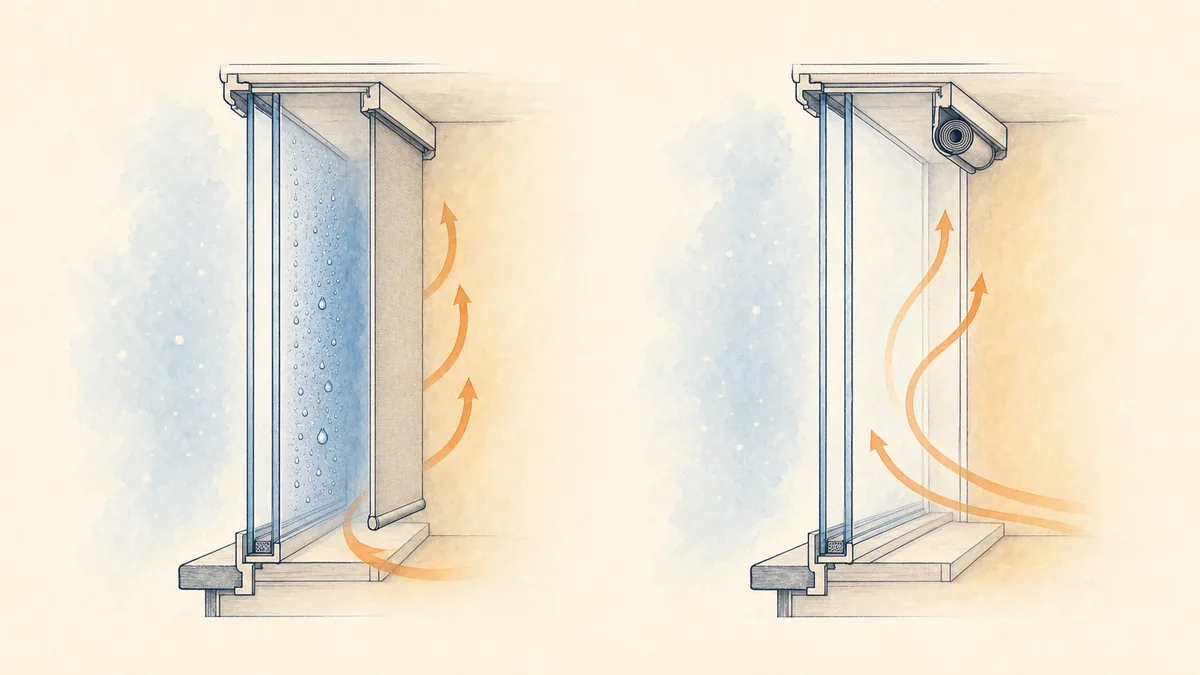
A room fan moves air; it does not remove water vapor. Heating alone also does not remove moisture. It can help by warming surfaces and lowering relative humidity at a given moisture content, but the water still needs an exit or a dehumidifier.
Keep bedrooms adequately heated overnight. A large temperature setback can leave glass colder by morning. The useful goal is a dry window at a reasonable room temperature, rather than increasingly high heating bills to overcome an unresolved moisture problem.
4. Record the pattern in the affected room
A hygrometer measures relative humidity. Record it alongside room temperature in the damp room and another living area, particularly around the time condensation appears. Place the meter away from a shower plume, supply vent, or direct sunlight.
Useful notes include whether one or many windows are wet, whether blinds were closed, outdoor conditions, recent showers or cooking, and whether the problem began after building work. Photos of the wet area and any damaged finish help a professional separate a local cold surface from a wider moisture problem.
Lawrence Berkeley National Laboratory explains that room and surface humidity can differ substantially. A moderate reading in the center of the room does not rule out dampness at a cold surface.
Choose ventilation, dehumidification, or window work
These solutions do different jobs. More than one may be appropriate, but each should have a defined purpose.
| Persistent pattern | Work that fits the problem | Limit |
|---|---|---|
| Several rooms become humid after tightening the home | A whole-home ventilation assessment, including existing exhaust and outdoor-air paths | Condensation alone does not identify a ventilation rate or equipment type |
| Humidity remains high during warm, humid weather | Air-conditioning performance assessment and, when needed, dehumidification | Opening windows can bring more moisture indoors |
| One window stays wet while comparable rooms remain dry | Local airflow, glass, frame, weatherstripping, and installation assessment | A whole-home machine may leave the cold spot unresolved |
| Fog is sealed within a glass unit | Glass-unit or sash repair | A dehumidifier cannot dry a sealed cavity |
| Water follows rain or surrounds damaged trim | Window-opening and bulk-water repair | Ventilation cannot fix the water-entry path |
Ventilation exchanges air
Ventilation reduces indoor moisture when the incoming air contains less water vapor than the outgoing air. Cold outdoor air often provides winter drying even when its outdoor relative humidity is high. Warm, humid outdoor air can increase the moisture load. EPA's condensation-control guidance distinguishes ventilation with cold, dry air from dehumidification in warm, humid conditions.
A brief airing can help when outdoor conditions permit, but leaving windows cracked throughout winter wastes heat and does not provide a controlled, year-round design. Smoke, pollution, severe weather, and security can also limit natural ventilation.
Balanced ventilation supplies and exhausts comparable amounts of air. A heat-recovery ventilator, or HRV, transfers heat between those streams. An energy-recovery ventilator, or ERV, transfers heat and some water vapor. The DOE's energy-recovery explanation describes that distinction.
Neither name guarantees a particular indoor humidity. Climate, occupancy, moisture sources, airflow, controls, and recovery characteristics determine the result. An ERV can reduce the incoming summer moisture load compared with unrecovered ventilation, but it is not a substitute for a dehumidifier when active moisture removal is needed.
Dehumidification removes water
A dehumidifier collects water from indoor air. It can help a damp room or a home that remains humid when the air conditioner has little cooling work to do. It does not repair a leak or, by itself, supply outdoor air.
A persistent whole-home problem may justify a ducted system. Our dehumidifier installation guide covers distribution, drainage, controls, and the distinction between dehumidification and ventilation. Buying a larger unit before addressing water entry or a cold window can leave the underlying problem intact.
Window work raises surface temperature or repairs a defect
Repairing air leaks, improving glazing, or adding a suitable storm panel can make room-side surfaces warmer. Full window replacement is a larger decision than drying a morning film of water. The frame's condition, glass performance, installation, operation, and repair options belong in that decision.
For moisture in a storm-window cavity, the room-side air-control layer matters. A leaky interior insert can let warm indoor air reach the cold original glass. Exterior storms need their intended drainage openings. Do not seal every gap indiscriminately. Our storm window guide explains how interior and exterior assemblies differ.
When persistent condensation needs professional help
Arrange an assessment when water pools repeatedly, wood softens, finishes deteriorate, frost interferes with window operation, or condensation continues despite moisture-source and airflow improvements. DOE's cold-weather moisture guidance describes how ongoing condensation can damage sills and frames. Water-damaged materials, recurring mold, or a musty smell also warrant attention beyond wiping the glass.
An energy auditor or qualified HVAC professional can assess whole-home humidity, ventilation, and pressure interactions. A window or building-envelope specialist handles failed glass units, localized cold surfaces, flashing, and rain entry. Significant water damage or suspected hidden mold needs an experienced moisture or remediation professional. Health concerns belong with a health professional.
For a post-air-sealing problem, a useful written assessment includes:
- Indoor temperature and humidity in affected and unaffected rooms, with outdoor conditions.
- The moisture sources and any active water-entry defects.
- Existing bathroom, kitchen, and whole-home ventilation performance.
- Air-leakage information and the proposed outdoor-air rate and schedule.
- Pressure and combustion-safety assessment where fuel-burning appliances are present.
- The proposed repair, controls, commissioning measurements, and maintenance requirements.
New fans, ducts, electrical work, and penetrations may involve local permits or code requirements. The contractor's scope should assign that responsibility. Increasing exhaust in a tight house with naturally drafted combustion appliances needs safety assessment, rather than simply fitting a larger fan.
If the assessment points to ventilation work, use our whole-house ventilation guide to compare system types, controls, and commissioning requirements before choosing equipment.