Last reviewed: October 28, 2026
Does an EV charger increase home value?
An EV charger can be a selling point for buyers who want home charging. There is no dependable national resale premium you can apply to a private home installation, and installation cost is not a promise of higher appraised value or a higher sale price.
We recommend treating resale upside as uncertain. Choose the project from your present needs and your property's circumstances:
| Your situation | Our recommendation | What supports the decision |
|---|---|---|
| You need charging while you still live there | Consider an installation sized for your driving and remaining time in the home | Daily convenience, the complete quote, and the cost of your alternatives |
| You would install only to help sell | Keep doing nothing as the baseline; spend only with a specific local-market reason | Relevant completed sales, actual buyer feedback, project cost, and listing timing |
| Charging is already installed | Document its capability and make the sale and handoff terms clear | Installation records, included equipment, operating condition, and account access |
Buyer appeal, appraised value, and sale price are different outcomes. Appeal means someone likes the feature. Appraised value is a professional opinion of the property's value. The sale price is what a buyer and seller agree to. None automatically establishes installation payback, and none is the same as the money you might save charging your own car.
What the home-value evidence actually shows
Two U.S. housing analyses explain why charging deserves accurate listing language without establishing a predictable return from installing it.
- Charging appears more often in listings. Realtor.com's 2025 research found EV-charging mentions rose 91.6% when comparing January through September 2025 with the same months in 2024. That measures sellers' marketing language, not a 91.6% increase in value or a measured buyer premium. The distinction is clear in its home-trends analysis.
- Older sales data showed a sale-speed association. Zillow's 2022 release reported that listings mentioning an EV charging station sold 9.5 days faster than expected in its analysis of 2020–2021 sales. The EV row reported no price-premium figure. Its EV charging results do not promise a faster sale for your house. Zillow's original analysis explicitly cautions that these relationships do not establish causation. The study did not measure EV charger installation-cost recovery.
A separate California study examined homes near public charging stations. Its public-charging findings concern neighborhood access, not adding a private charger to a garage. Applying that study's dollar or percentage figures to your installation would answer a different question.
The practical takeaway is narrow: describe an existing charging feature accurately. These findings do not supply a national amount to add to your asking price or an installation budget funded by future resale proceeds.
Will an appraiser count the charger?
An appraiser's treatment depends on support from the relevant market. Fannie Mae requires adjustments between comparable properties to reflect the market's reaction to their differences, rather than arbitrary rules of thumb. Its comparable-sales guidance does not assign EV chargers a fixed premium.
An installation invoice documents what you spent. Permit and inspection records help document the work. Neither proves that buyers will pay the same amount back. A panel upgrade or a faster charger has the same evidence problem when its sole justification is resale.
Installing for your own use before a move
Start with the charging problem you actually have: daily miles, time parked at home, and dependable alternatives at work or nearby. Some households can meet their driving needs with suitable Level 1 charging. Others need faster Level 2 charging. The Department of Energy ties that choice to driving needs, available charging time, and an appropriate electrical supply in its home charging guidance.
Our Level 1 versus Level 2 comparison helps separate the need for faster charging from the assumption that every EV needs a new high-output installation.
Then put your likely move date beside the complete installed cost. The quote should identify equipment, electrical assessment and circuit work, required permits and inspections, mounting, any trenching or surface repairs, and any panel, service, or utility work. Unpriced exclusions remain potential expenses.
For a hypothetical $2,400 installation used for 12 months before moving, the upfront cost works out to $200 per month of access. That is before electricity, maintenance, or any avoided public-charging expense. The example is a way to expose the short-use cost, not an estimate of local installation prices or a payback forecast.
Convenience can justify spending even when full cost recovery is unlikely. Budget with no assumed resale proceeds, then compare the project with the alternatives you can reliably use during those months.
If capacity work makes the quote larger, a qualified electrician can evaluate whether an appropriately sized or managed design fits the home. Our load management guide explains the options. Do not fund a panel upgrade solely on the assumption that a future buyer will reimburse it.
Keep incentives out of speculative resale math
For a new installation placed in service after June 30, 2026, the federal Alternative Fuel Vehicle Refueling Property Credit under Section 30C is unavailable. Earlier eligible installations have different tax circumstances. The IRS states the federal credit deadline.
Any available state or utility assistance belongs in the project budget only with program terms establishing eligibility, the amount, and timing for your installation. A subsidy reduces your eligible project expense; it does not establish a buyer's willingness to pay more.
Installing only to help sell the house
If you will get little or no personal use, this is a pre-listing spending decision. We recommend keeping the money unless your local transaction professional can make a specific case for the work.
Ask your agent or another local real-estate professional:
- Which recent completed sales support the idea? Comparable homes need to be relevant to your neighborhood, price range, parking, condition, and sale period. A higher asking price on a house with a charger does not isolate the charger's contribution.
- What have actual buyers asked for? Repeated requests for home charging are more useful than a general forecast about EV adoption. Buyer interest still does not establish a premium.
- What is the smallest justified scope? Separate correcting an existing problem from adding new equipment. Neither an unused conduit nor a new outlet deserves an assumed resale return.
- Will the work fit the listing schedule? The proposal needs a completion timeline that includes any required permits, inspection, utility coordination, and restoration.
- How does it compare with doing nothing? Evaluate the full outlay and disruption against selling with an accurate description of the home as it stands.
A local market with EV-driving buyers can make charging relevant. It does not turn every installation into an investment with predictable payback. If the argument relies on adding the invoice amount to the asking price, a national percentage, or an automatic value boost from a larger electrical service, it does not support the spending decision.
Selling a home that already has charging
Your first job is to explain what exists and what stays. Avoid a loose “EV-ready” label that leaves buyers guessing whether they are getting a charger, a receptacle, or only a route for future electrical work.
| What is present | What an accurate description identifies |
|---|---|
| Conduit or a planned route only | The existing conduit or route, with no claim that a powered charging circuit or charger is installed |
| A 240-volt receptacle without included charging equipment | The documented receptacle and circuit, plus the fact that charging equipment is not included |
| Installed charging equipment | The model, connector, installation type, documented operating capability, and whether the equipment remains |
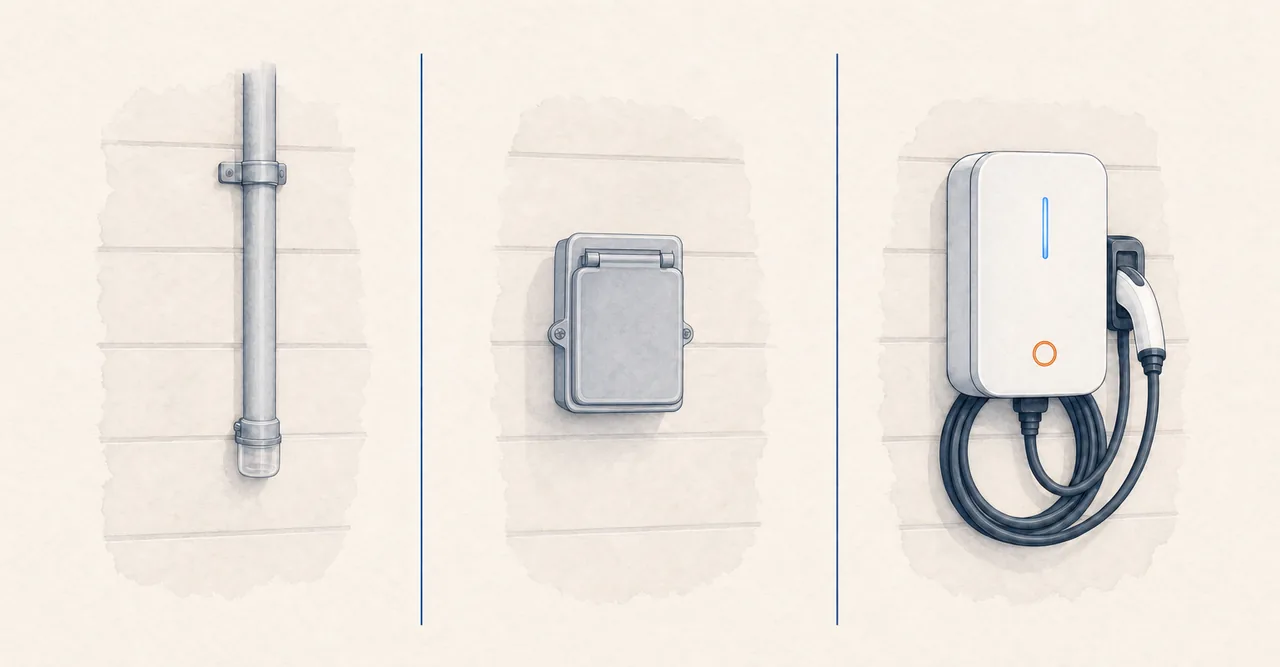
Simplified layout, not wiring instructions.
A receptacle's appearance does not establish that it is suitable for EV charging. A qualified electrician should resolve uncertain circuit capability or condition. Our plug-in versus hardwired guide explains those installation differences.
Assemble a charger handoff packet
Keep these details with the home's transaction documents:
- Equipment identity: Manufacturer, exact model, serial number, installation date if known, and the manual.
- Installation records: Invoice, installer contact, and required permit and final inspection records. Our EV charger permit guide explains why permit status depends on the work and jurisdiction.
- Usable capability: Documented charging setting or limit, connector type, and any load-management equipment the installation depends on. The charger's advertised maximum alone is insufficient.
- Operating condition: Known faults, service history, and available recent operating records. An app session from your vehicle is evidence of that session, not a promise of charging speed for every vehicle.
- Included items: Charger, cable, adapters, mounting equipment, and any necessary controls, identified in the agreed sale terms.
- Digital access and warranty: Product-specific ownership-transfer or registration instructions, setup documents the next owner needs, and the actual warranty terms for subsequent owners.
If a required permit or final inspection is missing, have the installer and local permitting authority establish the appropriate resolution. Tell the transaction professional what remains unresolved before the listing describes the installation as completed and approved.
Settle ownership and account access separately
Do not assume a plug-in charger is automatically yours to remove, or that every hardwired unit transfers under identical rules. Your transaction professional should resolve inclusion, exclusions, fixture questions, and disclosures under the sale contract and applicable state law. Any electrical removal or alteration belongs with a qualified contractor.
Smart-charger access needs its own handoff. Manufacturer procedures can involve registration or an ownership-transfer request. Provide the relevant setup documents and arrange the product's transfer process without handing over your personal account password. Warranty transfer is a separate question governed by that product's terms.
For a condo or shared parking area, association agreements can also govern ownership, billing, maintenance, and removal obligations. Our condo EV charger guide covers that separate decision.
If you are buying the home
A charging feature is useful only if the included setup fits your vehicle and parking needs. Ask the seller for the handoff packet and concise answers to four questions:
- What equipment and controls are included in the sale?
- What connector, documented output, and cable reach does the installation provide?
- Are there known faults or unresolved permit and inspection matters?
- What registration, account transfer, or warranty conditions apply to the next owner?
When capability, condition, or compatibility is uncertain, have a qualified electrician assess the installation and identify any additional work before you treat it as ready for your use. The price you would avoid paying for a comparable installation is a personal budgeting consideration, not an automatic appraisal adjustment.
Make the charging decision fit your plans
Install for a charging need you expect to use. Spend solely for a sale only with a credible local case. When equipment already exists, a clear description and organized handoff are useful work without a speculative value claim.
If home charging fits your own driving plans, use our home charging cost guide to build the electricity budget alongside the complete installation quote.