Last reviewed: November 20, 2026
Start with three numbers, then choose equipment
For multifamily EV charging, we recommend setting three separate targets:
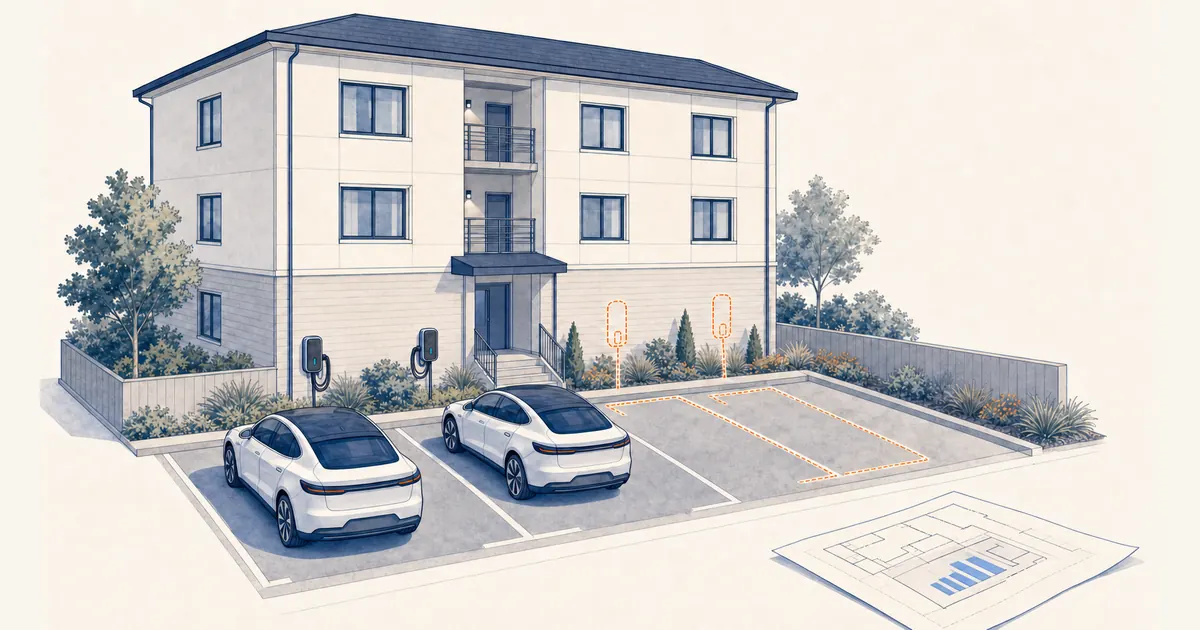
- Charging spaces available at launch. Count vehicles that can plug in, rather than charger cabinets. A dual-port station may serve two spaces.
- The site's approved charging power budget. Record the aggregate limit in kilowatts (kW), plus how it will be controlled. This is different from the sum of the chargers' advertised maximum outputs.
- Spaces prepared for expansion. Identify exactly what will be installed now for future spaces, such as conduit, pathways, or distribution equipment.
At Watt Wallet, we favor a phased plan that funds useful access today and prices expansion explicitly. More ports, more power, and more prepared spaces solve different problems. Combining them into one “charger count” makes bids difficult to compare.
Match the parking plan to resident demand
Survey current EV drivers and residents expecting to buy an EV. Collect typical daily miles, overnight parking hours, arrival and departure times, assigned-space needs, and vehicle connector types. Separate committed launch users from possible future users.
The first layout decision is assigned versus shared charging:
| Parking arrangement | Practical advantage | Operating commitment |
|---|---|---|
| Charging in assigned stalls | Residents can remain plugged in overnight without moving cars | More stalls may need equipment or outlets, potentially with longer routes |
| A shared charging area | Equipment can be concentrated near electrical infrastructure | Reservations, queues, parking enforcement, and realistic move-by rules |
| A mix of both | Overnight access for regular users plus shared capacity for others | Clear rules for who may use each space and how prices differ |
Avoid a plan that works only if residents move cars at midnight. A port occupied by a fully charged car remains unavailable even when the electrical system has spare capacity.
Count access and energy separately
Consider an illustrative 24-unit property planning for eight EV drivers. Suppose each needs 12 kilowatt-hours (kWh) of charging energy overnight, measured at the charging equipment. Total demand is 96 kWh.
A hypothetical 12 kW charging allocation available for ten hours provides an energy ceiling of 120 kWh. Yet four shared ports accommodate only four cars at once. Without a changeover, the other four drivers cannot connect. Eight assigned ports sharing the same allocation could offer all eight drivers access, subject to the equipment's minimum output, scheduling capability, and the approved design.
This arithmetic is an energy-budget illustration, not an electrical design or a charging guarantee. Building demand can reduce available charging time, and battery energy received is lower than energy drawn because of charging losses. The lesson: solve the parking-access constraint as well as the power constraint.
Choose a Level 1 and Level 2 mix that fits parked hours
Level 1 uses a 120-volt supply. Level 2 uses a 208- or 240-volt supply and includes lower-output configurations as well as higher-output equipment. Faster equipment needs more electrical capacity; long overnight parking can make lower-power charging useful. The charging-level guidance from the San Francisco Public Utilities Commission (SFPUC) connects these choices to dwell time and operating needs.
| Option | Where it earns consideration | Main limitation |
|---|---|---|
| Professionally designed Level 1 charging | Assigned overnight stalls and modest daily energy needs | Slower recovery, especially with short stays or demanding winter use |
| Lower-output or power-managed Level 2 | Overnight access across more stalls within limited capacity | The all-ports-in-use charging rate matters more than the nameplate maximum |
| Higher-output shared Level 2 | Shorter stays, higher-mileage users, or planned turnover | More power per active vehicle and a parking-management burden |
A mixed system can give regular overnight users lower-power access while reserving faster shared charging for residents who need it. Our charging-level comparison explains the charging-speed trade-offs in more detail.
An existing parking-lot outlet is not proof that a circuit is suitable. Require professionally assessed circuits and equipment certified by a nationally recognized testing laboratory. For Level 1 charging, use a suitable receptacle without an extension cord or multiplug adapter; the U.S. Fire Administration's charging safety guidance warns against those connections. Keep charging cables out of walking routes and include cable storage in the equipment scope.
Fund the electrical assessment before the construction commitment
Have a licensed electrical contractor or qualified design professional produce a written assessment covering the service, utility transformer constraints, panels, feeders, charging routes, available capacity, and planned building electrification. Empty breaker positions alone do not establish capacity.
Require alternatives priced against the same resident-service target:
- Lower-output charging within existing capacity.
- Managed charging with a defined aggregate limit.
- A panel, feeder, service, or utility upgrade where needed.
Power sharing distributes a fixed charging allocation among multiple ports, which can let a property serve more charging stalls without increasing the allocation. SFPUC's power-sharing guidance explains that shared-allocation benefit.
Dynamic load management can adjust EV charging as demand changes. Charger-group controls measure the chargers they manage; they do not establish what unrelated loads on the panel are using. For a design that must respond to those loads, specify panel-level monitoring. The Pacific Northwest National Laboratory (PNNL) explains in its multifamily EV charging guide how charger-group controls differ from devices that monitor overall panel power and smart panels that monitor every load on a panel.
The design scope should specify the controlled electrical limit, minimum service when many cars connect, response to lost communications, and responsibility for commissioning. Scheduling charging overnight is an operating strategy; it does not replace required electrical protection. Our load-management guide introduces the main control approaches.
Bring the utility into this stage for service capacity, meter arrangements, tariff options, upgrade costs, and lead times. An EV-only meter can make costs easier to separate, but any extra meter, service, and recurring account charges belong in the comparison.
Place chargers for usable access
PNNL's multifamily EV charging guide explains that conduit, circuit runs, and trenching add to installation costs as distance from the electrical source grows. Compare installable cable routes, rather than straight-line distance from the electrical room. Include trenching, pavement restoration, lighting, vehicle-impact protection, snow or drainage exposure, cellular reception, and the route residents use to reach the building.
Accessibility belongs in the initial layout. Charger reach, controls, cable handling, access aisles, and accessible routes can affect placement. The U.S. Access Board distinguishes residential accessibility obligations: privately owned residential charging is outside the Americans with Disabilities Act (ADA), but multifamily housing may be subject to Fair Housing Act requirements. Public-facing or government-operated areas can have different obligations. Include a project-specific accessibility and code review rather than assuming one national stall rule covers every property.
Price make-ready work and expansion separately
Make-ready work prepares the electrical infrastructure that serves charging equipment. It can include utility work, distribution equipment, conduit, circuits, and civil construction. The contract needs an explicit boundary between the utility's work, the property's work, and the charging provider's work.
For an initial four-port project with four possible future ports, separate these decisions:
- Install now: the equipment and infrastructure needed for the first four working ports.
- Prepare now: selected pathways or other infrastructure for four later spaces, where the incremental cost is justified.
- Defer: future chargers, additional electrical work, activation fees, and any later utility upgrade.
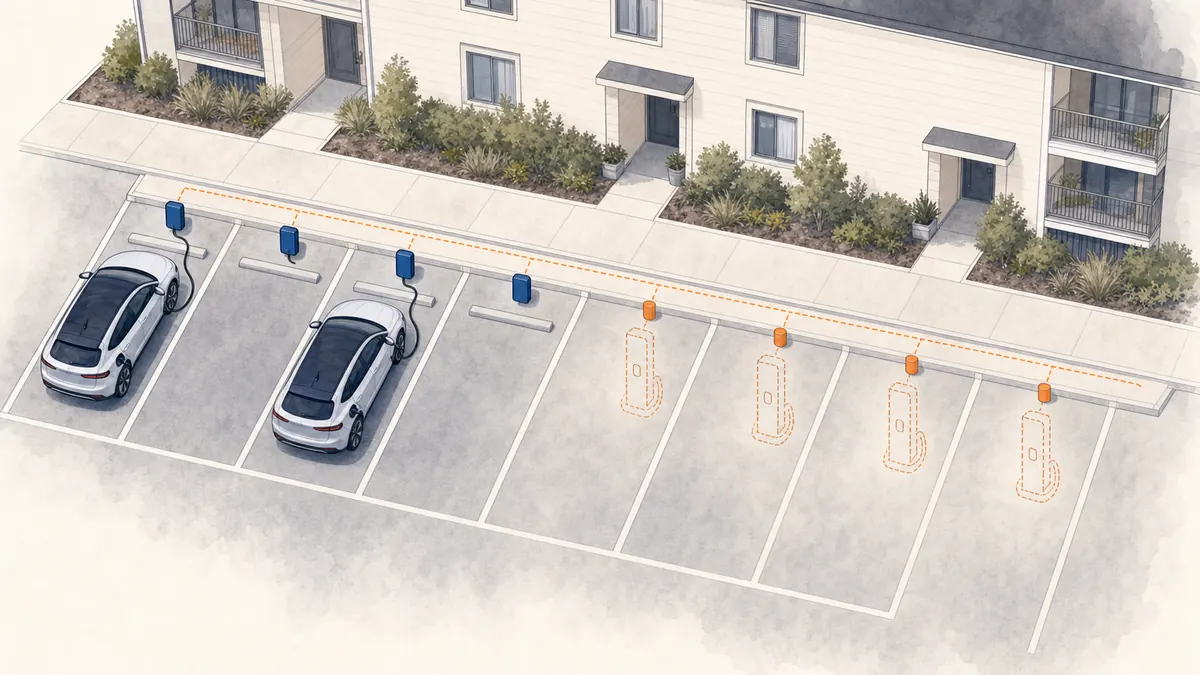
Simplified layout, not wiring instructions.
Empty conduit does not guarantee electrical capacity. “EV-ready” also needs a written definition in the bid: a pathway, a completed circuit, and an operating charger are different deliverables.
Coordinate disruptive work with planned resurfacing or other construction when practical. Require a phase-two price schedule showing the assumptions that could change, including route availability, equipment compatibility, permits, and remaining power capacity.
Decide who owns the equipment and runs the service
Owner-purchased equipment gives you a capital asset, but software, support, and maintenance may still require separate contracts. A lease spreads equipment payments. Charging-as-a-service can shift ownership and operating duties to a provider, with control and fees determined by the agreement. SFPUC's ownership and billing guidance separates these responsibilities.
Compare total owner payments over the same holding period. Include construction contributions, recurring fees, electricity, revenue sharing, annual increases, minimum payments, buyout terms, and removal or restoration at contract end. A provider-funded charger can still leave the property paying for make-ready work.
Put access and billing into the operating specification
For a small property, the software should support the service you intend to run:
- Resident authorization by account or access credential, plus prompt removal of access at move-out.
- Separate permissions for assigned stalls, shared stalls, guests, and any public users.
- Session energy records, itemized fees, receipts, refunds, and reconciliation of collections to owner payouts.
- Fault alerts, resident support, and a defined response when connectivity or payment systems fail.
Specify who pays network, cellular, payment-processing, and idle fees. State whether prices are controlled by you or the provider. Energy, subscription, session, and time-based charges distribute costs differently; applicable metering, payment, utility, and landlord-tenant rules belong in the compliance scope.
Do not equate a phone app with dependable access. Include a practical credential option for residents without smartphones where supported, and contract for the required outage behavior. For shared parking, use rules that fit normal sleeping hours. A charging-speed reduction imposed by the system should not quietly produce an unexpected connected-time bill.
Protect the exit path
Open Charge Point Protocol (OCPP) supports communication between chargers and management software. It does not by itself guarantee freedom to change providers. The Open Charge Alliance identifies contractual and technical lock-in even in products described as using OCPP.
Require written terms for network migration, configuration access, data export, transfer fees, and continued load management after a provider change. Name the supported hardware and software combination in the contract.
Build the capital budget and operating budget separately
A multifamily installation has no reliable national per-port price that captures every property's civil work, service capacity, and software model. PNNL's multifamily installation-cost guidance identifies charger type and quantity, geographic and site location, required trenching, existing wiring, electrical upgrades, labor, and permitting as installation-cost factors.
Require an itemized capital proposal covering:
- Design, electrical assessment, accessibility review, permits, and inspections.
- Utility work, metering, service, panels, feeders, and load controls.
- Charger or outlet hardware, mounting, cable management, and protection.
- Trenching, conduit, conductors, surface repairs, striping, and signage.
- Connectivity, commissioning, staff training, and future-space preparation.
- Exclusions, contingency, and any incentive shown separately from gross cost.
For operations, budget electricity, software, connectivity, payment fees, support, maintenance, and replacement reserves. Before setting resident prices, check the tariff for the property's serving utility to see whether demand or fixed charges apply, and include them in the model if they do. The U.S. Department of Energy (DOE) emphasizes maintenance responsibility and repair-response terms in its operating-cost guidance.
A worked capital and operating budget
Assume a four-port project costs $24,000, with an approved $8,000 reimbursement. The owner needs $24,000 before that payment arrives; net capital is $16,000. Suppose the property sells 600 kWh a month. These are illustrative assumptions, not market prices or a forecast:
| Annual item | Calculation | Amount |
|---|---|---|
| Resident energy revenue | 7,200 kWh × $0.35 | $2,520 |
| Electricity expense | 7,200 kWh × $0.20 | $1,440 |
| Software, connectivity, and payment costs | Assumed combined allowance | $1,200 |
| Maintenance and replacement reserve | Assumed allowance | $600 |
| Operating balance before capital recovery | Revenue minus the three expense lines | −$720 |
Here, the electricity allowance assumes purchased and billed energy are equal and includes no demand charge or separate fixed utility charge. Actual metering losses, standby use, tariff charges, taxes, and fee structures change the result.
The apparent $0.15-per-kWh margin does not cover the fixed costs at this utilization. Operating break-even is $0.45 per billed kWh under these assumptions, before recovering construction spending.
Allocating the $16,000 net capital over a simple ten-year planning horizon adds $1,600 a year, or about $0.22 per billed kWh at this usage. Combined recovery would require about $0.67 per kWh before financing and the omitted project-specific charges. That horizon is a budgeting assumption, not an equipment-life promise.
An owner can deliberately subsidize charging as an amenity. Record that subsidy in the property budget instead of calling the project self-funding. Model low, expected, and higher usage separately, and keep speculative rent or property-value gains out of the base case.
Apply incentives to the design, not just the price
For November 2026 planning, two examples show why parking allocation and program rules can change a small property's options:
| Program | Published offer and important boundary |
|---|---|
| New York's Charge Ready NY 2.0 | Eligible unassigned multifamily Level 2 ports receive $3,000 per port, plus $1,000 for eligible ports at sites in disadvantaged communities. Individually assigned or fleet-reserved ports receive $1,000 per port, with no additional disadvantaged-community bonus. Rebates are paid after completion and documentation. |
| Seattle City Light's multifamily charging program | Available to qualifying City Light customers at sites with at least five units; minimum two ports. A 120V outlet may serve assigned or shared parking. The two shared-parking Level 2 options are distinct: a 240V outlet without electric vehicle supply equipment (EVSE), used with a resident's portable Level 2 cord, and hardwired Level 2 EVSE. The completed application must be submitted before the Seattle Department of Construction and Inspections or other authority having jurisdiction completes its final project inspection. |
New York's site eligibility rules require at least ten dwelling units on site, with individual buildings containing at least five connected units. Residents must be the primary drivers of more than 50% of the vehicles regularly parked on the site. Only the site owner may apply as the equipment owner, though an installer may submit the application on that owner's behalf. Eligible equipment and networking, five-year operation, and data-sharing obligations also apply. A six-unit property on its own does not meet that threshold.
Seattle's new-construction terms limit the new-build charger incentive to eligible Level 2 EVSE equipment itself. Under this new-build rule, outlet incentives, conduit, wiring, and installation costs are excluded. Separately, a code rule applies when a new-build or substantial-retrofit project is required by code to install a minimum number of EV charging stations and “EV Ready” or “EV Capable” parking spaces. For those projects, only charging equipment beyond the project-specific code requirements is eligible, and participants must document the added scope and cost difference. The provisions are separate, so a new build subject to EV-readiness code may be subject to both. Newly constructed buildings are treated as retrofit projects if installation occurs six months after a Certificate of Occupancy or equivalent is issued by the authority having jurisdiction for the project site. We recommend beginning enrollment before work starts. Enrolled projects must submit post-construction documentation, including final itemized receipts or invoices for total project costs and a separate completed Contractor Cost Template for each contractor or vendor invoice. All invoices must be paid with a $0 balance unless the customer is reassigning the incentive payment directly to a contractor. If a project received additional funding, supporting documentation must show the final amount received and which project costs it covered. These materials support payment; they do not allow a finished project to begin enrollment retroactively.
These are location-specific examples, with funding and reservation conditions. Carry the gross construction cash requirement until the award's payment timing is reflected in the financing plan. Record stacking restrictions, eligible costs, equipment requirements, completion deadlines, and ongoing fees alongside each proposed award. A larger rebate can come with a more expensive operating commitment.
Do not budget the former federal charger credit for property placed in service after June 30, 2026. The Internal Revenue Service (IRS) Form 8911 instructions state that Section 30C is unavailable for refueling property placed in service after that date. A charger placed in service in November 2026 falls outside the credit window. Any property placed in service by June 30, or any other tax treatment, needs its own project-specific review.
Release construction with a launch plan and an expansion trigger
The approval package should contain the site layout, launch users, port and power targets, electrical design, gross and net capital budgets, operating subsidy or pricing model, utility scope, incentive conditions, and signed responsibility matrix.
Make final acceptance include the installer's commissioning of charging, aggregate power controls, access permissions, billing records, and outage behavior. The handover should provide inspection records, as-built information, warranties, support contacts, and staff training. Our EV charger permit guide explains the permitting questions, while the property's local authority determines the actual requirements.
Set an expansion trigger using denied charging requests, overnight occupancy, energy delivered, unmet departure needs, faults, and the waitlist. High occupancy with low energy use points to an access problem. All ports delivering too little energy points toward a power or scheduling problem. Buy the next phase to address the measured constraint.
Use our charger installation-cost breakdown to turn that capital plan into an itemized bid request, keeping multifamily infrastructure and operating costs separate from its single-home price examples.