Last reviewed: November 17, 2026
Start with parking access, not equipment
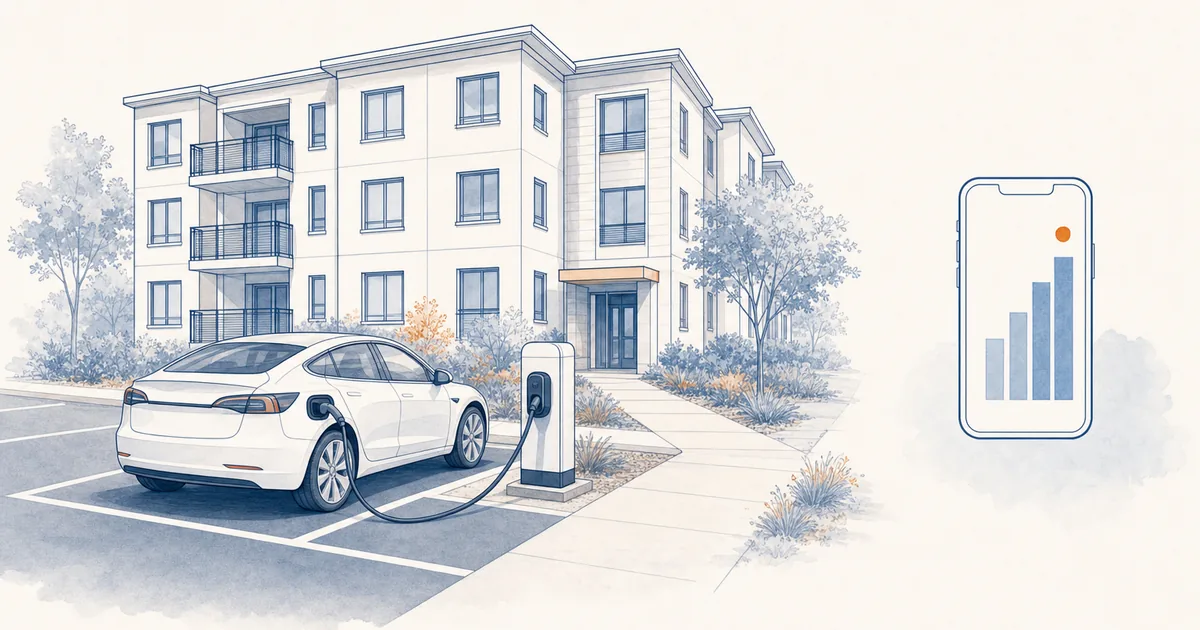
You can own an EV without a charger at your apartment. A workable plan needs a dependable primary charging location and a fallback for busy stations, outages, or changes to your schedule.
We recommend starting with existing on-site charging when its access rules and full price fit your routine. It avoids a tenant-funded installation. A charger listed as an apartment amenity, however, does not guarantee a place to plug in.
Get these details from the property manager before treating charging as part of your housing budget:
- Your parking right: An assigned stall, shared lot, separately rented garage, or street space creates different options. Permission to park does not automatically include permission to install equipment or use electricity.
- Charging access: Reserved access, reservations, a waiting list, and first-come use are different arrangements. Establish whether visitors or the public share the stations.
- Time limits: Charging-only spaces may require moving the car during the evening. A rule that conflicts with sleep or work can make an otherwise convenient station impractical.
- Problems and changes: Name the repair contact, the response when a bay is blocked, and what happens if your assigned space changes.
Renting a condo still means working through your landlord for property alterations and any required association approval. Owners planning their own installation have a separate set of parking and association questions in our condo charger guide.
Compare the five apartment EV charging options
Level 1 charging uses a suitable 120-volt outlet. Level 2 uses a higher-voltage supply, commonly 208 or 240 volts in multifamily and workplace settings. Public stations can offer Level 2 or direct-current (DC) fast charging. The vehicle, equipment, and available power determine the charging rate.
| Option | When it fits | Access and permission | Payment and ownership |
|---|---|---|---|
| Existing on-site charging | Charging hours and shared-space rules fit normal parking | Property or network enrollment; a usable reservation or sharing arrangement | Energy and possible access, parking, or service fees; equipment ownership stays with the existing owner |
| Permitted Level 1 | Modest driving and long parked periods at an authorized outlet | Landlord authorization plus a qualified electrician's assessment of the outlet and circuit | Agreed electricity payment; a portable charger may be yours, while the outlet belongs to the property |
| Landlord-approved Level 2 | Level 1 cannot supply enough energy during available hours, and the installation makes sense for your tenancy | Written property approval, professional design, and required permits and inspections | Installation contribution, electricity, and recurring fees; ownership and removal need written terms |
| Workplace charging | Regular work attendance provides enough charging time | Employer eligibility, registration, hours, and sharing policy | Employer-set charges and parking terms; no apartment installation to own |
| Public charging | Nearby destinations or charging stops fit your week | Compatible equipment, permitted parking, open hours, and available stations | Station charges plus any parking or membership fees; no installation ownership |
Existing on-site charging: separate charging from overnight parking
Ask whether the charging bay replaces your normal parking space or is a temporary stop before moving to another stall. Get the charging price, parking premium, move-by rules, and account requirements in writing.
If a session ends at 11 p.m. and overstay fees begin soon afterward, leaving the car until morning may be expensive even if overnight garage parking is allowed. A lower charging rate does not resolve an unusable parking rule.
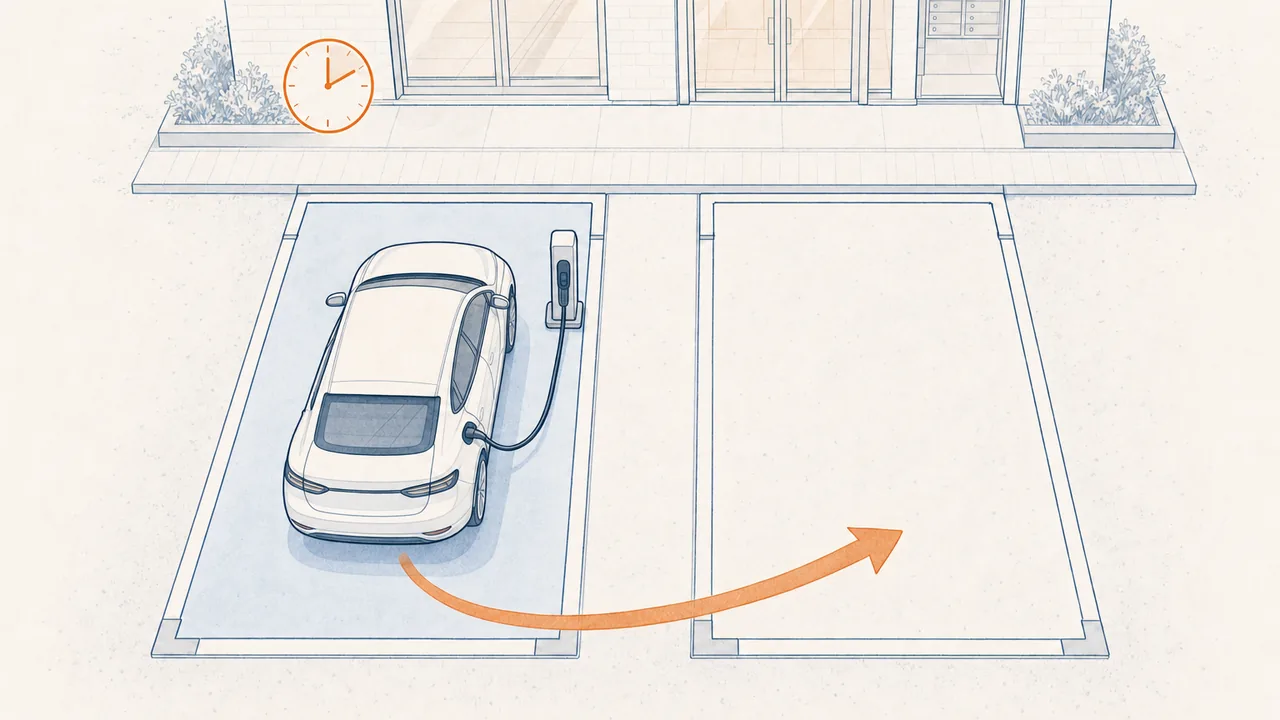
Simplified layout, not wiring instructions.
Permitted Level 1: an outlet needs both authorization and assessment
A nearby outlet is not proof that EV charging is allowed or electrically suitable. The U.S. Department of Energy (DOE) describes overnight Level 1 charging as an option when an appropriate outlet on a dedicated branch circuit is available near parking. Have the landlord authorize the use and arrange a qualified electrician's assessment of the circuit, outlet, and proposed equipment. Home charging guidance explains the electrical considerations.
Use charging equipment certified by a nationally recognized testing laboratory and follow the manufacturer's instructions. Plug directly into a suitable outlet. Never use an extension cord or multiplug adapter, and do not use visibly damaged charging equipment. Outdoor use requires equipment suited to that exposure. These are federal charging safety recommendations.
Do not run a cord from an apartment window or balcony, across a sidewalk, through a doorway, or over shared walking routes. An agreed electricity payment does not make an unsafe cable route acceptable.
Landlord-approved Level 2: settle the property agreement first
Level 2 can supply more energy during shorter parking periods. It also introduces a building project: capacity assessment, an approved power route, equipment placement, billing, permits, and restoration.
The landlord authorizes access to electrical areas and alterations to the property. A qualified electrical contractor determines the feasible design and output. An empty breaker position or a short distance to an electrical room does not establish available capacity or an inexpensive installation.
Keep three approvals separate: property permission, local permits and inspections, and utility authorization where required for service, metering, or utility equipment changes. Our EV charger permit guide explains the permit side. None of those approvals substitutes for the others.
Workplace charging: account for days away
Workplace charging can serve as your primary source if your attendance, charger access, and parked hours cover your driving. Employer policies can limit eligible users, require registration, set prices, and impose time limits or sharing schedules. Workplace charging policies determine the access you receive.
A plan based on three office days also needs an answer for holidays, remote-work weeks, or a job change. Permission to use an employer's outlet is separate from permission to use an apartment outlet.
Public charging: include the whole stop
Destination Level 2 charging works when the car can stay while you work, shop, or visit somewhere nearby. DC fast charging can suit a dedicated stop when the vehicle supports it. Many plug-in hybrids cannot use DC fast chargers.
A usable location needs a compatible connector and any manufacturer-approved adapter, network access, suitable hours, and legal parking for the entire session. The DOE consumer charging guide explains the charging levels and compatibility limits.
Build the routine around the detour, possible queue, charging time, and any walk or transit ride back home. A nearby station behind a closed garage gate is unavailable, regardless of its distance on a map. Keep a second location that does not depend on the same building access.
Match charging hours to a normal week
Battery size alone does not tell you how often you need to charge. The useful comparison is weekly driving against the energy available during the hours you can actually plug in.
The DOE consumer guide gives illustrative rates of about 2–5 miles of added range per hour for Level 1 and 10–30 for Level 2. Actual results vary with the vehicle, equipment, power allocation, temperature, and driving efficiency. Those ranges describe charging options, not a guaranteed overnight refill.
For a hypothetical 200-mile week:
- Five eight-hour Level 1 sessions at an assumed 3 miles per hour replace about 120 miles. That leaves an 80-mile gap.
- Two four-hour Level 2 sessions at an assumed 25 miles per hour replace about 200 miles.
- One missed Level 2 session leaves half the planned weekly charging unavailable.
This is why access frequency matters as much as speed. Shared equipment may also divide available power between vehicles. Leave room for a missed session and higher-energy driving rather than planning around the most optimistic charging rate. Our Level 1 versus Level 2 comparison explains the speed tradeoff in more detail.
Compare the full monthly bill
An apartment charger does not necessarily bill at your apartment's residential electricity rate. Charging may use a common building account and a separately priced service.
The monthly comparison is:
Energy charges + session or time charges + recurring fees + extra parking cost + expected overstay charges.
Prices can depend on kilowatt-hours (kWh), time connected, a session fee, a subscription, or a combination. Connected-time billing may continue after energy delivery stops, and overstay or service fees may also apply. ChargePoint's pricing policies and fees explain these distinctions. Garage parking can be a separate charge.
Use the additional parking cost attributable to charging. If ordinary parking costs $80 a month and an EV space costs $140, the charging-related premium is $60. Do not count the full $140 as an extra charging expense if you would pay $80 either way.
Consider this hypothetical comparison for 250 billed kWh per month:
| Monthly cost | Apartment charger | Public charging |
|---|---|---|
| Energy | 250 kWh × $0.25 = $62.50 | 250 kWh × $0.45 = $112.50 |
| Additional parking premium | $60 | $0 |
| Monthly charging fee | $10 | $0 |
| Total before other charges | $132.50 | $112.50 |
The apartment option saves $50 on energy but adds $70 in fixed costs. It costs $20 more in this example, while potentially saving charging trips. At these assumed rates and fees, the energy savings cover the fixed costs at 350 billed kWh per month: $70 divided by the $0.20-per-kWh difference.
These are illustrative prices, not national averages. Time-based fees, taxes, charging losses, and different amounts of public charging can change the comparison. Use billed energy for a bill comparison; energy reaching the battery can be lower than energy drawn from the supply.
Put a charger request and lease-end terms in writing
For a new installation, begin by requesting the property's application process and permission for a professional assessment. Buying a charger first can leave you with equipment that conflicts with the approved design or billing system.
A useful request identifies:
- Location and access: Your stall number, parking agreement, proposed mounting area, and permission for contractor access.
- Charging need: Vehicle model, normal driving, parked hours, and why existing charging does not meet the need.
- Professional scope: Installer qualifications, electrical assessment, proposed route, permits, inspections, and any utility involvement.
- Payment: Who pays for assessment, installation, shared-building work, electricity, subscriptions, and repairs.
- Responsibility: Equipment ownership, maintenance, damage, insurance where required, and access for servicing.
- End of tenancy: What stays, what may or must be removed, who arranges removal, and who pays for restoration.
Keep charger ownership separate from ownership of the circuit, conduit, meter, and shared controls. Paying for work does not by itself establish a right to take every installed component when you leave.
For example, a short opening request can say:
I rent parking space 24 and would like permission to arrange a qualified electrical contractor's assessment for EV charging there. Please send the property's application requirements and proposed terms for electricity payment, installation costs, ownership, maintenance, and removal at lease end. I will not authorize installation before the required approvals are in place.
The detailed proposal follows the assessment. Our Level 2 installation-cost guide explains itemized professional scope, including routing, electrical work, permits, and restoration. Its homeowner cost ranges are not an apartment quote. Keep any contribution to shared electrical upgrades separate from your personal charger cost, including whether repayment or a landlord contribution is actually agreed.
Right-to-charge laws have local limits
State and local rules can limit a landlord's ability to refuse a qualifying charger request. They do not create a universal U.S. entitlement to free equipment, landlord-funded electrical upgrades, or an additional parking space. Renter protections also differ from laws for condominium owners or homeowners associations.
Two examples show why parking and lease details matter:
- California: Qualifying-property rules address written requests to install at an allotted parking space, with exclusions and tenant responsibilities for installation, electricity, maintenance, removal, and damage. Those are conditional California renter charging protections, rather than permission to install anywhere on the property.
- Connecticut: The approval duty applies to qualifying written requests at dedicated tenant parking spaces and depends on lease execution, extension, or renewal dates under the law's phase-in. The statute requires compliance with the approval process and written responsibility terms. It expressly does not require an additional parking space. These limits appear in Connecticut's tenant charging law.
For a refusal, request the reason in writing. An electrical contractor can address a documented capacity or routing problem; a local tenant attorney or legal-aid service can address disputed legal coverage or approval conditions. An unanswered request does not establish that all installation approvals are in place.
Decide what is worth funding before you move
Compare a tenant-funded installation with the months you reasonably expect to use it. A hypothetical $1,800 contribution spread over 18 months is $100 per month before electricity, maintenance, or removal. That may outweigh a lower energy rate.
The written move-out agreement should distinguish a portable charger you can take, permanently installed equipment that stays, and work requiring professional removal and restoration. Include a process for transferring equipment if the landlord or next tenant wants it. Do not assume the landlord must buy it from you.
Budget without an assumed federal charger tax credit for a new installation. Section 30C does not cover property placed in service after June 30, 2026, so a new November 2026 installation falls outside the federal charger credit window. An earlier equipment purchase does not extend that deadline. State or utility assistance belongs in the budget only when the program's address, applicant, equipment, and timing requirements are established.
If the lease is short or parking access is unstable, existing building, workplace, or public charging may be the more practical commitment. When choosing your next apartment, get the actual charging and parking terms rather than relying on an amenity listing or a promised future installation.
Build a charging budget you can live with
Choose a primary location whose available hours cover your driving, retain a compatible fallback, and put property and payment responsibilities in writing before funding equipment. Then use our EV charging cost guide to turn energy use into a monthly budget, adding your apartment's parking premium and service fees.