Last reviewed: November 20, 2026
Start with how the charger will operate
Treat the charger, its electricity account, and the parking stall as three parts of one offering. Decide whether you are adding a landlord-owned amenity, approving a tenant's private installation, or preparing the property for a later installation. The answer changes which equipment you need, what the lease should say, and who handles the monthly bill.
| Rental setup | First model to price | Decision to settle early |
|---|---|---|
| Rental house with a tenant-paid electric account and assigned parking | A private charger for the tenant's space, if the electrical design can serve it from that account | Whether the landlord pays for permanent work while the tenant pays for electricity, and what remains after move-out |
| Rental house where the owner pays for electricity | A landlord-funded charging amenity, with charger ownership and any service agreement priced separately | Who absorbs electricity costs, who owns and services the charger, and whether any subscription is worthwhile |
| Duplex with separate unit meters and assigned spaces | A private station for one assigned stall, with a separate price for a future second location | Which meter serves the proposed stall, and how a second tenant would get fair access later |
| Duplex with a common meter or shared parking | A shared, owner-managed station | Who can use it, how sessions are accounted for, how parking access works, and who responds when it is offline |
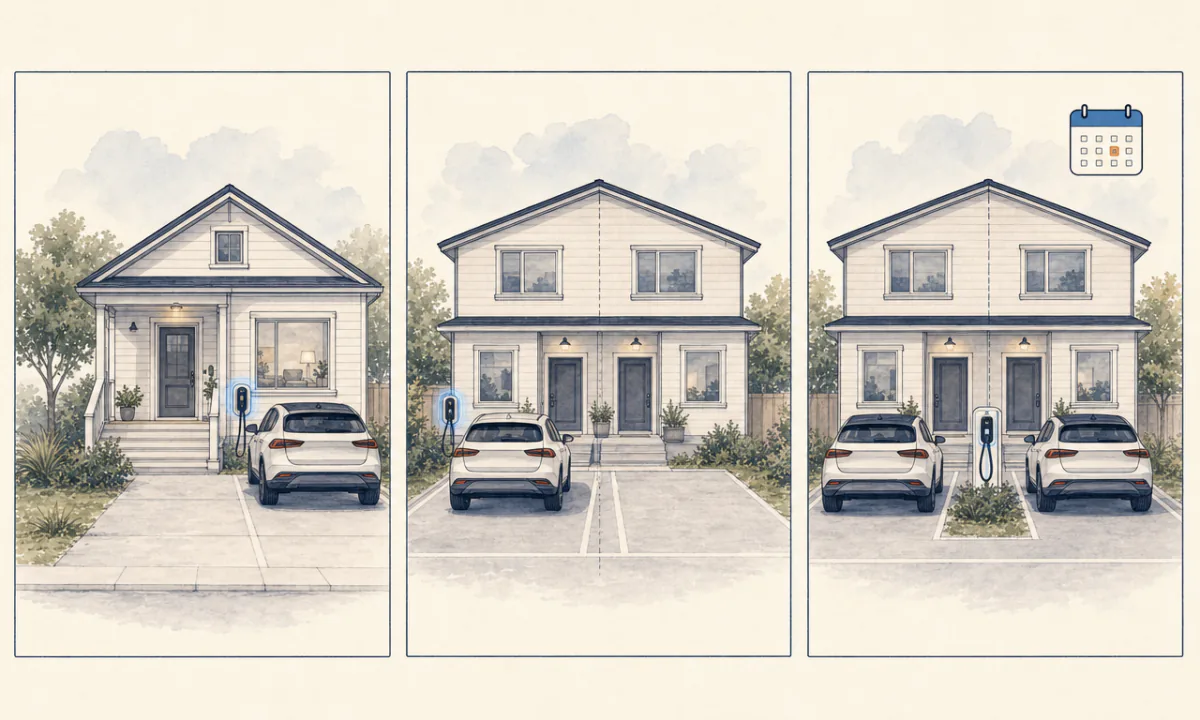
An owner-funded amenity and a tenant-requested installation are different projects. Funding does not by itself determine who owns the charger: it may be owned by the landlord, tenant, or service provider. Decide who controls access and pays for electricity, and assign warranty, maintenance, and support responsibilities according to the actual charger owner and any service agreement. With a tenant request, the written approval should say which work is allowed, who pays for each part, who owns each component, and whether the charger stays or goes when the lease ends.
Match charging speed and controls to the property
Level 1 uses a suitable 120-volt outlet and the vehicle's portable cordset. Level 2 uses a 208- or 240-volt supply and charges faster. The DOE says many drivers can meet daily needs with overnight Level 1 when a dedicated branch-circuit outlet is near parking. Its home-charging guidance explains why an ordinary-looking receptacle is not automatically suitable.
DOE's illustrative rates are about 2 to 5 miles of range per hour for Level 1 and 10 to 30 miles per hour for Level 2. Vehicle, output, and conditions affect actual results, so use the charging estimates as a planning range rather than a promise.
Start with the tenant's typical weekly driving and the hours the car will stay parked. A slower setup can be enough for routine commuting. Level 2 is more useful when the tenant needs more energy during a shorter parking window. We would not buy the highest-output charger just because the box supports it. A qualified electrician needs to size the circuit to the property and equipment. Once the electrician establishes a workable output, compare residential models in our best home EV charger guide, which covers connector, cable-reach, and control trade-offs.
A networked charger is a separate choice from charging speed. Networked models can offer access control, usage reports, payment collection, and remote status. Those functions can help with a shared duplex charger or landlord-metered electricity. They also add equipment or service costs, and some models rely on the network to operate. The U.S. Department of Energy's networked charger overview explains the trade-offs.
For one tenant using a private charger on that tenant's own electric account, network fees may buy little unless you need remote monitoring or a utility program requires them. For a shared station, access controls and usage records may be worth paying for. A networked charger still does not decide whether a fee or reimbursement method is allowed under the local utility and rental rules.
Keep billing controls separate from electrical load management. Billing records or allocates electricity use. Load management changes charging power when the home's available electrical capacity is tight. A networked access system is not automatically a load-management system, and a load-management device is not automatically an accepted tenant-billing meter.
Price the infrastructure as well as the charger
A charger's shelf price is only one part of a rental installation. The route from the electrical service to the parking space, the property's available capacity, permits, utility work, and restoration all affect the total. Ask for separate line items for the equipment, circuit and route, any panel or service work, permits and inspections, surface or wall restoration, and optional network or billing features. The Level 2 installation-cost guide can help you compare the scope in contractor proposals.
Have a qualified electrical contractor assess the service and proposed route. An open breaker position or an existing garage receptacle does not prove that the property can safely support EV charging. Older wiring may be unsuitable. A qualified electrician can assess whether a NEMA 14-50 receptacle or a hardwired charger fits the design; our NEMA 14-50 vs. hardwired guide compares the installation methods. The USFA charging safety guidance recommends a charger certified by a nationally recognized testing laboratory (NRTL) and a dedicated circuit, and warns against extension cords or multiplug adapters. It also says to maintain the charging station according to the manufacturer's instructions, never use damaged equipment, and check the manufacturer's guidance before charging in wet conditions. Outdoor installations require outdoor-rated equipment. Our EV charger permits guide explains the approval side.
If you do not need a charger immediately, ask the electrician to price a future-ready option separately. PNNL's multifamily guidance distinguishes three levels of EV infrastructure. In its reference example, an EV-capable space has panel capacity and physical space for a minimum 40-amp, 208/240-volt branch circuit, a reserved breaker slot (the breaker need not be installed), raceway or conduit, and a termination point near the parking space; it has no dedicated branch circuit or charger. EV-ready adds the dedicated branch circuit, and EV-installed adds the charger. The 40-amp specification is a multifamily reference example, not a universal code requirement; which level, if any, applies depends on local code. See PNNL's multifamily guidance for definitions.
If another project is already opening a wall, garage, or driveway, ask for a separate price for future-ready work rather than paying for a charger and network service you do not yet need. Preparation may avoid reopening finished surfaces later, but it does not guarantee a cheaper final installation or future equipment compatibility.
Give the electrician a brief that connects the property plan to the electrical quote: “Please price a private charger for the assigned space and a future-ready option without a charger. For each, identify which meter/account would supply it, the capacity assumptions, the equipment and route, any service or utility work, permits and inspections, restoration, and recurring network or billing fees.” This makes the owner-versus-tenant decision visible in the quote instead of leaving it for the lease addendum.
Make the business case without assuming a rent premium
An EV charger can be a useful amenity, but it does not guarantee higher rent or lower vacancy. Compare the installed cost with the number of tenants who can use it, the time you expect to own the property, and the electricity and maintenance obligations that continue after the current tenant leaves.
Budget for the full arrangement: equipment and electrical work up front; electricity, network service, and repairs over time; and possible removal or restoration at turnover. If a tenant pays for some work, keep that amount separate from any permanent improvement the owner funds. A tenant-paid charger does not automatically make the owner's circuit, conduit, service upgrade, or shared controls a tenant-owned asset.
For a simple payback estimate, divide the owner's net project cost by the annual net income the charger can actually produce after electricity, service, and maintenance. Use a rent increase only if comparable local rentals support it. If there is no new billable income, value the project as an amenity and long-term improvement instead of inventing a return.
For projects being budgeted now, do not count on the federal Alternative Fuel Vehicle Refueling Property Credit under Section 30C. IRS guidance says the credit is unavailable for charging property placed in service after June 30, 2026. State and utility programs are separate, and their eligibility and application timing vary. The DOE's laws and incentives database lists state, local, and utility programs. To compare an incentive claim with an installer estimate, see our rebate-versus-tax-credit quote guide; it is a general home-project guide and does not establish whether a rental property, landlord, or specific installation qualifies. Keep any local incentive outside the base budget until the program confirms the property, applicant, equipment, and timing qualify. The IRS lists the Section 30C deadline.
Put ownership, billing, and turnover in writing
Before any work starts, put the operating plan in the lease or a property-alteration agreement. At minimum, spell out:
- Ownership: Who owns the charger, circuit, conduit, meter, and any shared controls. These can have different owners.
- Electricity and fees: Whose account pays the utility, whether charging is included or separately billed, and who pays any network or payment-service fees.
- Access: Which parking space the charger serves, whether use is private or shared, who can charge, and what happens if the stall assignment changes.
- Maintenance: Who handles faults, cable damage, service calls, software or account changes, and replacement.
- Move-out: Whether the charger stays, who removes it if required, how the space is restored, and which records or warranties transfer to the next owner or tenant.
If the charger is on the landlord's meter, decide the electricity arrangement before installation. Usage reports can help document charging sessions, but the lease, local utility rules, and any tenant-billing requirements still govern how a landlord can recover those costs. State laws can affect tenant installation, so check local law. Connecticut phases landlord approval duties by unit count and by when a rental agreement is executed, extended, or renewed; it also excludes some properties, including those with fewer than five parking spaces. See the current Connecticut landlord-tenant statute. For Illinois, Section 10 states that Sections 30 and 35 apply to tenants and landlords of existing and newly constructed single-family homes and multifamily residential buildings with parking. Section 35 contains the renter-installation rules, subject to its conditions. These are limited examples, not a complete legal survey. Have a local landlord-tenant attorney review a request and agreement before work is approved.
For a shared or networked charger, write down what happens if internet service, the charger account, or a subscription ends. Some stations keep basic charging available when the network is down, while others rely on it. Put the installer, model, warranty, permit and inspection records, account owner, and support contact in the property's records so the next tenant does not inherit an unexplained box on the wall.
If you advertise charging as an amenity, describe what is actually available: Level 1 or Level 2, dedicated or shared space, access hours, electricity charges, and whether the listing includes a charger or only future-ready wiring. A working charger is useful only when the tenant knows which space it serves and can use it under the stated terms.
For a crowded panel or a quote that includes managed charging, compare the electrical options in our EV charger load-management guide before you approve the scope. If you are planning beyond a house or duplex for a larger rental property, our multifamily EV charging guide is a next read; it covers larger-property planning, not a single-house or duplex installation.