Last reviewed: September 29, 2026
Air conditioner circuit breaker size at a glance
There is no universal air conditioner circuit breaker size. The exact equipment nameplate, matched equipment, installation instructions, and locally adopted electrical code control the decision.
- MCA, or minimum circuit ampacity, is the nameplate value the electrician uses to evaluate the minimum ampacity of the circuit conductors.
- MOCP or MOP, or maximum overcurrent protection, is the highest listed breaker or fuse rating allowed for that equipment. It may also appear as Max Fuse, Max Breaker, or Max Fuse/Breaker.
- Tonnage describes cooling capacity. It does not select a breaker.
- Voltage and phase confirm whether the proposed equipment matches the home's supply. They do not provide a complete breaker answer.
For equipment comparisons, Carrier's 3-ton guidance directs readers to manufacturer MCA and MOCP values instead of estimating amperage from tonnage. Circuit and disconnect sizing must follow the exact equipment specifications and applicable electrical codes.
The U.S. Department of Energy (DOE) hosts a nameplate-first excerpt originally published by Structure Tech Home Inspections, with Pacific Northwest National Laboratory listed as a contributor. The excerpt favors the equipment label over simplified charts. This is homeowner inspection guidance, not manufacturer documentation or electrical code authority.
Find the exact equipment nameplate first
Before comparing the breaker line in two quotes, get the complete model number for the equipment being proposed. For a central split system, that usually means the outdoor unit plus the indoor coil, air handler, furnace, controls, and any electric heat kit. The model number in a retailer listing or a quote may be incomplete.
Ask the contractor for a clear photo of the rating plate or the current installation documentation. A homeowner can photograph a visible label without removing an equipment cover or panel. Look for:
- manufacturer and complete model number
- rated voltage, frequency, and phase
- MCA or minimum circuit ampacity
- MOCP, MOP, Max Fuse, Max Breaker, or Max Fuse/Breaker
- any listed circuit, fuse, or breaker language
- accessories that change the electrical scope, such as electric heat
The outdoor condenser's plate is often the starting point for a split AC quote. It is not always the only electrical information that matters. A matched air handler with electric heat can have its own rating plate and circuit requirement. The professional reviewing the job must reconcile the complete equipment combination.
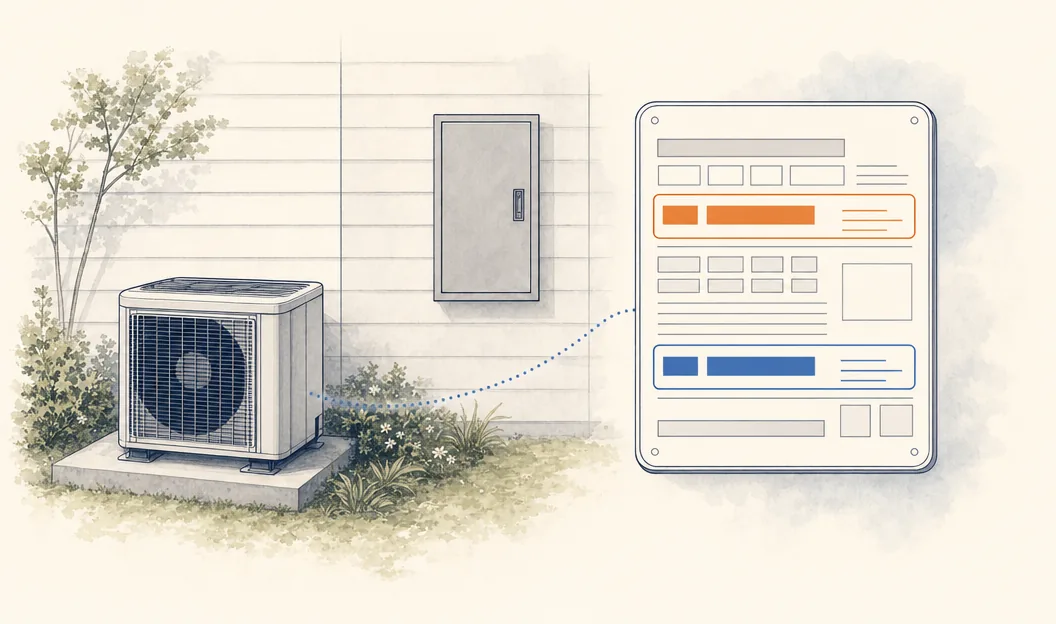
Simplified layout, not wiring instructions.
The exact rating plate is the starting point for a safe quote review.
MCA and MOCP answer different questions
MCA: Minimum circuit ampacity for the equipment. Quote question: Does the electrician's circuit assessment account for this value and the actual installation?
MOCP/MOP: Maximum overcurrent protection allowed for the equipment. Quote question: Is the proposed breaker or fuse compatible and no higher than this value?
Voltage and phase: The supply characteristics the equipment is designed to use. Quote question: Does the proposed equipment match the home's available service and the installation location?
Model number: The exact listed equipment configuration. Quote question: Does the quote identify this model and its matched indoor equipment?
MCA is not the breaker number. MOCP is not an instruction to install the largest possible breaker automatically. The electrician selects the listed protective device and evaluates the complete installation under the applicable code. If the proposed breaker does not make sense alongside the nameplate values, ask for the explanation in writing before approving the work.
Why tonnage does not give you a breaker size
An air conditioner's tonnage measures cooling capacity. Electrical requirements can change with the compressor, efficiency, voltage, motor or inverter design, matched indoor equipment, and optional electric heat. The same nominal capacity can therefore carry different MCA and MOCP values.
For example, Goodman's 2023 product overview for 2023-model outdoor units lists these two nominal 3-ton entries:
| Listed model example | Nominal capacity | MCA | MOP |
|---|---|---|---|
| GSXN3N3610 | 3 tons | 18.6 A | 30 A |
| GSXN403610 | 3 tons | 21 A | 35 A |
These figures illustrate why a 3-ton label cannot produce one universal breaker answer. They are examples from specific product listings, not a recommendation for another unit or a replacement for the current nameplate. Manufacturer lines and requirements change, so the exact model on the proposed equipment remains the controlling reference.
We do not publish a 2-ton through 5-ton breaker chart here because it would encourage the wrong shortcut. If a quote gives only the tonnage and a breaker number, request the complete model and nameplate values before comparing the electrical scope.
Equipment type changes the circuit question
The phrase “air conditioner” covers more than one equipment arrangement. DOE includes split systems, packaged systems, small-duct and space-constrained products, and ductless mini-split and multi-split systems in its central-air definitions. DOE's equipment overview helps explain why a single circuit rule cannot cover every product.
Central split air conditioner
A central split system places the outdoor condenser apart from the indoor coil and blower. The outdoor unit's nameplate is important, while the indoor unit, furnace, air handler, and optional heat kit can add separate requirements. Ask the contractor to identify which equipment receives the branch circuit, whether the indoor equipment has its own circuit, and whether the existing panel and service can support the complete system.
Our electrical panel guide explains why an open breaker space is not the same thing as available service capacity.
Heat pump
A heat pump may cool in summer and heat in winter, so the proposed equipment and accessories need a full-season electrical review. Backup electric heat, a heat kit, or an electric furnace can change the scope substantially. Use the exact outdoor and indoor model numbers, then compare the quote against both nameplates and the installation instructions. Our heat pump guide covers the broader electrical questions that can appear in a heat-pump quote.
Ductless mini-split or multi-split
Ductless systems can use different voltage and power arrangements depending on the model and the number of indoor heads. Some systems route power through the outdoor equipment, while others have different listed arrangements. Do not transfer a central-condenser assumption to a mini-split. Compare the exact outdoor-unit and indoor-unit documentation. Our ductless mini-split installation guide explains why the model controls the circuit and disconnect questions.
Packaged air conditioner
A packaged unit combines more of the equipment in one cabinet. The package may include cooling, the blower, electric heat, or gas heat. Its nameplate reflects that particular configuration, so a split-system breaker expectation does not apply automatically.
Window or portable room air conditioner
Room units are commonly cord-connected appliances rather than outdoor condensers on a field-installed branch circuit. Follow the product's exact voltage, current, plug, receptacle, and installation instructions. Do not use an outdoor-unit MCA or MOCP value to review a window or portable unit, and do not assume a nearby receptacle is suitable because another appliance used it before.
What a complete AC quote should say
A useful quote makes the electrical assumption visible. Ask the contractor to put these items in writing:
- Exact equipment: outdoor, indoor, heat kit, controls, and accessory model numbers, with confirmation that the system is matched.
- Nameplate values: voltage, phase, MCA, MOCP or MOP, and any Max Fuse or Max Breaker marking used for the proposal.
- Circuit scope: whether the existing circuit is being retained, corrected, or replaced; whether a new circuit is included; and which professional is responsible for the electrical work.
- Panel and service scope: whether a load calculation or service-capacity review is included, and whether the quote assumes panel work. A new 240-volt circuit does not automatically require a panel upgrade, while a genuine capacity constraint can make broader work necessary. Use our panel upgrade planning guide if that appears in the quote.
- Disconnect: the type, location, condition, and replacement or relocation scope for the equipment disconnect.
- Permits and inspection: the permit types, the authority having jurisdiction, who will pull each permit, and who will schedule and complete inspections.
- Handoff documents: the final model numbers, nameplate information, inspection record, and any changes from the quoted equipment.
If the quote lists only “30-amp,” “40-amp,” or “50-amp” without the model and nameplate values, it is missing the information needed for a reliable comparison. Turn those gaps into written questions before you approve the work.
Disconnect requirements belong in the quote
For a permanently installed outdoor unit, the quote should identify the disconnect arrangement and explain whether the existing equipment is acceptable for the proposed system. Carrier's HVAC installation guidance describes licensed technicians assessing circuit sizing, breakers, grounding, and code-compliant disconnects.
Ask the contractor to resolve these questions using the exact equipment manual and the local authority having jurisdiction (AHJ):
- Where must the disconnect be located for this equipment and address?
- What accessibility and service-clearance requirements apply?
- Does a within-sight requirement apply to this installation?
The disconnect may be fused or nonfused, and the enclosure, rating, location, clearances, grounding, and weather exposure all matter. A nearby box or pullout is not proof that it is suitable for a new model. The quote should say whether the disconnect stays, is replaced, is moved, or is included as new work.
Do not open the disconnect or panel to identify parts yourself. Have the electrician evaluate the existing equipment and include the result in the written scope. Our HVAC installation checklist is useful at handoff because it prompts you to record voltage, current, circuit, and disconnect information.
Permits, inspections, and the local authority
Permit rules are local. The authority having jurisdiction, or AHJ, may be a city, county, state, or other agency that enforces building and electrical requirements. The same replacement can have a different permit path depending on whether it uses the existing circuit, adds a new circuit, changes the panel, or changes the equipment location.
Official local guidance shows why a national yes-or-no answer is unsafe. Miami-Dade says permits are required for new electrical or mechanical air-conditioning work and notes that municipalities within the county have their own building officials. Miami-Dade's permit guidance is an example, not a rule for every address. San Diego says HVAC systems generally require a mechanical permit, while some minor installations can use a simple permit path. San Diego's mechanical permit page describes those distinctions. Milpitas separates a same-location replacement using existing electrical connections from new installation and new electrical work. Milpitas' AC requirements show how the project scope can change the permit type.
Ask the contractor or local building department:
- Is this a central split, heat pump, mini-split, packaged unit, or cord-connected room unit for permit purposes?
- Is it a same-location replacement, or does it add a circuit, disconnect, panel work, or a new equipment location?
- Are both mechanical and electrical permits required?
- Who is allowed to pull each permit, and who is responsible for inspections?
- Does the local code require a particular disconnect, grounding method, or protective device for this equipment and location?
- Are there zoning, property-line, pad, noise, service-clearance, HOA, or historic-district conditions?
The contractor should resolve these questions before work begins. The permit answer for one city is not evidence of the answer at another address.
What homeowners can do safely
You can make a quote review much more useful without doing electrical work:
- Photograph the visible equipment nameplate and record the complete model number.
- Ask for the current installation instructions and the matched indoor and outdoor model numbers.
- Read the existing breaker-directory label from the outside of the panel if it is easy to do so, but do not remove the panel cover.
- Give the contractor the home's address, equipment type, and any known history of breaker trips or previous electrical work.
- Ask for MCA, MOCP/MOP, breaker, disconnect, panel, permit, and inspection assumptions in writing.
- Keep the final nameplate photo, model documentation, permit record, and inspection approval with the home's records.
Leave these tasks to licensed professionals:
- selecting or replacing a breaker or fuse
- sizing or changing conductors, conduit, or disconnect equipment
- opening a panel or equipment enclosure
- testing energized equipment
- calculating service capacity for the installation
- connecting equipment or handling refrigerant
The safe homeowner role is to collect the visible information and review the quote. It is not to turn MCA and MOCP into a wiring project.
If the AC breaker keeps tripping
A tripping breaker is a safety and diagnostic signal, not proof that the next larger breaker is the answer. Do not keep resetting it, replace it with a larger device, or assume the existing breaker is correct for a replacement unit.
Stop using the equipment and arrange a professional inspection if the breaker trips repeatedly or you notice a warm or discolored panel, buzzing, sizzling, sparks, a burning smell, smoke, or damage. The National Fire Protection Association's electrical checklist tells homeowners to call a qualified electrician for repeated trips, warm or discolored outlets, burning smells, and sparks. The Consumer Product Safety Commission's electrical safety poster also advises hiring a licensed electrician for electrical work in the home.
If there is smoke, fire, or active arcing, leave the area and call emergency services from a safe location. Do not investigate inside a panel or disconnect.
Air conditioner circuit breaker size FAQ
What size breaker does a 3-ton AC need?
There is no single answer for every 3-ton unit. The two 3-ton examples above have different MCA and MOP values, and other models can differ again. Ask for the exact outdoor-unit nameplate and the matched equipment documentation, then have a licensed professional confirm the breaker and circuit scope.
Is MCA the same as breaker size?
No. MCA is the minimum circuit ampacity value used to evaluate the circuit conductors. MOCP or MOP is the maximum overcurrent-protection value for the equipment. The breaker or fuse must be compatible with the equipment and must not exceed the applicable maximum, while the electrician evaluates the complete installation.
Does a central AC always need a dedicated circuit and disconnect?
A permanently installed central outdoor unit commonly has a branch circuit and a local disconnect, but the exact arrangement depends on the equipment, matched components, installation instructions, adopted code, and AHJ. A mini-split, packaged unit, or room AC may follow a different arrangement. Ask the quote to identify the circuit and disconnect scope instead of assuming one pattern.
Will replacing an AC require a panel upgrade?
Not automatically. The answer depends on the proposed equipment, existing circuit, service capacity, other household loads, physical panel limitations, and the local load-calculation requirements. Ask the electrician to separate a genuine capacity issue from an empty-slot or sales-package assumption. If the project exposes a service constraint, our 200-amp service upgrade guide explains the larger decision.
Does an AC replacement need a permit?
It may. Permit and inspection requirements vary by location and project scope. A same-location replacement using existing connections can follow a different path from a new unit with a new circuit or panel work. Ask the installer to identify the AHJ, permit types, permit holder, and inspection responsibility in the quote.
Before you approve an AC quote, ask the contractor to put the exact model, nameplate MCA and MOCP/MOP, proposed breaker, disconnect, panel assumptions, permit path, and inspection responsibility in writing. Then use our questions to ask an HVAC contractor checklist to close any remaining gaps.